
















What Is Cling Film Tear Resistance?
Cling film tear resistance is how much force the film can withstand before a rip starts or spreads. In simple terms, it’s how hard you can pull or snag plastic wrap before it tears and ruins the seal.
Why Tear Resistance Matters in Everyday Wrapping
In real life, good tear resistance means:
- Home kitchens: Wraps don’t shred when you pull them from the box or stretch over bowls.
- Food service: Staff can work fast without constant rewrapping or wasted film.
- Industrial packaging: Pallets, trays, and bulk food stay sealed during handling, transport, and cold storage.
When tear resistance is too low, you get edge tears, pinhole runs, and split corners, which lead to leaks, contamination risk, and higher film usage.
Tear Resistance vs Tensile Strength vs Puncture Resistance
These three properties are related but not the same. For cling film quality control, I always separate them clearly:
| Property | Simple Meaning | Typical Test Focus |
|---|---|---|
| Tear resistance | How hard it is to start or grow a tear | Elmendorf, Graves, trouser tear tests |
| Tensile strength | How much stretch/force before it breaks | Tensile test (pulling until break) |
| Puncture resistance | How well it resists being poked through | Puncture or dart impact tests |
- A film can have high tensile strength but still tear easily once a nick starts.
- Good puncture resistance stops holes, but if a hole forms, tear resistance decides whether it stays small or runs across the wrap.
When we design and test cling film for the US market, we target a balanced profile: enough cling and softness for easy use, with stable tear resistance so the wrap doesn’t fail when customers actually use it.
Key Factors Affecting Cling Film Tear Resistance

When we evaluate cling film tear resistance in our factory, we always start with the core factors that really control how a film behaves in real use.
1. Material Type (PVC, PE, LDPE, LLDPE, Biodegradable)
Different plastics, different tear behavior:
- PVC cling film – Strong cling, good tear resistance, but can “zip tear” once started if not well formulated.
- Standard PE – Softer feel, decent durability, lower natural cling without additives.
- LDPE – Flexible, easy to seal, but generally lower tear resistance than LLDPE at the same thickness.
- LLDPE – Higher toughness and tear strength, especially in the machine direction, ideal for stronger food wrap.
- Biodegradable blends – Modern eco blends are engineered to match or get close to PVC/PE tear performance, while still supporting lower‑waste packaging and pairing well with reusable containers like stainless steel lunch boxes.
2. Film Thickness & Uniformity
For plastic wrap tear resistance evaluation, thickness is huge:
- Thicker film = generally higher tear strength, but too thick feels stiff and wastes material.
- Typical range for food wrap: ~8–15 microns for home use, higher for food service.
- Uniform gauge (no thin spots or streaks) is critical; local thin areas are where tears start.
3. Molecular Structure & Additives
At the resin level:
- Molecular weight and tie-chain density help the film resist crack growth once a tear starts.
- Additives like slip, antiblock, cling, and plasticizers all change tear behavior.
- Poor additive balance can make film either too brittle or too gummy and easy to nick.
4. Manufacturing Process (Blown vs Cast)
How we run the line directly affects tear:
- Blown film – Usually better toughness and tear resistance, more “forgiving” in rough handling.
- Cast film – Very clear and quiet, but can have more directional properties; tear can be easier along one axis if not controlled.
- Cooling rate and line settings lock in the final crystal structure and thus the tear performance.
You can see many of these process choices in action in a typical cling film manufacturing process overview.
5. Film Orientation (MD vs TD)
Tear resistance of food wrap is rarely the same in all directions:
- MD (Machine Direction) – Along the length of the roll. Often higher tensile strength, but can tear easily once a notch starts.
- TD (Transverse Direction) – Across the width. Depending on stretch and cooling, TD tear can be stronger or weaker than MD.
- We always measure MD vs TD tear strength because customers feel this difference when they pull or cut the film.
6. Environmental Conditions
Even a perfect film can lose tear resistance if stored wrong:
- Low temperature – Film gets stiffer and more brittle; easier to crack or start a tear.
- High temperature – Can relax orientation and reduce strength over time.
- Humidity and aging – Some biodegradable films and PVC grades are sensitive; long storage can slowly lower tear resistance.
- Storage best practice – Keep rolls in a cool, dry place, away from direct sun and high heat to keep tear performance stable.
By controlling these factors in production and raw material selection, we keep our cling film tear strength test results consistent and aligned with what U.S. kitchens, restaurants, and food packers actually need.
Industry Standards for Cling Film Tear Resistance

Why Tear Test Standards Matter
If you’re making or buying cling film in the U.S., consistent cling film tear resistance is non‑negotiable. Standardized tests make sure:
- Every batch is measured the same way
- Data from different suppliers is comparable
- Food brands and supermarket chains can lock in clear specs
For larger buyers (grocery chains, meal-prep brands, co-packers), having defined tear standards is often part of their cling film requirements and vendor approvals, similar to what they expect from other food packaging lines.
ASTM D1922 – Elmendorf Tear Test for Cling Film
ASTM D1922 (Elmendorf tear test) is the go‑to method for plastic wrap tear resistance evaluation:
- Measures the force to propagate a pre‑cut tear in the film
- Uses a pendulum tear tester that swings through a notched sample
- Reports tear strength in gf, mN, or N in both MD and TD
For cling film factories, D1922 is usually the primary spec customers ask for when they talk about “tear strength numbers” on data sheets.
ISO 6383-2 – Elmendorf Equivalent
ISO 6383‑2 is the international version of the Elmendorf method:
- Very similar principle to ASTM D1922
- Useful if you’re supplying U.S. and EU markets
- Lets you align plastic film tear strength benchmarks across regions
Most multinational buyers will accept either ASTM D1922 or ISO 6383‑2 as long as the test direction (MD/TD) and thickness are clearly stated.
ASTM D1004 – Graves Tear (Initiation Tear)
ASTM D1004 (Graves tear test) focuses on tear initiation, not just propagation:
- Uses a notched specimen pulled in a tensile tester
- Shows how easily a tear starts at a flaw or cut
- Useful for thin PVC, PE, LDPE, LLDPE, and biodegradable cling film where edge nicks are common
If your film tears too easily from a small cut at the clamp or cutter bar, D1004 is the method that exposes that weakness.
ASTM D1938 – Trouser Tear (Propagation Resistance)
ASTM D1938 (trouser tear test) is ideal for measuring tear propagation resistance in very thin films:
- Sample looks like a “pair of pants” (two legs)
- Tester pulls the legs apart and measures the force to keep the tear moving
- Great for comparing MD vs TD tear strength and film orientation effects
This method is especially helpful for LLDPE and eco‑friendly films where controlled, steady tear is preferred over sudden tearing.
ASTM D2582 – Puncture–Propagation Tear
ASTM D2582 looks at puncture‑propagation tear, making it closer to real-world abuse:
- Film is punctured, then the test measures how the tear spreads from that puncture
- Very relevant for food wrap puncture and tear tests where bones, sharp tray edges, or frozen corners hit the film
For U.S. food processors, this method helps predict whether film will split wide open or hold together after a puncture on a production line.
How These Standards Apply to Food-Grade & Eco-Friendly Films
For food-grade cling films (PVC and PE):
- Buyers often specify:
- ASTM D1922 (MD/TD range)
- Sometimes D1004 or D1938 for extra assurance
- Certification and specs are usually part of supermarket and food-service requirements, similar to how they define cling film requirements for supermarket chains.
For biodegradable and eco‑friendly cling film:
- The same tear test standards apply (no “easier” scale)
- Tear strength must still meet the customer’s minimum benchmarks for wrapping, transport, and cold storage
- You should ask suppliers for:
- ASTM D1922 data at the target thickness
- Any D1938 or D2582 data that proves real‑world durability
When we develop or select eco‑friendly films for the U.S. market, we always lock in tear specs by standard test method, direction, and thickness. That’s the only way to compare apples to apples across different cling film materials and brands.
Professional Lab Methods to Evaluate Cling Film Tear Resistance
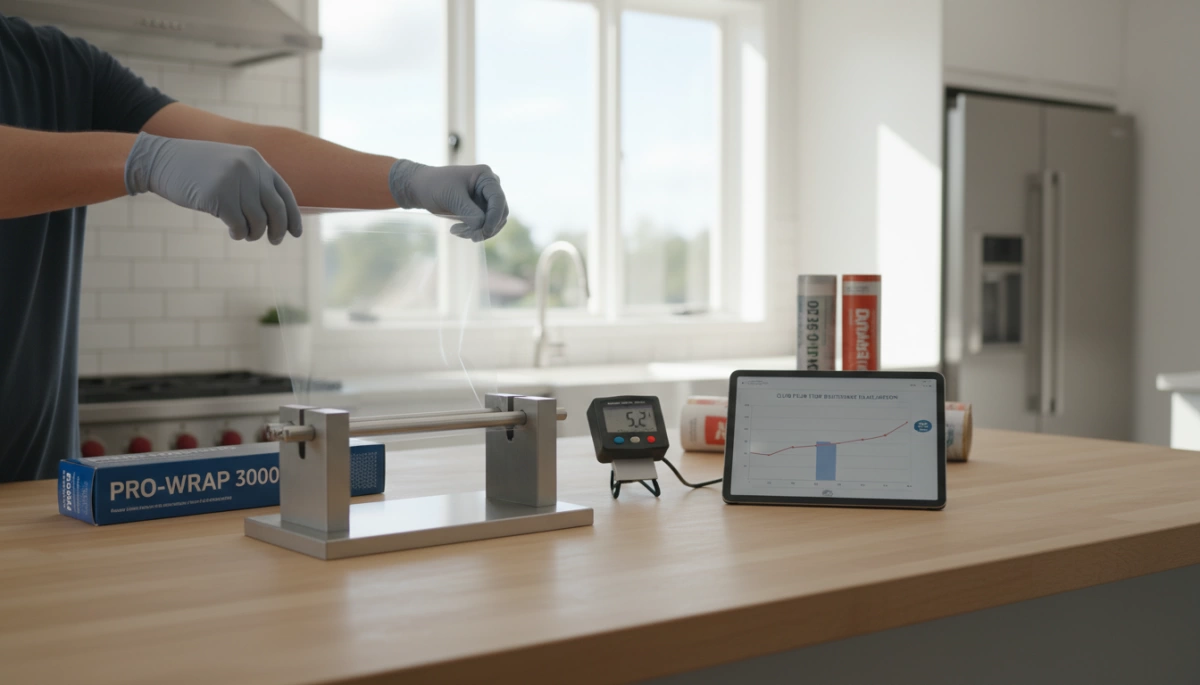
As a cling film manufacturer, I rely on standardized tear tests to keep tear strength consistent roll after roll. Here’s how professional labs typically evaluate plastic wrap tear resistance and what matters most if you’re running or outsourcing tests.
Sample Preparation and Conditioning
Good data starts with good samples. For any cling film tear strength test:
- Cut samples:
- Use a sharp die cutter or template
- Avoid wrinkles, folds, or stretch marks
- Keep edges clean – no nicks unless required by the method
- Conditioning (usually 23 ± 2 °C, 50 ± 5% RH unless your spec says otherwise):
- Lay flat without tension for at least 24 hours
- Keep away from heat, sunlight, and drafts
- Identify directions:
- Clearly mark MD (machine direction) and TD (transverse direction) on every strip
- Test both MD and TD – cling film is rarely isotropic
Most of these steps align with general film practice and with how we treat samples for broader cling film performance and technical specifications.
Elmendorf Tear Test (ASTM D1922) – Step by Step
The Elmendorf tear test for cling film measures pendulum tear strength, mainly for propagation tear resistance.
Equipment:
- Elmendorf pendulum tear tester
- Calibration weights
- Special sample cutting die and notch cutter
Basic procedure:
- Calibrate the pendulum and zero the instrument.
- Prepare samples to the required size (typically a rectangle per ASTM D1922) and pre-notch one side in the center.
- Clamp the sample between the fixed and movable jaws, making sure:
- Film is flat, no slack
- Notch is aligned with the tear starting edge
- Release the pendulum so it swings through and tears the film.
- Record tear force directly from the dial or digital readout (gf, mN, or N).
- Repeat for multiple specimens in MD and TD (usually 10+ per direction).
- Average and report tear strength per direction, plus standard deviation.
Graves Tear Test (ASTM D1004) – Step by Step
The Graves tear test focuses on tear initiation resistance using a tensile tester.
Equipment:
- Universal tensile testing machine
- Graves tear die (crescent-shaped notch)
- Pneumatic or mechanical grips
Procedure:
- Die-cut the specimens with the Graves punch, including the specified notch.
- Condition the samples as above.
- Clamp the sample in the grips with the notch centered between jaws and aligned straight in the pull direction.
- Set crosshead speed according to ASTM D1004 (commonly 254 mm/min, verify your spec).
- Start the test and record the maximum force as the notch opens and tear initiates.
- Test multiple samples in MD and TD.
- Report peak force (N or lbf) as Graves tear strength per direction.
Trouser Tear Test (ASTM D1938) – Step by Step
The trouser tear test measures tear propagation resistance using a slit “trouser leg” shape.
Equipment:
- Universal tensile tester
- Trouser tear cutting die or template
- Standard grips
Procedure:
- Cut the film into a strip, then slit from one end down the center to form two “legs.”
- Condition per standard conditions.
- Clamp each leg in opposing grips so the “waist” of the specimen is centered between jaws.
- Set crosshead speed per ASTM D1938 (commonly 250 mm/min; confirm in your SOP).
- Run the test and record the steady-state tear force as the tear propagates down the strip.
- Ignore initial spikes, then average the stable section of the curve.
- Report average propagation tear force in N or lbf, MD and TD.
Typical Lab Equipment for Cling Film Tear Testing
In a professional plastic wrap tear resistance evaluation setup, you’ll usually see:
- Pendulum tear tester (Elmendorf type)
For ASTM D1922 and ISO 6383-2 methods. - Universal tensile testing machine
Used for Graves tear (ASTM D1004), trouser tear (ASTM D1938), and also tensile strength, elongation, and some puncture tests. - Precision cutting dies and notchers
To ensure consistent sample shape and notch geometry. - Conditioning chamber
To maintain temperature and humidity before and during testing. - Data acquisition software
For capturing full force–displacement curves and doing automatic averaging.
Common Testing Mistakes (and How to Avoid Bad Data)
If you’re running cling film tear resistance in-house or in a partner lab, watch out for these issues:
- Poor sample cutting
- Jagged edges or damaged notches can inflate or deflate tear values.
- Always keep dies sharp and blades clean.
- Wrong film direction
- Mixing MD and TD samples ruins comparisons. Clearly label and separate.
- No conditioning or unstable environment
- Temperature swings and humidity changes alter film behavior, especially PVC and biodegradable films.
- Incorrect machine setup
- Wrong pendulum range, grip spacing, or crosshead speed gives non-comparable data.
- Too few samples
- Tear is naturally variable. Test enough pieces (usually 10+ per direction) to get a reliable average.
- Operator bias or handling damage
- Stretching or creasing samples during prep changes results. Handle film gently and consistently.
Dialing in these lab methods lets us tie our material choices and processing settings directly to real tear performance on the line and in the kitchen, instead of guessing.
Simple At‑Home and Quick Factory Tear Tests
Basic hand “stretch and tear” test for plastic wrap
If you just want a fast feel for cling film tear resistance, this hand test works well:
- Pull about 8–10 inches of film from the roll.
- Hold both ends, gently stretch the film until it’s tight.
- Then pull harder and see how it tears:
- Good film: stretches first, then tears in a controlled line.
- Weak film: splits suddenly, shreds, or tears right at the edge of the box.
This is not a lab test, but it’s a simple plastic wrap tear resistance evaluation you can repeat the same way every time.
Notched tear test with scissors or a blade
A quick way to see tear initiation vs tear propagation:
- Cut a strip about 2″ wide in the machine direction (MD).
- Make a tiny notch (2–3 mm) on one edge with sharp scissors or a blade.
- Pull from both ends and watch:
- If the tear jumps straight across, initiation is easy and propagation is fast.
- If the film resists and needs more force to grow the tear, you’ve got higher tear resistance.
Repeat in transverse direction (TD) to compare MD vs TD tear strength.
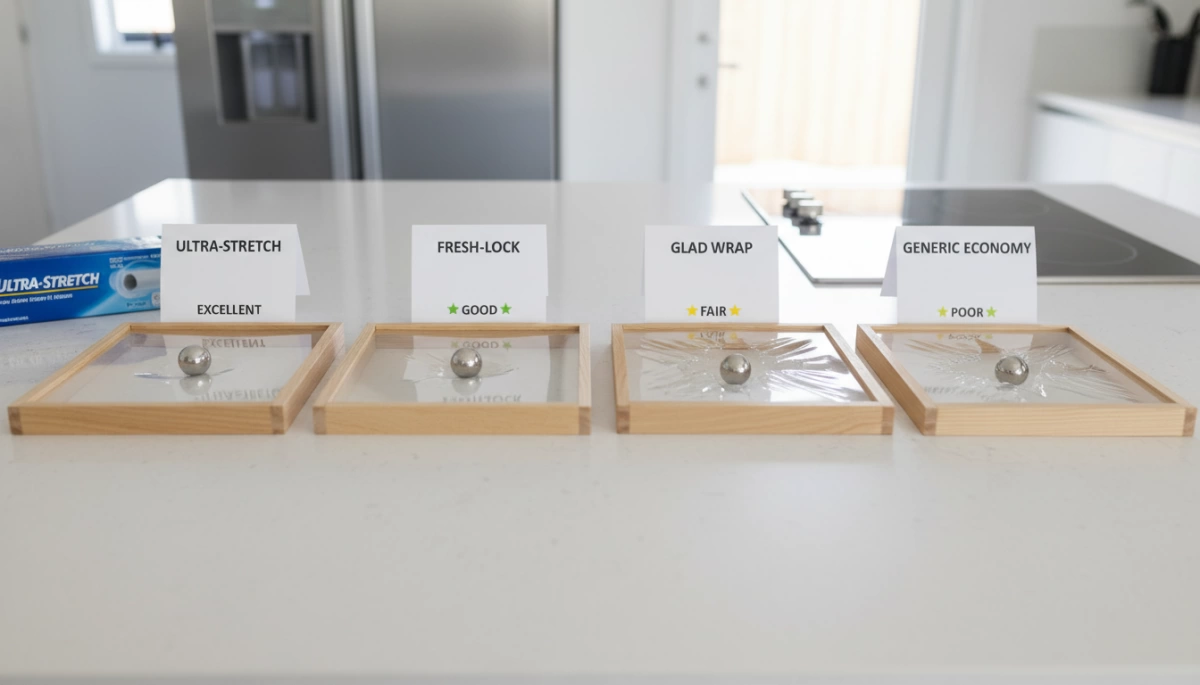
Side‑by‑side comparison between brands
For buyers or kitchen managers comparing different wraps:
- Cut same‑size strips from each brand (same width, same pull direction).
- Run the same hand “stretch and tear” and notched tests on each.
- Score each wrap on:
- Stretch before tearing
- How clean or ragged the tear is
- Ease of starting a tear from a small notch
You’ll quickly see which cling film has stronger tear performance and feels better in real food wrap use.
Fast checks for incoming film rolls in a factory
On the factory floor, I like quick, repeatable checks before full lab testing:
- Every new roll / pallet:
- Tear a strip off the core and test in MD and TD by hand.
- Do a quick notched tear test on 2–3 samples per roll.
- Look for:
- Obvious weak zones or easy edge tearing
- Big differences between rolls in the same lot
For export shipments, we often combine these checks with more formal quality steps and global supply chain support for cling film export to keep performance consistent across different U.S. customers and warehouses (details on our export support).
Safety tips for testing food‑contact films
Even simple cling film tear strength tests should respect food‑contact safety:
- Use clean scissors or blades reserved only for film testing.
- Keep test samples away from food areas and trash them after testing.
- Don’t reuse hand‑tested film on food, especially in commercial kitchens.
- Store test tools and sample rolls in a dry, clean place to avoid contamination or moisture damage that can change tear behavior.
These quick checks don’t replace ASTM tear tests, but they’re powerful for fast screening, cling film quality control, and daily decision‑making in real kitchens and factories.
How to Read and Compare Cling Film Tear Resistance Results
Typical Units in Tear Testing
When we evaluate cling film tear resistance, we mainly see these units:
- gf (gram-force) – common in Elmendorf tear tests (ASTM D1922, ISO 6383-2)
- mN (milli-Newton) – often used in international reports
- N (Newton) – more common in tensile and trouser tear tests
Quick rule:
- 1 gf ≈ 9.81 mN
- If your supplier sends data in different units, convert everything to N or gf before comparing.
Typical Elmendorf Tear Strength for Cling Film
For standard food wrap thickness (≈8–15 micron), typical Elmendorf tear strength ranges are:
- PVC cling film:
- MD (machine direction): ~5–20 gf
- TD (transverse direction): ~15–60 gf
- PE / LDPE / LLDPE cling film:
- MD: ~8–30 gf
- TD: ~20–80 gf
These are reference bands, not spec limits. For your own line, set internal specs based on what works in your customer’s daily use (no edge tearing, easy cutting, clean unwind).
Graves and Trouser Tear Values for Thin Film
When we look beyond Elmendorf and use Graves (ASTM D1004) or trouser tear (ASTM D1938):
-
Graves tear (initiation tear, N or gf):
- Thin cling film usually falls in the low single-digit N range.
- Higher Graves value = harder to start a tear at a notch or cut.
-
Trouser tear (propagation tear, N or mN):
- Measures how a tear continues once started.
- For food wrap, we want moderate propagation tear:
- Strong enough not to “run” across the whole film
- Not so strong that customers can’t rip by hand along a cut edge
If a film has high Graves but very low trouser tear, it may resist starting a tear but “zip” too easily once a cut appears.
MD vs TD Tear Resistance and Anisotropy
Cling film is almost always anisotropic, meaning MD and TD tear strength are different.
- MD (machine direction): along the length of the roll
- TD (transverse direction): across the width
What you should look for:
- TD tear is usually higher than MD for blown and cast films.
- Too low MD tear → film tears along the length when users pull from the roll.
- Too high TD tear → film becomes hard to tear off by hand or with a cutter.
For quality control, always:
- Test both MD and TD
- Report results as MD/TD pair (e.g., 12/35 gf Elmendorf)
- Track the MD/TD ratio over time to catch process drifts (orientation or cooling changes)
What Good Tear Resistance Looks Like for Biodegradable Film
For biodegradable and bio‑based cling film
Comparing Different Cling Film Materials (Tear Resistance)
PVC vs PE Cling Film Tear Strength
In real use, PVC and PE cling films behave very differently when it comes to tear:
| Material | Typical Tear Behavior | Real-World Use Insight |
|---|---|---|
| PVC | Higher tear resistance, tougher to start a tear but still easy to cut | Great for food service, busy kitchens, strong cling + good durability |
| PE (general) | Softer, easier to stretch, can tear more easily once nicked | Better for home use and simple wraps, especially when thickness is higher |
- PVC cling film tear strength usually feels “tighter” and more stable on sharp container edges.
- PE cling film tear resistance depends heavily on grade (LDPE vs LLDPE) and thickness.
LDPE vs LLDPE Tear Behavior
LDPE and LLDPE are both polyethylene, but they don’t tear the same way:
| Material | Tear Resistance | Feel & Performance |
|---|---|---|
| LDPE | Lower tear strength, easier to split once started | Softer, more “buttery” feel, okay for light-duty wrap |
| LLDPE | Higher tear resistance, better propagation resistance | More elastic, better for stretch, ideal for films that must survive handling |
- For plastic wrap tear resistance evaluation, I usually prefer LLDPE or LDPE/LLDPE blends when we want stronger rolls without jumping thickness too much.
Biodegradable & Bio‑Based Cling Film Tear Performance
Modern biodegradable cling film durability is much better than most people think:
- Good blends (PLA, PBAT + bio-based fillers) can match or closely approach PVC/PE tear resistance at similar thickness.
- We tune additives and tie-chain density so the film doesn’t shatter or split when you pull it off the roll.
- For eco-conscious U.S. customers who also use reusable solutions like durable silicone food bags for longer storage, a strong biodegradable wrap helps cut one-time-use waste between refills; see how eco‑friendly silicone bags hold up long term in this durability guide.
Thickness + Material: How They Work Together
Tear resistance isn’t just “which resin is best”—it’s resin + thickness:
- Thicker film (e.g., 10–14 micron)
- Higher tear strength
- Feels more premium, less likely to split near the cutter
- Thinner film (e.g., 7–9 micron)
- Saves cost and plastic
- Needs better material (LLDPE or engineered blends) to avoid weak spots
Rule of thumb for cling film tear strength test:
- If you want to stay thin, move toward LLDPE or reinforced biodegradable blends.
- If you want a softer home-use feel, LDPE or PE blends at slightly higher micron work well.
Trade‑Off: Flexibility, Cling, and Tear Resistance
You can’t max out everything at once; there’s always a balance:
- More flexibility & stretch
- Better for tight wrapping
- Can reduce tear resistance if the film “necks” too much
- Higher cling
- Great seal on bowls and trays
- Too much cling can make the film distort and start small tears when unrolling
- Higher tear resistance
- More durable and less waste
- Sometimes means a slightly stiffer feel or higher thickness
When I design or select a film for the U.S. market, I usually:
- Use PVC or LLDPE-rich blends for food service and restaurant rolls (high tear strength, consistent performance).
- Use PE or eco-friendly biodegradable films with tuned thickness for home kitchen rolls, where easy handling and “feel” matter as much as pure lab tear numbers.
Improving Tear Resistance in Cling Film Selection and Use
How to choose cling film specs for better tear strength
If you want better tear resistance in cling film, start with the specs:
- Material:
- LLDPE or PVC usually give higher tear resistance than basic LDPE.
- For biodegradable cling film, look for blends specifically tested to ASTM or ISO tear standards.
- Thickness (micron / gauge):
- For everyday kitchen use: 8–12 microns is common.
- For food service / industrial wrapping: 12–18 microns holds up much better to rough handling.
- Orientation:
- Ask for data on MD and TD tear strength so you know how the film behaves when pulled off the roll or stretched around trays.
- Additives / performance:
- Slip and anti-block additives should be optimized so you still get good cling plus high tear resistance.
When we design a film, we balance cling, stretch, and tear resistance so it works in real American kitchens, restaurants, and packing lines—without constant breaks or rewraps.
Buyer checklist: material, thickness, certifications
If you’re buying cling film for retail, food service, or converting, use this simple checklist:
- Material type: PVC, PE (LDPE / LLDPE), or certified biodegradable blend
- Thickness: Micron or gauge clearly listed, with min and max tolerances
- Food-contact certifications:
- FDA-compliant for food contact in the U.S.
- Clear documentation for BPA-free / plasticizer type where relevant
- Tear test data:
- Elmendorf tear (ASTM D1922 or ISO 6383-2) in MD and TD
- Any Graves / trouser tear values for more demanding use
- Sustainability claims:
- Compostable, recyclable, or reusable alternatives (like sustainable food storage solutions similar to those discussed in our eco-friendly food storage overview)
Ask your supplier for a short spec sheet with tear resistance, thickness, and test standard listed. If they can’t provide it, that’s a red flag.
Storage and handling tips to keep tear strength stable
Even a strong cling film can turn brittle if it’s stored wrong. To keep tear strength stable:
- Temperature: Store between 59–86°F (15–30°C). Avoid hot warehouses or freezing garages.
- Humidity: Keep cartons dry and away from steam, sinks, and floor moisture.
- UV and heat: Don’t park film next to ovens, windows, or heaters—UV and heat can age the film and lower tear resistance.
- FIFO: Use first-in, first-out so old stock doesn’t sit for years and get brittle.
- Packaging: Keep rolls in their original carton or wrap until use to reduce dust, contamination, and edge damage.
Handled right, quality cling film maintains its tear resistance well within normal shelf life.
Using dispensers and cutters to reduce accidental tears
A lot of “weak film” complaints are actually dispensing issues, not material problems. To cut down accidental tearing:
- Use a proper dispenser:
- Heavy base or wall-mounted for restaurant and deli use
- Smooth bar or integrated cutter for home kitchens
- Sharp, clean cutting edge:
- Replace dull serrated blades—they snag and start tears.
- Avoid bent or damaged cutter bars.
- Correct pulling direction:
- Pull film straight out along the MD (machine direction) instead of at an angle to avoid stress points.
- No over-stretching:
- Stretching is good for cling, but over-stretching thin film makes it much easier to tear.
With the right dispenser and cutting motion, you get cleaner cuts, fewer edge nicks, and much better real-world tear resistance.
Common mistakes that lead to weak or tearing film
Most tear issues we see from U.S. users come from a few simple mistakes:
- Going too thin to save cost
- Dropping from 12 microns to 8 microns without changing material type can cause constant tears in food service or production.
- Using the wrong film for the job
- Light household wrap used on heavy deli trays or sharp bakery edges will rip every time.
- Poor storage
- Rolls kept in hot trucks, cold walk-in freezers, or direct sun age fast and lose tear resistance.
- Rough handling on the line
- Dragging rolls on the floor, dropping cartons, or denting roll cores leads to edge damage and “mystery” tearing.
- Cheap, untested film
- No ASTM/ISO tear data, inconsistent thickness, and poor raw materials usually show up as easy tearing in real use.
If you avoid these mistakes and choose cling film with verified tear resistance, you’ll cut rewraps, reduce food waste, and keep your wrapping process running smooth.
Evaluating Eco‑Friendly Cling Film Tear Performance
Myths About Biodegradable Cling Film Being Weak
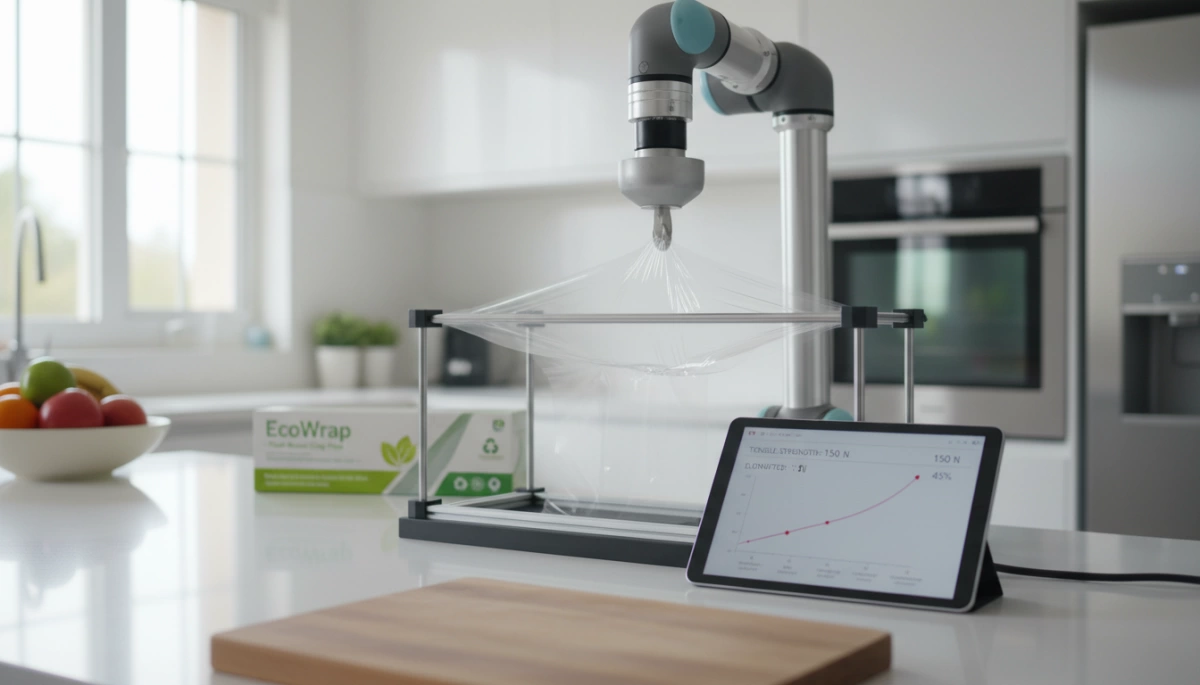
A lot of buyers assume “biodegradable” automatically means flimsy and easy to tear. That used to be true for early generations of eco films, but not anymore. Modern eco‑friendly cling film tear performance can match or even beat standard PE wrap when the resin, thickness, and process are dialed in.
How Modern Biodegradable Blends Stay Strong
Today’s biodegradable cling films use:
- Blended resins (e.g., PBAT, PLA with modified starch or bio‑PE) for better toughness
- LLDPE‑style structures to improve tear propagation resistance
- Optimized thickness (usually 10–15 microns for food wrap) to balance softness and strength
When we run Elmendorf tear tests for cling film and trouser tear tests (ASTM D1938) on our eco blends, we target tear strength ranges that feel strong in real kitchen use—no “zipper” tears when you pull from the roll.
If you’re also considering other eco food packaging, our breakdown of eco‑friendly food wrap alternatives shows how modern materials stay durable while cutting plastic waste.
Balancing Compostability, Recyclability, and Durability
For the U.S. market, we focus on three things at the same time:
- Compostability or improved recyclability (depending on your program)
- Real‑world durability: no constant rewrapping, no tearing during prep
- Food‑safe performance: stable at fridge and room temperatures
The goal is simple: eco film that behaves like a “normal” high‑quality plastic wrap in daily use.
What to Ask Suppliers About Eco‑Film Tear Testing
When you evaluate any biodegradable cling film durability, ask your supplier for:
- Tear test standards used (ASTM D1922 Elmendorf, ASTM D1004, ASTM D1938)
- MD and TD tear values (machine direction vs transverse direction)
- Test thickness and conditions (temperature, humidity, sample prep)
- Minimum and typical tear strength specs they guarantee for production
If a supplier can’t share real tear data, they’re guessing. We build internal specs around standardized plastic wrap tear resistance evaluation, then keep those numbers stable lot to lot.
Why Eco‑Friendly Wraps Can Cut Waste and Rewraps
Strong eco film doesn’t just “feel good” — it reduces waste:
- Fewer tears while dispensing = less film thrown away
- Better tear propagation resistance = fewer failed wraps
- Less rewrapping in restaurant kitchens, meal prep, and grocery back rooms
When cling film tear strength tests are done right on eco materials, you get wraps that protect food, handle busy U.S. kitchen use, and still support your sustainability goals.
How Often to Test and Control Tear Resistance in Production
Recommended tear test frequency in production
For cling film factories and converters, tear resistance control can’t be “once in a while.” I keep it simple and systematic:
- Startup of each line / shift change
- Run at least 1 full tear test set (MD & TD) when a line starts or settings change.
- Per production lot or roll batch
- For standard food wrap: every 10–20 rolls or every 3–5 tons, whichever comes first.
- For eco-friendly or biodegradable cling film, I test twice as often because material variation is higher.
- During new material / recipe trials
- Test every roll until the process is stable.
This gives real-time feedback and prevents weak lots from reaching customers or food service users who rely on consistent cling film tear resistance.
Setting internal tear strength benchmarks and specs
I don’t rely only on supplier datasheets. I build internal benchmarks based on real use:
- Define spec by product line
- Example (just for illustration):
- Standard PE cling film (10–12 μm):
- Elmendorf tear (MD): ≥ X gf
- Elmendorf tear (TD): ≥ Y gf
- Standard PE cling film (10–12 μm):
- Example (just for illustration):
- Include MD and TD separately – cling film is anisotropic; MD vs TD tear strength will differ.
- Add tolerance bands
- Example: target ±10–15% around your nominal tear strength.
- Lock specs into QC documents
- Use the same targets in your incoming resin checks, in-process control, and final inspection.
Once set, every cling film tear strength test (Elmendorf, Graves, or trouser tear) is checked against these internal numbers, not just generic ASTM/ISO limits.
Using tear data in quality control and batch release
Tear data shouldn’t sit in a lab notebook. I use it to drive decisions:
- In-line & lab checks
- In-process tear tests flag drift in thickness, cooling, or orientation.
- Batch release decision
- Only release a lot when:
- All tear tests (MD/TD) are inside spec
- Variation between samples is reasonable (no wild outliers)
- Only release a lot when:
- Trend analysis
- Track tear resistance over time by:
- Resin lot
- Line
- Operator
- This quickly shows if a new resin, die clean, or cooling change is helping or hurting tear propagation resistance.
- Track tear resistance over time by:
For customers who also buy related packaging (like custom-branded wraps or private-label food packaging), I keep the same QC mindset that we’d apply to custom OEM/ODM cling film projects: stable tear data is part of the brand promise.
What to do when a lot fails tear resistance targets
When tear resistance of food wrap drops below spec, I treat it as a process and risk issue, not just a number:
- Quarantine the lot
- Block all pallets / rolls from shipment.
- Retest & confirm
- Repeat the tear tests (MD & TD) with fresh samples.
- If still low, move to full investigation.
- Check process records
- Resin batch change?
- Die temperature / cooling changes?
- Line speed or stretch/orientation changes?
- Run corrective actions
- Adjust thickness, chill roll temperature, blow-up ratio, or drawdown as needed.
- Produce a controlled re-test batch and verify tear resistance again.
- Decide on disposition
- Scrap, downgrade for non-critical use, or rework if possible.
- Never ship cling film that tears too easily for food wrap use—rewraps and complaints will cost more later.
A tight loop of test → compare to spec → correct → retest is how I keep cling film tear performance steady across the full production run.
FAQ on Cling Film Tear Resistance Testing
Quick FAQ Table
| Question | Short Answer |
|---|---|
| Best simple home test? | Hand stretch + notched tear comparison |
| Do biodegradable wraps tear easier? | Not necessarily – depends on blend and thickness |
| Does thickness really matter? | Yes – thicker = higher tear, up to a point |
| Initiation vs propagation tear? | Start of the tear vs how fast it runs |
| Tear vs puncture resistance? | Side split vs sharp poke |
| How long does tear strength last? | 12–24 months in good storage |
| Best standard for cling film? | ASTM D1922 (Elmendorf) as the main reference |
Best simple method to test cling film tear resistance at home
If you’re a home user or checking samples quickly:
- Cut two strips of wrap (same size) from different brands.
- Make a small notch with scissors on each.
- Pull slowly and feel:
- How much force before the tear starts
- How smoothly or suddenly the tear runs
- The film that needs more effort and tears more controllably has better tear resistance.
This same logic we use in the factory is just a simplified version of a lab tear test.
Does biodegradable cling film tear more easily?
Not always.
- Older generation compostable films were weaker.
- Newer biodegradable cling films use blended resins and better processing, so they can match or get close to PVC/PE tear resistance at the same thickness.
- The key is:
- Resin blend
- Thickness
- Quality control
We design our eco wraps to balance durability and sustainability, similar to how high-quality eco-friendly food storage products keep strength while reducing impact.
How thickness changes tear resistance in real use
In real kitchen or food-service use:
- Thicker film (e.g., 12–15 micron)
- Better tear resistance
- Less risk of “zipper” tears off the roll
- Thinner film (e.g., 8–10 micron)
- Saves material and cost
- Needs better resin and processing to avoid easy tearing
Rule of thumb: If you go thinner, you must upgrade material quality to keep similar tear resistance.
Initiation tear vs propagation tear
These two concepts matter when we design and test cling film:
- Initiation tear (start)
- How much force is needed to start a tear from a notch or cut
- Measured by tests like ASTM D1004 (Graves)
- Propagation tear (run)
- How the tear continues once it has started
- Measured by ASTM D1922 (Elmendorf) or ASTM D1938 (trouser)
In real life:
- Initiation = how easily a cut edge starts to rip
- Propagation = how fast that rip races across the sheet
Tear resistance vs puncture resistance
Two different failure modes:
- Tear resistance
- Film splits from an edge or notch
- Important when pulling film off the roll, wrapping trays, or cutting on a serrated blade
- Puncture resistance
- Film is pierced by a sharp corner or bone
- Measured by specific puncture tests, not tear tests
Good cling film needs both: resist tearing off the roll and survive sharp food edges.
How long tear resistance stays stable in storage
For quality cling film stored properly:
- Stable for 12–24 months under:
- 60–77°F (15–25°C)
- Dry, shaded storage
- Away from direct sunlight, heat, and ozone sources
- PVC and biodegradable films can lose strength faster at high temperature, UV, or very long storage.
On our side, we always suggest using within the labeled shelf life to keep tear and cling performance reliable.
Which tear test standard to prioritize for cling film
If you’re a buyer, QA manager, or converter, and you can’t test everything, focus on:
- ASTM D1922 Elmendorf tear test
- Most common benchmark for cling film tear strength
- Good for comparing suppliers and batches
- Add ASTM D1004 (Graves) or ASTM D1938 (trouser) if you need deeper data on how tears start vs run.
For most food-wrap applications, we treat ASTM D1922 as the primary standard and use others as support when we tune materials or do R&D.
If you want us to help interpret your own tear test data or set spec ranges for your application (home use, restaurant, or industrial wrap), send the material type, thickness, and test method you’re using and we can give you target ranges.