
















Understanding EU 10/2011 Food Grade Cling Film – Key Principles and Scope
If you’re buying or specifying food wrap for export into Europe, you’ve probably asked yourself:
“Is this cling film really compliant with EU food contact rules?” or “Will an auditor or customs inspector accept this documentation?” That’s exactly where Regulation (EU) No 10/2011 comes in.
As a cling film supplier, I work with this regulation every day. Let me walk you through what actually matters in practice.
Overview of Regulation (EU) No 10/2011 for Cling Film
Regulation (EU) No 10/2011 is the core plastic food contact materials regulation in the EU. It sits under the broader Framework Regulation (EC) No 1935/2004, which sets the general safety rules for all food contact materials.
For food grade cling film, EU 10/2011 does three big things:
- Defines which plastic materials and substances you’re allowed to use (the Union List authorized substances)
- Sets migration limits (how much of those substances can transfer into food)
- Requires Good Manufacturing Practices (GMP) and documented Declaration of Compliance (DoC EU)
In plain language:
If a plastic cling film is going to touch food in the EU, it must be made only from approved substances, manufactured under control, and tested to prove that it does not transfer unsafe levels of chemicals into food.
Which Cling Film Products and Uses Fall Under EU 10/2011?
EU 10/2011 applies to all plastic food contact materials, including:
- PE cling film (LDPE, LLDPE, blends) used for wrapping fresh produce, meat, cheese, baked goods, and more
- PVC food wrap used in supermarkets, foodservice, and industrial packaging
- Multilayer plastic films (e.g., PE/EVOH/PE) designed for direct food contact
- Pre-cut sheets, rolls, and dispenser-packed rolls that are intended to touch food
The regulation covers:
- Direct contact: Film wrapped tightly around food (e.g., fresh meat, cheese, deli items, bakery products, fruit and vegetables)
- Indirect contact inside packaging: Film used as an inner wrap or separator that will reasonably contact food
- All stages of the supply chain: From resin manufacturers and film extruders to converters, packers, and retailers
If the film is “intended to come into contact with food” or could reasonably be expected to do so, it is in the scope of EU 10/2011. Even if you are based in the United States, if your cling film is sold to EU customers or used in products exported to the EU, these rules apply.
Core Food Safety Principles for EU 10/2011 Food-Grade Cling Film
Under the Framework Regulation 1935/2004, food-grade cling film must not:
- Transfer its components to food in quantities that could endanger human health
- Cause an unacceptable change in food composition
- Deteriorate the taste, odor, or appearance of the food
EU 10/2011 turns these broad principles into concrete rules using three key concepts:
1. Positive Lists and the Union List of Authorized Substances
The regulation includes a Union List authorized substances table that specifies which:
- Monomers and starting substances
- Additives (including stabilizers, plasticizers, and slip agents)
- Certain polymers and macromolecular substances
can be used to manufacture plastic food contact materials, including cling film.
If a substance is not on the Union List (and not covered by an explicit exemption), it generally cannot be used in a plastic food contact material in the EU.
For cling film, this means:
- Your PVC and PE resins must be made from authorized monomers
- Plasticizers, heat stabilizers, antioxidants, and processing aids must be on the Union List and meet any specific migration limits (SML) or conditions of use
- You need to know exactly what’s in your formulation — vague descriptions or “trade secrets” without regulatory backing are a high-risk red flag
2. Migration Limits: OML and SML
EU 10/2011 caps how much material can move from the film into food:
-
Overall Migration Limit (OML):
The total amount of non-volatile substances that can migrate from the plastic into food.
For most plastic materials, the OML is 10 mg/dm² of food contact surface. -
Specific Migration Limits (SML):
Substance-by-substance limits for certain critical chemicals, such as specific plasticizers, monomers, and metals.
Each listed substance has its own SML value that must not be exceeded.
For buyers, this means any cling film marketed as EU 10/2011 compliant should have valid OML and SML migration testing data behind it, documented in a Declaration of Compliance.
3. Good Manufacturing Practices (GMP) for Food Packaging
On top of EU 10/2011, manufacturers must follow Good Manufacturing Practices under Regulation (EC) No 2025/2006. For cling film, that typically includes:
- Controlled sourcing of resins and additives with proper certificates
- Validated production processes (e.g., extrusion, winding, cutting) to avoid contamination
- Batch traceability from raw material to finished roll
- Routine migration testing and change-control when formulations or suppliers change
- Documented quality management systems that support compliant production
In short, a compliant food-grade cling film is not just about having the right polymer. It’s about using approved substances from the Union List, controlling the process under GMP, and backing it all up with reliable migration testing and documentation.
As suppliers, we build our cling film ranges around these principles so that procurement teams and quality managers in the US and EU can specify with confidence, pass audits, and avoid costly shipment rejections at the border.
EU 10/2011 Food Grade Cling Film Material Rules – Selecting Compliant Polymers
When we talk about “EU 10/2011 food grade cling film,” we’re really talking about the materials. If the polymer, monomers, and additives don’t match the EU Union List and migration limits, the film is not compliant – no matter what the label says.
Below is how we look at materials when we source and supply cling film for food contact.
Authorized Polymers, Monomers, and Additives (Union List Basics)
Under Regulation (EU) No 10/2011, only certain plastic substances are allowed for direct food contact. These are listed on the Union List of authorized substances.
For cling film, that mainly means:
-
Common base polymers
- PE cling film (LDPE, LLDPE)
- Widely used for fresh produce, meat, cheese, and general wrapping.
- Good overall safety profile when made from authorized monomers and controlled additives.
- PVC cling film
- Used heavily in supermarkets and food service because it clings well and stays flexible.
- Relies on plasticizers and stabilizers that must be carefully selected and controlled.
- PE cling film (LDPE, LLDPE)
-
Monomers and starting substances
- Must be listed on the Union List and follow:
- Any Specific Migration Limits (SML) in food or food simulants.
- Any use restrictions (e.g., only for certain food types or temperatures).
- No “off-list” monomers are allowed for intentional use.
- Must be listed on the Union List and follow:
-
Additives (plasticizers, stabilizers, slip agents, antioxidants)
- Must also be on the Union List of authorized substances.
- Each additive can come with:
- SML values (e.g., mg/kg food).
- Limits on which foods and conditions are allowed.
- Overall functional barrier rules, if multilayer structures are used.
When we select materials, we check:
- The resin producer’s food contact statement against EU 10/2011.
- The CAS numbers and substance names against the Union List.
- Any SML or “not to be used for fatty foods” type restrictions before we approve it for our films.
2025 EU Plasticizer Restrictions: What They Mean for PVC and PE Cling Film
The EU is tightening rules on several phthalate and other plasticizers by 2025 (and beyond) to reduce health and environmental risks. This is especially critical for PVC cling film, which traditionally relies on plasticizers to stay soft.
Key points for buyers:
-
PVC cling film
- Older PVC wraps may contain phthalate plasticizers that are now heavily restricted or banned.
- Going forward, EU markets are moving toward:
- Non-phthalate plasticizers with clear SML and toxicology data.
- Stricter checks on DEHP, DBP, BBP, DINP, DIDP, and similar substances.
- Any PVC cling film for EU use must:
- Use only authorized plasticizers on the Union List.
- Prove compliance with SML and overall migration tests for those plasticizers.
- Be clearly limited to certain food types and temperatures, if required by the regulation.
-
PE cling film
- PE typically doesn’t need the same level of plasticizer loading as PVC.
- Impact of 2025 restrictions is more about:
- Slip agents, antioxidants, and processing aids.
- Ensuring no legacy or non-authorized additives make their way into formulations.
- PE cling film remains a safer, lower-risk choice from a plasticizer perspective, especially for long-contact or high-fat foods.
As a supplier, we continuously review:
- Updated EFSA opinions and EU amendments on plasticizers.
- Material safety data from our raw material suppliers.
- Our own migration testing plans for new and existing formulations.
Practical Sourcing Tips: Choosing Compliant PE and PVC Cling Film by Food Type
For U.S. customers supplying or importing into the EU, here’s how we recommend selecting the right EU 10/2011-compliant cling film:
1. Match Film Type to Food Category
- High-fat foods (cheese, meat, deli items, oily leftovers)
- Prefer PE cling film or PVC with proven SML compliance for each plasticizer.
- Confirm testing was done in fatty food simulants (e.g., olive oil or ethanol-based simulants).
- Aqueous or low-fat foods (fruits, vegetables, bread, non-oily leftovers)
- Both PE and PVC can be used, but:
- Make sure temperature limits (fridge, room temperature, short heating) are clearly defined.
- Verify that the film isn’t restricted from contact with acidic foods if used on tomatoes, citrus, etc.
- Both PE and PVC can be used, but:
2. Ask for Specific EU 10/2011 Proof, Not Just “Food Safe”
When we work with buyers, this is what we tell them to demand:
-
Material-level documentation
- Clear statement that the film is compliant with EU 10/2011 and Framework Regulation 1935/2004.
- List of polymers and type (e.g., PVC with [X] plasticizer, or PE type).
- Confirmation that all monomers/additives are on the Union List.
-
Migration testing results
- Overall migration testing (OML) in the correct simulants and conditions.
- Specific migration testing (SML) for key substances:
- Plasticizers in PVC.
- Antioxidants, slip agents, and other critical additives in PE.
-
Clear usage instructions
- Which foods the film is intended for (fatty, aqueous, acidic).
- Which temperatures (refrigeration, ambient, microwave reheat).
- Any time limits (e.g., not suitable for long-term storage with hot, fatty foods).
3. Choose Suppliers Who Know EU Rules, Not Just Local Rules
If you’re supplying both US and EU markets, you know each region plays by different rules. We build our cling film offer around:
- EU 10/2011 alignment from the material level up, not just last-minute testing.
- Long-term relationships with resin producers that also support other food packaging lines (for example, some customers pair our films with their stainless steel food containers for a reusable + compliant system).
- Consistent batch documentation so you can show a clean chain of compliance to your customers and auditors.
What Buyers Should Lock In
When you source EU 10/2011 food grade cling film, lock in these material rules:
- The film must be PE or PVC produced only from Union List–authorized substances.
- All plasticizers and additives must respect 2025 and upcoming EU restrictions.
- You hold in hand:
- A clear EU 10/2011 statement covering the polymer, monomers, and additives.
- Recent migration test reports (OML + SML) linked to the exact formulation.
- Usage limits that match your real-life applications (foods, time, and temperature).
We structure our cling film product range around these exact points, so when you buy from us for EU use, you’re not guessing—you’re covered by design, not by chance.
EU 10/2011 Migration Testing for Food Grade Cling Film – Essentials
When we say our cling film is “EU 10/2011 compliant,” we’re really talking about one thing: migration. In simple terms, migration is how much material can move from the plastic into the food. The regulation sets strict limits and very specific test conditions to make sure food contact is safe in real life, not just on paper.
Overall Migration Limit (OML) for Cling Film
The Overall Migration Limit (OML) is the total amount of all non-volatile substances that can transfer from the cling film into food.
Under EU 10/2011:
- OML = 10 mg/dm² of food contact surface
or - 60 mg/kg of food (for containers/films designed for infants and small children)
What this means for cling film in direct food contact:
- The film is tested in contact with a food simulant that represents the type of food it will be used on.
- Lab reports must show overall migration ≤ 10 mg/dm² under the required test conditions.
- OML tests are done on the finished cling film, not just the raw resin.
For buyers, a compliant OML report tells you the cling film is safe for normal use and won’t release excessive material into meat, cheese, produce, or prepared foods.
Specific Migration Limits (SML) for Critical Substances
On top of the total migration, EU 10/2011 sets Specific Migration Limits (SMLs) for individual substances that can pose higher risks if they migrate too much. This is where plasticizers, stabilizers, and certain monomers are closely checked.
Key points:
- SMLs are substance-by-substance limits listed in the Union List (Annex I) of EU 10/2011.
- Common focus materials in cling film include:
- Plasticizers (especially in PVC food wrap)
- Certain additives and antioxidants
- Residual monomers from the base polymer
- The lab checks each regulated substance and confirms migration is below its SML (often in the range of µg/kg or mg/kg of food).
For food buyers and importers, SML compliance is what protects you from issues like:
- Excess plasticizer migration into fatty foods (cheese, meat, deli items)
- Claims of non-compliance during port inspections or customer audits
- Future problems as EU rules tighten, especially around plasticizers
Time, Temperature, and Test Conditions
EU 10/2011 doesn’t just say “test it and see.” It tells labs exactly how to simulate real-world use with time and temperature conditions that match the way cling film is actually used.
Typical test conditions for cling film:
- Room temperature contact
- Example: 10 days at 20–25°C for long-term storage in the fridge or at room temp.
- Short-term contact
- Example: 2 hours at 40°C for foods wrapped and kept briefly in warm conditions.
- Higher temperature scenarios (only if the cling film is intended for that use)
- Example: 2 hours at 70°C or 1–2 hours at 100°C for reheating or warm filling.
Important details:
- The worst-case scenario is usually tested (longer time, higher temperature than normal daily use).
- Test labs must follow the Annex V conditions of EU 10/2011 for time/temperature combinations.
- If a cling film is not intended for high heat (like oven use or intense microwave reheating), it should be clearly labeled as such, and the migration testing will reflect only the intended uses.
As a cling film supplier, we design our testing around how U.S. and EU customers actually use the product:
- Wrapping fresh produce, meat, and cheese
- Refrigerated or short-term room temperature storage
- Occasional brief contact with slightly warm foods (within the tested temperature range)
We also combine migration testing with broader food safety controls similar to what we use for our food-grade cling film for export markets, so buyers get more than just a lab report – they get a full compliance package.
What Buyers Should Expect in Migration Test Reports
When you review migration testing for EU 10/2011 food grade cling film, you should see:
- OML results (mg/dm²) with clear “Pass”/“Fail” status
- SML results for each relevant substance, with test values vs. legal limit
- Detailed test conditions:
- Food simulant used
- Time and temperature
- Sample description and thickness
- Lab identity and accreditation details (typically ISO 17025)
If any of this is missing or unclear, it’s a sign you need more data before you trust that cling film in your food packaging chain.
Food Simulants and Lab Testing for EU 10/2011 Cling Film Compliance
If you want real EU 10/2011 food grade cling film compliance, you need the right food simulants, the right lab, and a tight paper trail. This is the core of any serious EU 10/2011 Food Grade Cling Film Compliance Guide.
Choosing the right food simulants
Under the plastic food contact materials regulation (EU) No 10/2011 and Framework Regulation 1935/2004, cling film must be tested with food simulants that represent how it’s actually used:
- Aqueous foods (water-based)
Soups, fresh-cut vegetables, salad greens. Labs typically use a water-based simulant (Annex III “Simulant A”). - Acidic foods
Tomato dishes, pickles, citrus-based products. These use an acidic simulant (often “Simulant B”) to stress the film. - Alcoholic or mixed foods
Sauces, marinades, and dressings with alcohol or emulsions may require hydroalcoholic simulants. - Fatty foods (high risk for migration)
Cheeses, meats, pizza, ready meals, and oily snacks. These use fatty simulants (Annex III “D1”, “D2” or vegetable oil), which are critical for PVC and PE cling films.
When our cling film is designed for wrapping fresh produce, we match the simulants and test conditions to real use in grocery and foodservice, similar to how we design our reusable bags for fresh vegetables and fruits for direct contact with moisture-rich foods.
Key lab testing and accreditation
To prove compliance, we work only with labs set up for accredited migration testing:
- Overall migration testing (OML)
Measures the total amount of substances that migrate into the simulant. Must be within the OML set by EU 10/2011. - Specific migration limits (SML)
Targeted checks for substances like plasticizers, monomers, and other critical components. Results must meet the SML values in the Union List authorized substances. - Realistic time and temperature
Test setups simulate chill storage, room temperature display, and reheating where relevant (for example, microwave or hot-fill use). - Accredited lab migration analysis
We use ISO/IEC 17025–accredited labs with clear methods (GC-MS, LC-MS, gravimetric OML, etc.) and traceable calibration.
Building a strong documentation and verification trail
For every cling film grade we supply, we keep a complete trail behind the test report so buyers can verify EU 10/2011 compliance quickly:
- Full test package: migration reports (OML and SML), test conditions, food simulants, contact times, and temperatures.
- Batch-level traceability: lot numbers, production dates, resin batch IDs, and additive references tied to each test and shipment.
- Version-controlled formulations: any change to resin, additives, or film thickness triggers a review and, when needed, new migration testing.
- Easy-to-audit records: we maintain digital access to certificates, lab reports, and internal GMP checks so your QA team and auditors can validate our cling film without guesswork.
This approach gives US buyers clear, practical proof that our food grade cling film is tested, documented, and ready for EU 10/2011 inspections and customer audits.
EU 10/2011 Declaration of Compliance for Food Grade Cling Film
When I sell cling film into the EU, the Declaration of Compliance (DoC) is my main proof that the film is legal for food contact. Under Article 15 of Regulation (EU) No 10/2011 and Framework Regulation 1935/2004, every food grade cling film we supply must be backed by a clear, written DoC that buyers and auditors can rely on.
Mandatory contents of an EU 10/2011 DoC
A compliant EU 10/2011 Declaration of Compliance for food grade cling film should include at least:
- Manufacturer and importer details – company name, full address, and contact person.
- Product identification – trade name, material type (e.g., PVC, PE), thickness, and intended use (wrapping meat, cheese, produce, etc.).
- Regulation references – a statement that the film complies with EU 10/2011, Framework Regulation 1935/2004, and relevant GMP food packaging rules (Reg. (EC) 2025/2006).
- Conditions of use – time, temperature, food types, and any restrictions (e.g., “not for fatty foods above X°F”, “not for microwave use”).
- Migration limits – confirmation that the film meets the Overall Migration Limit (OML) and all applicable Specific Migration Limits (SML) for substances listed on the Union List authorized substances.
- Materials and additives – information on plastic type, key monomers, additives, and any use of plasticizers relevant to the EU plasticizer ban 2025.
- Date, version, and signature – responsible person, issue date, and version number to support document control.
This is what retailers, food factories, and wholesale buyers in the U.S. expect to see when they import cling film into the EU or serve EU-facing customers.
Evidence and migration data behind the DoC
A strong DoC is always built on real data. Behind our EU 10/2011 Food Grade Cling Film Compliance Guide and our own products, we keep:
- Accredited lab migration analysis reports (ISO 17025 labs) covering OML and SML.
- Food simulant test results (Annex III) for aqueous, acidic, alcoholic, and fatty foods, run at worst‑case time/temperature conditions.
- Raw material certificates from resin and additive suppliers confirming compliance with the Union List and any PVC food wrap restrictions or PE cling film safety standards.
- Internal GMP records – process controls, cleaning records, change control, and non‑conformance handling.
When customers ask “how do you prove EU 10/2011 compliance?”, this is the documentation stack we show them, on top of the DoC itself.
Using detailed DoCs and batch traceability
For serious buyers, the DoC is just the starting point. We connect every DoC to full batch traceability, so we can track:
- Which resin and additive batches went into each production lot.
- Which machines, dates, and operators produced the film.
- Which overall migration testing and specific migration testing reports apply to that batch.
That level of traceability protects both sides if there is a claim, a recall, or a customs inspection. It also makes supplier audit food contact compliance much smoother, because auditors can pick a roll and follow its history all the way back to the raw materials and lab tests.
If you also manage large volumes, it helps to pair a robust DoC with a clear purchasing strategy. For example, when we advise distributors, we often link them to our practical guide on the best cling film for wholesale business so they can align product specs, EU 10/2011 documentation, and real‑world use cases from day one.
Common EU 10/2011 Cling Film Compliance Pitfalls
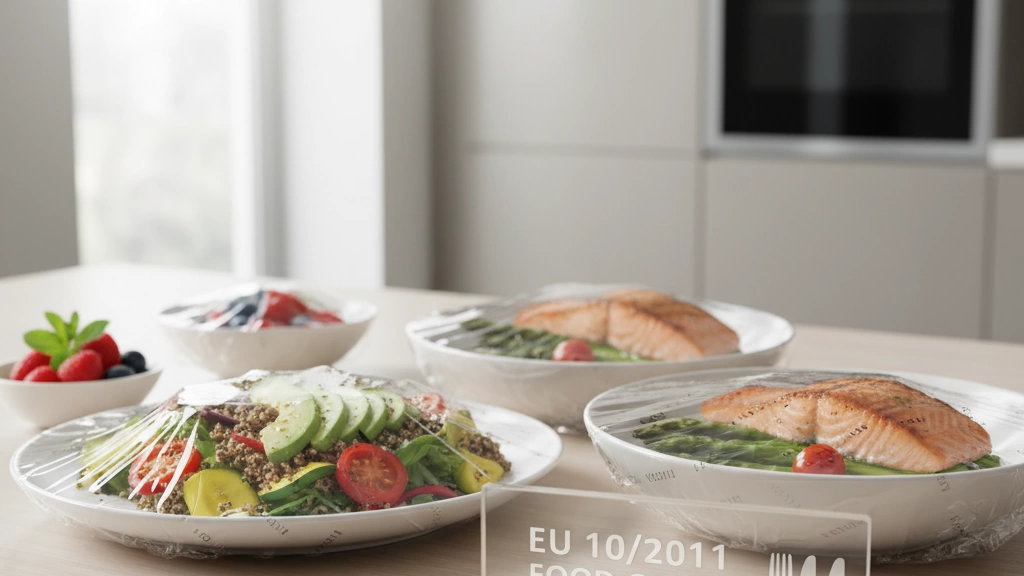
Frequent Mistakes With EU 10/2011 Food Grade Cling Film
Even experienced buyers slip up on EU 10/2011 cling film rules. In our day‑to‑day work with U.S. brands exporting to the EU, these are the problems we see over and over:
- No or weak Declaration of Compliance (DoC) – DoCs missing reference to Regulation (EU) No 10/2011, Framework Regulation 1935/2004, or migration limits for cling film.
- Using the wrong film for fatty foods – Standard PE or PVC wrap used for cheese, meat, or oily snacks without checking specific migration limits (SML) for plasticizers and other additives.
- Outdated formulations – PVC cling films still using plasticizers that will fall under the 2025 EU plasticizer restrictions, but with no plan to phase them out.
- Wrong or missing food contact symbols – Packaging shipped without the glass-and-fork symbol or without clear “for food contact” instructions in EU languages.
- No real traceability – Batch codes on the box, but no internal link to resin lots, masterbatch, and migration testing reports.
- Unaccredited testing labs – Overall migration testing (OML), specific migration testing, or food simulant testing done in labs without ISO/IEC 17025 accreditation.
When we supply cling film, we build these checks into our standard workflow so you don’t have to chase them down for every order.
Real-World Examples of Cling Film Non-Compliance
Here are typical ways shipments get stopped at EU borders or rejected by retailers:
-
Shipment rejection for missing DoC
A U.S. food packer ships pallet loads of PVC food wrap to an EU distributor. Customs asks for an EU 10/2011 DoC; the supplier only has a generic “food safe” letter. Result: shipment held, then returned at the buyer’s cost. -
Non-compliance due to migration over SML
Cling film for wrapping high-fat cheeses fails accredited lab testing. A plasticizer exceeds its specific migration limit (SML) into fatty food simulant. The retailer pulls the entire batch and requires full reformulation and re-testing. -
Incorrect material for direct contact
A film labeled “for secondary packaging only” is used directly on ready-to-eat food. There is no migration data for direct contact, leading to non-compliance findings in an internal audit and forced relabeling.
These are exactly the issues our EU 10/2011 Food Grade Cling Film Compliance Guide helps customers avoid when they’re planning packaging for fresh food, meal prep, or alongside reusable options like stainless steel lunch boxes.
How Buyers Can Prevent EU 10/2011 Cling Film Failures
To keep your cling film program clean and audit-ready, put a few tight systems in place:
-
Standardized supplier audits
- Require full EU 10/2011 and 1935/2004 references in the DoC.
- Verify Union List authorized substances, OML/SML data, and food simulants (Annex III) used in the tests.
- Check that the producer follows GMP for food packaging (Regulation (EC) No 2025/2006).
-
Batch-level documentation
- Link each batch number to resin lots, additives, and migration test results.
- Store DoCs, test reports, and Certificates of Analysis in one digital system for quick retrieval during supplier audits or retailer checks.
-
Ongoing lab verification
- Use accredited lab migration analysis (ISO/IEC 17025) for both overall migration and specific migration tests.
- Re-test whenever you change suppliers, resin grades, pigments, or plasticizers.
-
Digital tracking and alerts
- Use simple digital tracking tools (even a solid ERP or QMS) to flag expiring test reports and upcoming regulation changes like the EU plasticizer ban 2025.
- Keep labels, instructions, and DoC templates aligned with how your cling film is actually used (direct contact, freezer use, microwave, fatty foods, etc.).
If you do this consistently, EU 10/2011 food grade cling film stops being a risk point and becomes a stable part of your broader food packaging setup, right alongside insulated or reusable containers you may already be using for hot and cold foods.
How Buyers Verify EU 10/2011 Food Grade Cling Film Compliance
As a cling film supplier, I know serious buyers don’t just trust claims – they verify EU 10/2011 Food Grade Cling Film compliance with a clear audit process.
Step-by-step audit checklist (EU 10/2011)
Use this quick checklist when you review a cling film supplier:
-
Check the Declaration of Compliance (DoC)
- References to Regulation (EU) No 10/2011 and Framework Regulation 1935/2004
- Clear product identification: material type (e.g. PE, PVC), thickness, intended use
- Stated overall migration limit (OML) and any relevant specific migration limits (SML)
- List of restricted substances and conditions of safe use (time/temperature, food types)
-
Confirm test reports and lab details
- Recent accredited lab migration analysis (ISO 17025 or equivalent)
- Tests done with correct food simulants (Annex III) for aqueous, acidic, and fatty foods
- Test conditions that reflect real use: fridge, room temp, or hot-fill where relevant
-
Review materials and additives
- Statement that all components come from the Union List authorized substances
- Clear note on plasticizers and any impact of the EU plasticizer ban 2025, especially for PVC
- Information on base resin (e.g. PE, PVC) and additives used for cling, clarity, and strength
- If you’re comparing films, this breakdown pairs well with a material guide like our overview of polyethylene vs polypropylene for food packaging films.
-
Check GMP and quality systems
- Written Good Manufacturing Practices (GMP) food packaging procedures
- Batch records, cleaning procedures, and foreign matter controls
- Documented supplier audit food contact compliance program for raw materials
-
Verify batch traceability
- Unique lot numbers printed or linked to each roll or case
- Ability to pull batch traceability plastic films records quickly (production date, resin batch, test data)
- Clear recall procedure if an issue is found
Red flags in EU 10/2011 cling film paperwork
When I review a new supplier, these are instant warning signs:
- DoC is missing, generic, or not signed
- DoC doesn’t mention EU 10/2011, 1935/2004, or usage limits
- Test reports are older than 3 years or don’t match the exact film you’re buying
- No mention of OML, SML, or test conditions (time/temperature, food simulants)
- Lab is not independent or not clearly accredited
- Vague answers on plasticizers for PVC or no position on the 2025 changes
- No system for batch numbers, or they can’t link a roll back to test data
If you see two or more of these, you should assume the compliance story is incomplete and push for better proof or walk away.
Choosing long-term cling film partners
For long-term supply into the EU, buyers in the U.S. tend to prioritize reliability over small price differences. Here’s how I suggest you pick your partners:
-
Look for testing transparency
- Supplier shares full reports (not just cover pages)
- Clear explanation of overall migration testing (OML), specific migration limits (SML), and food simulants in simple terms
- Regular retesting after material changes or regulatory updates
-
Assess how they handle regulations
- Proactive updates about plastic food contact materials regulation changes and EU plasticizer rules
- Ability to adapt formulas while keeping performance (cling, clarity, tear resistance) stable
- Product lines designed specifically as PE cling film safety standards or low-risk PVC options
-
Evaluate documentation habits, not just one DoC
- Version-controlled DoCs, with revision dates and reasons for changes
- Digital storage of lab reports, raw material specs, and shipment records
- Willingness to build customer-specific documentation packs for audits and retailer checks
- For more advanced programs, some buyers also tie cling film specs into broader packaging choices, like how they select preservative film materials for shelf life.
-
Test their support under pressure
- Ask how they’ve handled past non-conformances or shipment questions
- Check response time when you request extra certificates or clarification
- See if they can support your own customer audits or retailer questionnaires
A strong partner doesn’t just send a one-page document. They give you a full EU 10/2011 Food Grade Cling Film Compliance Guide for each product: DoC, accredited lab tests, clear migration limits, and clean traceability from resin to finished roll. That’s what protects your brand in the U.S. while you sell safely into the EU.