















What Is PVC Cling Film and How Is It Different from PE Cling Film?
When people ask me, “Is PVC cling film safe?” what they’re really asking is, “What exactly is this plastic touching my food, and how is it different from the alternatives?”
Let’s break down PVC vs PE cling film in simple, practical terms.
PVC Cling Film Basics
PVC cling film is made from polyvinyl chloride (PVC). On its own, PVC is quite rigid (think pipes, window frames). To turn it into a soft, stretchy wrap, manufacturers add plasticizers.
Why plasticizers are added to PVC:
- Make the film soft and flexible
- Improve cling strength (so it sticks well to containers and food)
- Increase stretchability without tearing
- Enhance clarity and gloss for product display
Without plasticizers, PVC would be too stiff to work as a food wrap.
Common PVC Plasticizers and What They Do
PVC cling film often contains one or more of these plasticizers:
| Plasticizer | Type | What It Does in Film |
|---|---|---|
| DEHP | Phthalate | Strong flexibility, long-lasting softness |
| DINP | Phthalate | Flexibility, commonly used as DEHP replacement |
| DIDP | Phthalate | High-temperature durability |
| DEHA | Adipate | Softness, used especially in food wraps |
| ATBC | Citrate (non-phthalate) | “Safer” plasticizer, often used in newer wraps |
These additives aren’t chemically bonded to the PVC. That’s why you hear about “plasticizer migration” from PVC cling film into food, especially fatty foods and under heat.
How PE Cling Film Works Without Plasticizers
PE cling film (what we supply) is made from polyethylene, usually:
- LDPE (Low-Density Polyethylene)
- LLDPE (Linear Low-Density Polyethylene)
Key point: PE is naturally flexible.
It doesn’t need added plasticizers to be soft and stretchy.
What this means in practice:
- No phthalates (like DEHP, DINP, DIDP)
- No adipates (like DEHA)
- No need for plasticizer migration worries
The film’s performance comes from the polymer structure itself and how it’s processed, not from additives that can leach out.
Performance: PVC vs PE at a Glance
Here’s how PVC and PE cling films generally compare in everyday use:
| Feature | PVC Cling Film | PE Cling Film (LDPE/LLDPE) |
|---|---|---|
| Cling strength | Very strong, “grippy” | Slightly less “sticky,” modern grades cling well |
| Stretch | Excellent stretch and “shrink” effect | Good stretch; newer PE wraps are highly elastic |
| Clarity | Very clear and glossy | Clear; some grades slightly less glass-like |
| Tear resistance | Good, especially in pro food-service | Very good; tougher in thin gauges |
| Odor | Can have a slight plastic smell | Typically low or neutral odor |
| Feel | Softer, more rubbery | Smooth, slightly firmer feel |
Modern PE cling films have closed most of the performance gap while avoiding plasticizers altogether.
Microwave and Heat Resistance: PVC vs PE
Heat is where safety concerns really start to diverge.
-
PVC Cling Film
- Can soften and release more plasticizers when heated
- Often not recommended for direct contact with hot food
- Only safe to use in a microwave if explicitly labeled “microwave-safe” and used following strict instructions (no contact with fatty foods, keep film away from food surface, etc.)
-
PE Cling Film
- Has a higher melting point than many PVC wraps
- Generally more stable in fridge and room-temperature use
- For microwaving, most guidance still says:
- Don’t let the film touch the food
- Use vented containers and follow label instructions
- Crucially, there are no plasticizers to migrate when PE gets warm, which simplifies the risk profile
Cost and Availability in Real Life
Historically, many supermarkets and restaurants chose PVC cling film because it offered excellent performance at low cost. That picture is changing.
PVC cling film:
- Widely used in professional food service, especially for meat, cheese, and produce
- Often slightly cheaper per roll in bulk, depending on region and spec
- Performance is familiar to chefs and prep staff
PE cling film:
- Once seen as “secondary,” but newer films (including ours) now offer:
- Competitive cling
- Strong stretch
- Solid clarity
- In the US, more retailers and food-service operators are shifting to PE to:
- Avoid phthalate and DEHA concerns
- Simplify regulatory compliance and brand risk
- Cost difference is increasingly small, and in many cases, PE is cost-neutral when you factor in:
- Fewer restrictions on use
- Less consumer concern
- Longer-term brand trust
In short:
PVC cling film relies on plasticizers to perform; PE cling film doesn’t.
That one design difference sits at the heart of most safety, regulatory, and consumer preference questions about plastic wrap today.
The Main Safety Concerns with PVC Cling Film
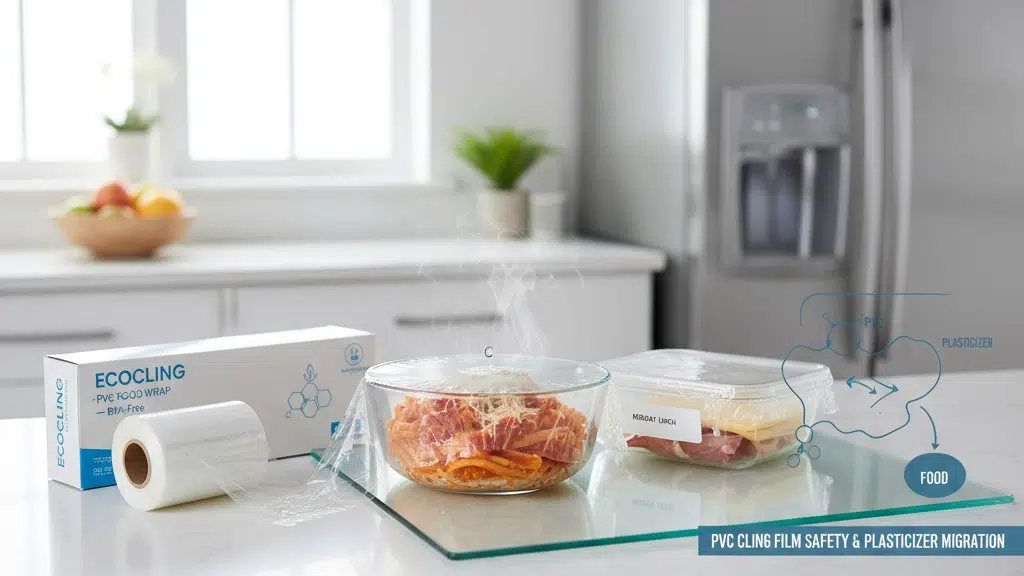
When people ask, “Is PVC cling film safe?” they’re really asking about one core issue: plasticizer migration into food and what that means for health and the environment.
How Plasticizers Migrate into Food
PVC on its own is stiff. To make PVC cling film soft and stretchy, manufacturers add plasticizers (like DEHP, DINP, DIDP, DEHA, ATBC). These are small molecules that don’t chemically bond to the plastic. Because they’re loosely held, they can:
- Move within the film and collect at the surface
- Transfer into food when there is direct contact
- Migrate faster with heat, time, and certain types of food
This process is called plasticizer migration, and it’s the main safety concern with PVC cling film.
Why Fatty, Oily, and Acidic Foods Are Higher Risk
Not all foods pull plasticizers out of PVC at the same rate. Migration is much higher when PVC touches:
- Fatty meats and cold cuts
- Cheese and butter
- Oily leftovers and sauces
- Oily snacks and baked goods
- Tomato-based and acidic dishes
Plasticizers are fat-loving (lipophilic). That means they dissolve more easily in oils and fats than in water. Add warm temperature or long storage time, and migration goes up again.
In simple terms:
PVC cling film touching hot, greasy food = higher migration risk.
DEHP and Other Phthalates as Endocrine Disruptors
Some of the traditional PVC plasticizers are phthalates, such as:
- DEHP (di-2-ethylhexyl phthalate)
- DINP (diisononyl phthalate)
- DIDP (diisodecyl phthalate)
These are under intense global scrutiny because they can act as endocrine disrupting chemicals (EDCs). Studies have linked certain phthalates to:
- Changes in testosterone levels
- Altered development of the reproductive system
- Potential impacts on sperm quality and fertility
- Possible effects on thyroid hormones and metabolism
Regulators set strict specific migration limits and acceptable daily intake (ADI) values because of these risks, especially for children and pregnant women.
What Studies Say About Hormones and Fertility
Human and animal research has shown:
- In animals, DEHP and related phthalates can affect testicular development, sperm production, and hormone levels.
- In humans, population studies have found associations between phthalate metabolites in urine and:
- Lower sperm count or quality
- Changes in reproductive hormone profiles
- Possible effects on child development when exposure occurs during pregnancy
These studies don’t mean every use of PVC wrap causes harm, but they’re strong enough that regulators and many brands are moving away from certain phthalates in food wrap.
DEHA, Adipates, and the “Microwave Scare”
To replace phthalates, many PVC wraps shifted to adipate plasticizers, especially DEHA (di-2-ethylhexyl adipate).
DEHA is not a phthalate, but earlier studies showed that:
- It can migrate into high-fat foods, especially at high temperatures.
- Some lab tests using extreme microwave conditions reported migration levels that raised concerns, sparking the original “microwave PVC wrap” scare.
Regulators later refined the risk assessments, but the basic message remains practical:
If you’re heating food, especially oily or fatty food, you want to avoid PVC cling film touching it directly—unless it’s clearly labeled and approved as microwave-safe and used exactly as directed.
Short-Term vs Long-Term Exposure Risks
Short-term exposure (like wrapping a sandwich now and eating it later) is generally considered low risk if:
- The food is not very fatty or oily
- The temperature stays refrigerated or room temperature
- Contact time is relatively short
Long-term or higher exposure is more of a concern for:
- Babies and kids (developing bodies, higher intake per body weight)
- Pregnant women (fetal development)
- Workers who handle PVC film all day (cumulative occupational exposure)
- People with high intake of fatty packaged foods
Regulators build large safety margins into ADI values, but many consumers prefer to avoid avoidable exposure when safer options like PE cling film are available.
Environmental Impact: PVC Production, Use, and Disposal
Beyond personal health, PVC cling film raises environmental concerns:
- PVC production can involve chlorine-based chemistry and generate hazardous by-products if not tightly controlled.
- At the end of life, PVC is hard to recycle. It can contaminate recycling streams designed for polyethylene (PE) or other plastics.
- When burned improperly, PVC can release toxic gases and dioxins, which are persistent and harmful pollutants.
If you care about lower-impact packaging, it’s worth comparing PVC to materials like PE film and food-grade plastic bags that fit more easily into existing recycling systems in the U.S. Some buyers evaluate cling film along with other packaging choices, like cost-effective preservative films compared with traditional packaging, to balance safety, performance, and sustainability.
Microplastics and Persistent Additives
PVC cling film can also contribute to microplastic pollution:
- Thin films degrade into small fragments during use, washing, or waste handling.
- These fragments can carry plasticizers and other additives into water, soil, and the food chain.
- Many of these additives are persistent—they don’t easily break down and can accumulate in the environment.
This is another reason more U.S. retailers, restaurants, and consumers are taking a hard look at PVC cling film safety and moving toward non-toxic cling film options like PE wrap, reusable silicone lids, and glass containers for hot or fatty foods.
What Do Global Regulations Actually Say in 2025?
When people ask, “Is PVC cling film safe?”, the honest answer is: it depends on the plasticizers used, how it’s used, and what the law in your country allows. Here’s how major regulators treat PVC cling film and plasticizers right now.
EU (EFSA) Rules for Plasticizers in Food Contact
In the European Union, PVC cling film is tightly controlled under EU food contact regulations and EFSA scientific opinions.
- EFSA sets Specific Migration Limits (SMLs) for each plasticizer – this is the maximum amount allowed to migrate from the film into food.
- Typical SML values (simplified ranges) for phthalates used in PVC food contact materials:
- DEHP: around 1.5 mg/kg of food
- DINP / DIDP: usually 9 mg/kg of food (but banned in some uses, like toys)
- Many phthalates are restricted or phased down for direct food contact, especially for fatty foods and baby/child-related uses.
- New EU assessments are moving toward stricter limits and combined exposure (multiple plasticizers at once) rather than one-chemical-at-a-time.
Bottom line: In the EU, PVC cling film must pass migration tests into food simulants, with a special focus on high-fat foods and higher temperatures.
U.S. FDA Rules for PVC Cling Film (21 CFR)
In the United States, the FDA regulates PVC food wrap under Title 21 of the Code of Federal Regulations (21 CFR).
- PVC resins and plasticizers used in food wrap must be:
- Listed in 21 CFR (for example, parts under 21 CFR 177 and related sections), or
- Cleared through a Food Contact Notification (FCN).
- The FDA doesn’t just look at the material; it looks at “intended use”:
- Type of food: fatty vs. aqueous vs. acidic
- Temperature: refrigeration, room temp, or heating
- Contact time: short vs long
- Some substances are treated as GRAS (Generally Recognized as Safe) only under specific conditions. That doesn’t mean “safe in all situations”; it means “safe when used as intended.”
So in the U.S., PVC cling film is allowed, but only with approved additives and under defined use conditions (for example, not all PVC wraps are cleared for microwave use on fatty foods).
FSANZ (Australia & New Zealand) Updates Through 2024
Food Standards Australia New Zealand (FSANZ) follows a similar framework:
- Sets ADI (Acceptable Daily Intake) values for plasticizers like DEHP, DINP, DIDP, DEHA.
- Requires migration testing into fatty food simulants for PVC films.
- Recent updates through 2024 have:
- Tightened attention on children’s exposure
- Re-affirmed that PVC cling film should not touch fatty foods at high temperatures unless specifically tested and labeled for that use.
FSANZ generally aligns with EFSA-style risk assessment, but adapts it for local diets and exposure patterns.
Japan, South Korea, and China Regulations
Japan
- Japan maintains positive lists of allowed plasticizers in food contact materials.
- Some traditional phthalates are restricted or not permitted in food wrap.
- Japan prioritizes low migration and often uses non-phthalate plasticizers for PVC food film.
South Korea
- South Korea has strict phthalate limits in food-contact plastics, especially materials touching oily or fatty foods.
- Certain phthalates are banned or heavily restricted in food-contact uses and children’s items.
China
- China’s GB standards manage which plasticizers can be used in PVC food contact materials and at what levels.
- There are defined migration limits and testing protocols, similar in structure to EU rules, though individual limit values can differ.
Across Asia, the trend is clear: phthalates are under pressure, and regulators are nudging industry toward safer plasticizers or alternative materials.
What “Phthalate-Free” PVC Actually Means
“Phthalate-free” on PVC cling film does not mean “chemical-free” or “risk-free.”
Typically it means:
- Traditional phthalates like DEHP, DINP, DIDP, DBP are not used.
- Instead, manufacturers may use:
- Adipates (e.g., DEHA)
- Citrates (e.g., ATBC)
- Other non-phthalate plasticizers
Legally and technically:
- As long as the alternative plasticizers are approved and migration stays below SML limits, the film can be sold as food contact safe.
- However, some of these alternatives are still being researched, and long-term, low-level exposure data is less complete than for older phthalates.
So “phthalate-free PVC cling film” is better marketing-wise, but from a safety standpoint, it still relies on plasticizers that can migrate and still needs proper temperature and food-type limits. If you want to avoid plasticizer migration altogether, that’s where PE cling film has a real advantage, as we detail in our dedicated PVC cling film safety guide.
How Supermarket and Food-Service Policies Go Further
Major supermarkets and food-service brands are not just following the law; many are going beyond minimum regulations:
- Policy shifts we see in practice:
- Dropping DEHP and other high-concern phthalates
- Moving from PVC to PE cling film for in-store wrapping of meats, cheese, and bakery items
- Setting internal rules like “no PVC on hot or microwaved foods”
- Drivers for these changes:
- Concern over endocrine-disrupting chemicals
- Pressure from consumers who want non-toxic cling film options
- Simplifying compliance across multiple regions with different rules
From our own work supporting chain accounts, many retailers that once used PVC are now specifying PE cling film as a default, aligning with their wider health, safety, and sustainability goals. If you’re exploring that transition for your store or kitchen, our supermarket-focused cling film requirements case study breaks down how others are already doing it.
Key takeaway: In 2025, regulators still allow PVC cling film, but under tight conditions. At the same time, the market is clearly shifting toward PE and other alternatives to sidestep plasticizer issues and make compliance easier.
Latest Scientific Studies on PVC Cling Film Safety (2020–2025)
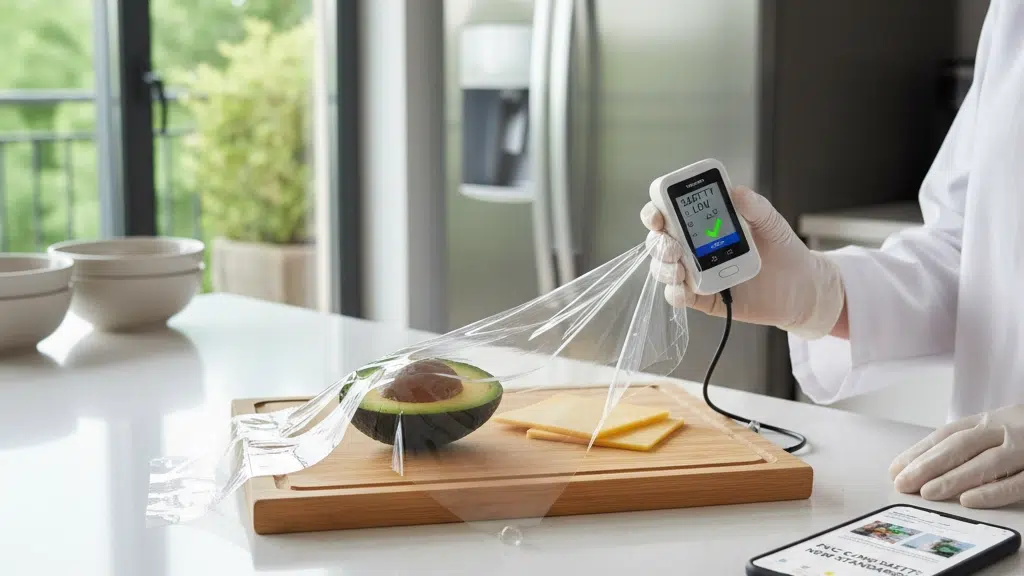
From 2020–2025, most new research on PVC cling film safety focuses on how plasticizers move into food, especially fatty and acidic foods, and whether real exposure comes close to health limits set by regulators.
Plasticizer Migration Into Food
Recent peer‑reviewed studies confirm a few key points:
- Fatty foods (meat, cheese, oils, sauces) pull the most plasticizer from PVC wrap.
- Acidic foods (tomato sauce, pickles, citrus) can also increase migration, though usually less than high‑fat items.
- Migration is driven by:
- Direct contact between wrap and food
- Higher temperature
- Longer contact time
In multiple tests, DEHP, DINP, DIDP, and DEHA levels in fatty foods wrapped with PVC climbed sharply when stored warm or heated, compared with the same foods stored cold.
Lab vs Real‑World Use (Fridge, Freezer, Microwave)
Researchers now combine controlled lab tests with “real kitchen” and food‑service scenarios:
- Fridge (≈4 °C / 39 °F):
- Migration from PVC cling film into food is usually low and often below detection, especially when contact time is short and food isn’t very fatty.
- Freezer:
- Very little migration; cold temperatures slow movement of plasticizers significantly.
- Room temperature (counter, displays):
- Noticeable uptake into fatty foods after several hours to days, especially when the wrap is tightly pressed to the surface.
- Microwave / reheating:
- Studies show the highest migration when PVC wrap touches hot, oily food.
- When there’s an air gap and the film is labeled “microwave-safe”, migration is lower, but still higher than at room or fridge temperatures.
Overall, real‑world tests in homes and restaurants often show that everyday habits (stretching wrap tightly over hot leftovers, microwaving with the wrap touching cheese or meat) can exceed the conditions used in safety testing.
Migration Levels at Different Temperatures and Times
Across studies, the pattern is consistent:
- Low temp + short time → lowest migration
- Moderate temp + long time → moderate migration
- High temp (heating, hot holding) + direct contact with fat → highest migration
For example, a fatty cheese wrapped in PVC and stored several days at room temperature can absorb several mg/kg of plasticizer, while the same cheese in the fridge may be under regulatory specific migration limits (SMLs).
Toxicology, ADI Values, and Safety Margins
Regulators like EFSA and FDA set acceptable daily intake (ADI) values for major plasticizers based on toxicology data. Recent risk assessments still generally find:
- For most adults using cling film normally, total exposure from PVC wrap alone is typically below ADI.
- However, kids, pregnant women, and heavy users (e.g., food‑service workers constantly wrapping fatty foods) may have smaller safety margins because:
- They may have higher exposure per pound of body weight
- They are exposed from multiple sources: food packaging, flooring, tubing, etc.
Several 2020–2024 reviews point out that ADIs were often based on single‑chemical studies, while real life is mixed exposure.
Comparing PVC Cling Film vs PE and Other Wraps
Studies that compare PVC vs PE cling film are clear on one point:
- PE (LDPE/LLDPE) cling film doesn’t rely on phthalates or adipate plasticizers for flexibility, so plasticizer migration into food is essentially zero.
- When both are used under the same conditions:
- PVC-wrapped fatty foods often contain measurable levels of DEHP, DINP, DIDP, or DEHA.
- PE-wrapped foods show no detectable levels of those plasticizers.
This is why many researchers now highlight polyethylene food wrap as a lower‑risk option, especially for fatty foods and reheating. If you want a deeper look at how materials differ, I break this down in more detail in our guide to common materials for food storage bags and their properties.
Combined Exposure to Multiple Plasticizers
Newer work doesn’t just look at one chemical at a time. It tracks combined exposure to several plasticizers from:
- PVC cling film
- Food trays, caps, and seals
- Food‑processing equipment
- Indoor dust and air
What these studies suggest:
- Total exposure to phthalates and other plasticizers in some populations (especially children) can approach, or in some cases exceed, conservative health‑based guidance values when all sources are added together.
- Even when each individual plasticizer stays under its ADI, the “cocktail” effect is a concern. Endocrine‑disrupting chemicals can have additive or synergistic effects at low doses.
Because of this, many scientists and regulators now recommend minimizing avoidable exposure, starting with obvious sources like PVC cling film on hot or fatty foods, and favoring non‑plasticized options like PE cling film whenever possible.
When Is PVC Cling Film Considered Safe to Use?

How regulators define “safe use” for PVC cling film
Regulators like the FDA and EFSA don’t say “PVC cling film is always safe.” They say it’s safe under specific conditions:
- The film must use approved plasticizers.
- It must pass migration tests (how much chemical moves into food).
- It must be used only with the food types, temperatures, and contact times it was tested for.
In plain terms: PVC cling film is considered “safe” when you follow the intended use on the label. Once you go beyond that (hot food, fatty food, microwaving), the risk of plasticizer migration goes up.
Temperature limits: why under 40°C matters
Most safety tests and regulations assume PVC wrap is used at room temperature or colder, typically below 40°C (104°F). Above that:
- The PVC softens.
- Plasticizers move more easily into food.
- Migration into food can jump quickly with higher heat and longer time.
Safe rule of thumb:
Use PVC cling film only for cold or room-temperature food, and keep it away from hot surfaces, ovens, and hot dishes.
Lower-risk vs higher-risk foods
Not all foods behave the same when they touch PVC. Plasticizers dissolve far more into fatty and oily foods.
Higher-risk foods (avoid PVC contact if possible):
- Fatty meats (steaks, bacon, sausage)
- Cheeses (especially soft and high-fat cheeses)
- Butter, margarine, cream-based sauces
- Pizza, fried foods, oily leftovers
- Oily marinades, salad dressings
Lower-risk foods (short, cool contact is less concerning):
- Fruits and vegetables
- Bread, tortillas, baked goods (not greasy)
- Cooked rice, pasta without oil-heavy sauce
- Cool, low-fat leftovers in containers
If you need quick, simple guidance: the fattier or oilier the food, the more you should avoid direct PVC wrap contact.
Why direct contact with high-fat foods is the big issue
Plasticizers like phthalates and adipates are oil-loving. When PVC cling film touches fatty food:
- Plasticizers move from the film into the fat.
- The warmer the food and the longer the contact, the more migration happens.
- Cutting off the outer layer won’t fully fix it—migration can go deeper than the surface.
To reduce this:
- Put food in glass or plastic containers, then cover with wrap.
- Use PE cling film instead of PVC for direct wrap on fatty foods.
- For cheese, meats, and butter, avoid tightly wrapping with PVC whenever possible.
Safe PVC use in the fridge
PVC cling film can be reasonably safe in the fridge when:
- Food is cooled before wrapping (not still hot).
- Time in contact is short to moderate (a day or two, not weeks).
- The food is low-fat or not directly touching the film, or both.
More careful options:
- Let leftovers cool on the counter until just warm, then put them in a container and cover.
- For salads, fruit, veggies, and bakery items, PVC over a plate or bowl is typically lower risk.
- For meat and cheese, use PE cling film, wax paper, or containers for direct contact.
Microwaving PVC cling film: why it’s risky
Microwaving is where PVC cling film can really become a problem:
- Heat + steam + fat = high migration potential.
- The film can soften or even melt, increasing contact and migration.
- Most PVC wraps in the U.S. are not designed to be microwaved directly against food.
Only consider microwaving if:
- The wrap is clearly labeled “microwave-safe” for direct contact.
- It’s used according to the instructions (no touching food, vented, short time, etc.).
Safer approach:
- Use microwave-safe glass containers with loose lids.
- If you must use wrap, keep it raised above the food and not touching.
- Better yet, switch to PE cling film or a lid that’s rated microwave-safe.
Common habits that break these safety rules
At home and in food-service, these behaviors are common—and they all increase risk:
- Covering hot, greasy leftovers with PVC wrap and putting them straight in the fridge.
- Microwaving leftovers with the PVC wrap touching the food.
- Wrapping blocks of cheese, bacon, or fatty meats directly in PVC for days.
- Using PVC wrap over hot trays or pans in restaurant kitchens.
- Keeping wrapped fatty items in PVC for long storage times.
If any of this sounds familiar, it’s a strong reason to switch to PE cling film for high-fat or heated foods and to use containers more often.
For businesses, updating wrap use is similar to updating any food-safety routine—just like when we help customers shift to safer packaging or even explore options like edible preservative films for specific applications.
Who should be extra cautious
Certain groups are more vulnerable to chemicals like plasticizers, especially endocrine-disrupting ones:
- Babies and toddlers
- Pregnant and breastfeeding women
- Kids and teens (still developing hormonally)
- Workers with high exposure (kitchen staff, deli workers constantly handling PVC wrap)
If you’re in one of these groups—or buying for someone who is—it’s smart to:
- Avoid PVC for fatty foods and any heated use.
- Choose PE cling film or reusable glass containers for everyday storage.
- Keep PVC, if used at all, only for cool, low-fat foods and short storage times.
For most U.S. homes and food businesses, the simplest path is this:
Use PVC only for cold, low-fat foods and never for microwaving; use PE cling film or containers for everything else.
Why Many Consumers and Retailers Are Switching to PE Cling Film
How PE Cling Film Removes Plasticizer Migration
PVC cling film usually needs plasticizers (like phthalates or adipates) to stay soft and stretchy. Those additives can migrate into food, especially fatty or hot foods.
PE cling film (LDPE/LLDPE) doesn’t need plasticizers at all. It’s just polyethylene, so:
- There are no phthalates, no adipates, no BPA in the film itself.
- You’re not worrying about plasticizer migration into food every time you wrap cheese, meat, or leftovers.
- It’s a cleaner, simpler material that’s easier to explain to customers and staff.
For U.S. families and food businesses that want “set it and forget it” safety, switching to PE wrap takes one major risk off the table.
PE Cling Film: Certified Food-Safe With Fewer Restrictions
PE cling film is widely accepted by major food-contact regulations worldwide, including FDA and EFSA, when produced under standard food-contact rules. In practice, that means:
- Fewer usage restrictions compared with PVC that contains regulated plasticizers
- Easier compliance for supermarkets, restaurants, and caterers
- A more straightforward path to proving safety in audits and buyer reviews
With our PE cling film, we build directly around these food-contact standards, similar to how we approach our other safe-food solutions like elastic food covers for international markets.
Cling, Stretch, and Clarity: Modern PE vs Traditional PVC
Older PE films used to feel “stiff” and less sticky than PVC. That’s changed. Modern PE cling film is engineered to:
- Cling strongly to common surfaces (plastic, glass, stainless steel, ceramic)
- Offer good stretch for wrapping trays, pans, and bulk containers
- Deliver clear visibility, so food looks fresh in display cases and home fridges
For most everyday uses—home kitchens, delis, prep stations—high-quality PE now matches or comes very close to PVC performance, without the plasticizer headache.
Cost Comparison for Supermarkets, Restaurants, and Home Users
In the U.S. market, PE cling film is increasingly competitive on price:
- Per-foot cost is similar to or only slightly higher than PVC in many regions
- When you factor in reduced compliance risk and fewer restrictions with fatty foods, the overall cost of using PE often comes out ahead
- For home users, the price difference on a single roll is usually small, but the peace of mind is big
Large buyers (grocery chains, foodservice groups) see PE as a low-risk, stable long-term choice.
Recyclability: PE vs PVC
From a recycling standpoint, PE has a clear edge:
- PE (especially LDPE/LLDPE) fits into existing polyethylene recycling streams (where local programs accept film plastics).
- PVC is harder to recycle, can contaminate other plastic streams, and is often treated as non-recyclable waste.
In U.S. markets where plastic bag/film drop-off programs exist, PE cling film is far more likely to have a viable recycling path than PVC.
Retail and Food-Service Trends Away From PVC
Across the food industry, we see a steady shift:
- Grocery chains and meal-prep brands are moving away from PVC wraps due to phthalate and DEHA concerns.
- Many corporate and institutional buyers now include “PVC-free” or “phthalate-free” requirements in their specs.
- PE cling film, silicone covers, and reusable containers are gaining ground as safer-feeling options, a trend we also see in our manufacturing process for preservative films.
The direction is clear: fewer additives, simpler materials, easier compliance.
Brand and Reputation Benefits
Switching to PE cling film isn’t just about safety—it’s also about how your brand is perceived:
- You can honestly say you’re avoiding phthalate-based plasticizers in your wrap choice.
- You reduce the risk of customer questions like “Is this wrap safe to microwave?” or “Does this contain phthalates?”
- You position your store, restaurant, or meal service as health-conscious and future-focused, without asking customers to change their habits.
For U.S. consumers and retailers, PE cling film hits a sweet spot: food-safe, regulation-friendly, and aligned with where the market is already heading.
Artfullife® PE Cling Film as a Safer Everyday Option
What Makes Artfullife® PE Cling Film Different from PVC Wraps
Artfullife® PE cling film is designed for people who care about food safety as much as convenience. Unlike PVC wraps, it’s made from 100% polyethylene (PE), so it doesn’t rely on plasticizers to stay flexible or sticky. That means:
- No phthalates (like DEHP, DINP, DIDP)
- No adipates (like DEHA)
- No BPA or similar additives
You get strong cling and stretch without the chemicals most shoppers are trying to avoid when they wrap kids’ lunches, fresh meat, or next-day leftovers.
100% Polyethylene, No Question Marks
Because our cling film is pure PE, there’s no plasticizer migration risk the way there is with traditional PVC cling film. It’s a straightforward, food-grade material that’s already widely used in safe food packaging.
We also use strict raw material controls and production standards similar to those used for certified food-grade plastics, just like we do for our other food-contact packaging products.
Tested and Compliant With Major Food-Contact Regulations
Artfullife® PE cling film is engineered to comply with key global standards for food contact, including:
- FDA requirements for food-contact plastics in the U.S.
- EFSA principles used in the European Union for polyethylene food wrap
- Other major international food-contact safety frameworks followed by large retailers and food-service brands
We design our specs so supermarkets, restaurants, and catering companies can confidently use the film in professional settings where compliance and documentation matter.
Formats for Home, Retail, and Food Service
We built the range around how people in the U.S. actually use cling film:
- Retail cutter boxes – for home kitchens and small offices
- Refill rolls – for supermarkets and back-of-house prep areas
- Professional catering sizes – longer, wider rolls for restaurants, bakeries, and commissary kitchens
All formats keep the same food-safe PE formula, so you don’t have to worry about different materials in different sizes.
Real-World Performance in Kitchens
In daily use, Artfullife® PE cling film is made to feel familiar to anyone used to PVC wrap, just without the safety doubts:
- Strong cling to glass, ceramic plates, plastic containers, and stainless pans
- Good stretch and tear resistance for wrapping trays, cut fruit, and bulk ingredients
- Clear visibility, so staff and families can see what’s inside at a glance
- Works smoothly on standard wrap dispensers and cutting bars in prep areas
In professional kitchens that already rely on durable food containers and wraps for prep and storage, our PE cling film fits right in alongside reusable food containers and other safe packaging solutions.
Used by Supermarkets and Food-Service Brands
We supply PE cling film to:
- Supermarkets and grocery chains that want a “safer-feeling” option at the deli, bakery, and meat counter
- Restaurants, cafes, and catering companies that prep large volumes of food and want to lower plasticizer exposure for both staff and guests
Many partners have switched from PVC to PE specifically to align with internal safety policies and customer expectations.
What Customers Say: Cling, Control, and Peace of Mind
Feedback from U.S. retailers, chefs, and home users tends to focus on three things:
- Ease of use – rolls dispense smoothly, cut cleanly, and don’t tangle easily
- Cling strength – holds tight around plates, bowls, and pans without constant re-wrapping
- Peace of mind – people feel better using a non-toxic cling film option with no phthalates, no adipates, and no BPA, especially around kids, pregnant women, and long-term food storage
In short, Artfullife® PE cling film aims to deliver the performance everyone expects from premium plastic wrap, while cutting out the plasticizers and safety questions that come with PVC cling film.
Practical Recommendations for Home and Business Use
Simple rules for safer use of any cling film with food
Here’s the short version, whether you’re at home or running a kitchen:
- Keep cling film away from very hot food and high-fat food when you can.
- Don’t let wrap touch food while microwaving unless the film is clearly labeled “microwave-safe.”
- Use the right wrap for the job: PE cling film for everyday use and direct contact, especially with fatty foods.
- When in doubt, use a plate, lid, or glass container instead of wrapping food tightly in plastic.
How to tell PVC vs PE cling film (labels and symbols)
If you’re in the U.S., a quick label check goes a long way:
- Look for material codes:
- “PE,” “LDPE,” or “LLDPE” → polyethylene (PE cling film).
- “PVC,” “V,” or “3” → polyvinyl chloride (PVC cling film).
- Check for wording like:
- “Phthalate-free” or “No plasticizers” (usually a safer sign, but still check material).
- “Microwave-safe” with clear use directions.
- On boxes for food-service rolls, you’ll often see “PVC Food Wrap” or “Polyethylene Food Wrap” printed near the specs.
For businesses buying larger rolls, the product specs on cartons or invoices will clearly list “PVC” or “PE.” If it’s not clear, assume PVC and ask your supplier.
Visual and touch cues: PVC vs PE cling film
Labels are best, but you can also get clues from how the film looks and feels:
- PVC cling film:
- Very “sticky” cling, grips metal and glass strongly.
- Slightly firmer, more “rubbery” stretch.
- Often extra clear and glossy, sometimes with a faint smell.
- PE cling film:
- Softer, more “buttery” feel.
- Slightly less aggressive cling (modern PE is much better than old versions).
- Usually no noticeable odor; may look a bit less glass-clear but still transparent.
These are just hints. Always use labeling and product info first for safety decisions.
When to avoid direct contact with fatty or hot foods
To reduce plasticizer migration from any cling film—especially PVC—avoid direct wrap-on-food contact when:
- The food is hot or warm (fresh from stove, oven, air fryer, or microwave).
- The food is high in fat:
- Meats (steaks, burgers, bacon, deli meats, rotisserie chicken).
- Cheeses (especially soft and processed cheeses).
- Sauces and foods with oil/butter/cream (pasta with Alfredo, curries, pizza, lasagna).
- The food is both oily and acidic (tomato sauces, salad dressings with oil and vinegar).
Safer habits:
- Let food cool to room temperature before wrapping.
- Use a plate or shallow container, then lay the film over the top instead of wrapping tightly around the food itself.
- For very fatty foods, prefer PE cling film or a reusable container with a lid.
Safer ways to reheat food
If you’re reheating leftovers, play it safe:
- Use:
- Glass or ceramic containers with glass or vented plastic lids.
- A microwave-safe plate with the cling film loosely tented above the food, not touching it.
- Make sure:
- The film is labeled “microwave-safe.”
- There’s a vent (small gap or corner lifted) so steam can escape.
- Better options:
- Replace cling film with a microwave-safe lid or a silicone cover whenever possible.
For ovens, air fryers, or toaster ovens: do not use cling film at all. Use oven-safe lids, foil, or oven-safe covers instead.
Alternative wraps and covers
If you want to cut down on plastic risk and waste:
- At home:
- Glass containers with locking lids.
- Silicone stretch lids or silicone bowl covers.
- Beeswax wraps (for bread, fruit, and room-temp or chilled foods, not raw meat).
- Reusable plastic or stainless steel containers.
- In food service:
- Hotel pans with reusable lids.
- Food-grade containers with snap-on lids for prep and storage.
- For transport, combine reusable containers with outer wrap only when needed.
How restaurants, cafes, and supermarkets can move from PVC to PE
In a U.S. commercial kitchen, switching from PVC to PE cling film can be done in stages:
- Start with high-risk uses:
- Use PE cling film for wrapping meats, cheeses, and hot/cooked items.
- Keep any remaining PVC wraps away from hot and fatty foods.
- Standardize SKUs:
- Choose 1–2 core widths and lengths of PE rolls for line cooks and prep staff.
- For larger operations, consider commercial kitchen cling film rolls that match your existing dispensers.
- Talk to your supplier:
- Ask specifically for “PE cling film for food contact, phthalate-free, no PVC.”
- Request documentation that shows FDA and EFSA compliance.
Training staff on safer food wrapping
For businesses, training is key. Keep it simple and visual:
- Post quick guides:
- Color-coded labels on wrap dispensers: “PE – safe for meats & hot food” vs “PVC – no contact with hot/fatty foods.”
- Simple posters near prep areas showing what to use for which foods.
- Include in onboarding:
- Basic explanation of PVC vs PE and why you choose PE for most use.
- Clear rules about not microwaving food with cling film touching it.
- Spot checks:
- Have managers do quick line checks to make sure staff are using the right wrap in the right situations.
- Encourage staff to speak up if they’re unsure what material they’re grabbing.
Clear rules plus the right materials make it easy for your team to protect both food quality and customer safety.
Frequently Asked Questions About PVC and PE Cling Film
Can I microwave PVC cling film and when is it absolutely a no-go?
You should not microwave PVC cling film unless the packaging clearly says “microwave-safe” and you follow the instructions exactly. In general:
- Absolutely no-go:
- PVC wrap touching melty cheese, fatty meats, butter, oils, or sauces in the microwave
- High temperatures, boiling, or grilling
- Long heating times or repeated reheating
If you do reheat food in the microwave, use:
- A glass or microwave-safe plastic container with a vented lid
- A plate or paper towel over the top instead of wrap
Is all PVC cling film toxic or does it depend on the plasticizers?
It depends mainly on the plasticizers used and how you use it:
- PVC on its own is hard and brittle, so manufacturers add plasticizers (often phthalates or adipates) to make it soft and stretchy.
- These additives can migrate into food, especially when in contact with fatty or hot foods.
- Modern, regulated PVC cling films are designed to stay below safety limits, but misuse (high heat, long contact with greasy foods) can push migration higher.
So, no, not all PVC wrap is “toxic” by default, but it’s more sensitive to how and where you use it compared with PE.
If there are concerns, why is PVC cling film still allowed and sold?
PVC cling film is still allowed because:
- Regulators like FDA and EFSA set strict limits on which plasticizers can be used and how much can migrate into food.
- When PVC wrap is used as intended (cool or room temperature, not in direct contact with hot/fatty food, not in the oven or under a broiler), exposure is generally below regulatory safety limits.
- It’s also popular for its strong cling, high clarity, and low cost, especially in commercial kitchens.
The concern is less about “legal vs illegal” and more about real-life habits (microwaving with wrap, covering greasy leftovers, etc.) that can increase exposure.
Is PE cling film as sticky and convenient to use as PVC wrap?
Modern PE (polyethylene) cling film is much better than older versions and, in many cases, practically just as convenient:
- Cling: Newer PE formulations cling well to glass, ceramic, plastic containers, and plates.
- Stretch: Good-quality PE has strong stretch and tear resistance, ideal for home and food-service use.
- Clarity: Slightly less glass-clear than PVC, but the difference is small with high-grade PE.
We designed Artfullife® PE cling film specifically to close that performance gap, so U.S. home users, restaurants, and catering teams get PVC-like usability without plasticizer concerns.
Which countries or retailers have restricted or moved away from PVC food wrap?
Trends (especially in Europe and developed markets) are clear:
- Several EU countries, large UK and EU supermarket chains, and many U.S. food-service brands have largely phased out PVC wrap for in-store wrapping, favoring PE or other materials.
- Retailers and restaurant groups are moving away from PVC because of:
- Ongoing concern over phthalates and other plasticizers
- Brand and customer trust around “cleaner” packaging
- Recycling and sustainability policies
Many of our U.S. and international partners that use PE cling film also pair it with reusable food containers and lunch solutions, such as leakproof insulated lunch boxes for food delivery, to cut down on single-use plastics overall.
Does “phthalate-free” PVC cling film exist and how safe is it in practice?
Yes, “phthalate-free” PVC cling film exists. Instead of phthalates, it uses alternative plasticizers (like adipates or citrates). But:
- “Phthalate-free” doesn’t mean plasticizer-free.
- It still relies on additives that can migrate into food, especially with fat and heat.
- Safety depends on:
- Which plasticizer is used
- Its allowed specific migration limit (SML)
- How the wrap is actually used day to day
Phthalate-free PVC is a step up from older DEHP-heavy wraps, but PE cling film removes the plasticizer question entirely, which is why many retailers prefer it.
Is any type of cling film bad for the environment and what are better options?
All cling film (PVC or PE) has environmental impact:
- Both are single-use plastics and can contribute to waste and microplastics if not managed properly.
- PVC is generally harder to recycle and can release problematic chemicals if mismanaged during disposal.
- PE is usually easier to recycle where facilities exist and fits better into mainstream plastic recycling streams.
Better options to reduce impact:
- Use less wrap overall and reuse containers.
- Switch to:
- Glass containers with lids
- Stainless steel or insulated lunch boxes
- Silicone lids and reusable covers
- Beeswax wraps (for some cold uses)
We see many U.S. customers pairing PE wrap with durable lunch and storage gear like our portable stainless steel lunch boxes with thermal bags to cut down on daily plastic use.
How can retailers switch from PVC to PE without losing performance or increasing cost?
The switch can be straightforward if you plan it right:
- Test PE samples in your actual workflow (meat, produce, deli, bakery) to confirm cling and clarity.
- Choose professional-grade PE rolls designed for food-service, not just home-use wrap.
- Match or optimize:
- Roll length and thickness (to avoid overuse)
- Cutter boxes or dispensers staff already know how to use
- Train staff on:
- Proper stretching and wrapping technique
- Avoiding overheating food in contact with any wrap
With Artfullife® PE cling film, most of our retail and food-service clients in the U.S. shifted from PVC without higher total cost, because:
- Staff use less film per wrap thanks to good stretch.
- There are fewer customer complaints about “chemical smell” or safety worries.
In short: yes, you can move from PVC to PE, keep performance high, control costs, and offer packaging that simply feels safer to your customers.