















What Exactly Is PE Cling Film?
If you’re buying food wrap in bulk for supermarkets, restaurants, or food production, PE cling film is probably one of your highest-turnover items. Choosing the right film isn’t just about “cheap per roll” – it’s about cling performance, clarity, safety, and real cost per use.
Here’s the simple breakdown you actually need.
Material Basics: LDPE, LLDPE, and Metallocene PE
Most quality cling film in the U.S. market today is made from:
-
LDPE (Low-Density Polyethylene)
- Softer, more flexible
- Good clarity and easy handling
- Often used for cost-effective, everyday food wrap
-
LLDPE (Linear Low-Density Polyethylene)
- Better stretch and toughness than LDPE
- More puncture resistant (good for trays with sharp corners, bones, or rough edges)
- Helps reduce film breakage and waste
-
Metallocene PE (mPE)
- Premium resin with very high clarity and strength
- Excellent cling and uniform stretch
- Ideal when you need “display-grade” looks for supermarket trays and retail packs
In practice, we usually blend LDPE + LLDPE, and for higher-end lines, we add metallocene PE. This lets us balance:
- Cost vs. performance
- Clarity vs. strength
- Cling level vs. ease of use (no over-sticking or blocking)
For U.S. buyers, this blend is key to getting food grade PE cling film in bulk that doesn’t tear, fog, or smell, even under heavy daily use.
Key Performance Features Buyers Care About
When our customers ask for “good cling film,” they usually mean a few very specific things:
-
Strong cling, but not annoying
- Wrap should grip bowls, trays, and itself firmly
- No constant lifting or peeling off in the cooler
- But also not so aggressive that staff struggle to unroll or separate layers
-
High clarity and gloss
- Food must look fresh and appealing in the case
- Low haze, high transparency for meat, produce, bakery, and deli
- Important for supermarkets and food processors selling in retail packs
-
Reliable stretch and toughness
- Film should stretch smoothly without whitening or tearing
- Good puncture resistance around sharp tray corners and bones
- Helps you use thinner film without complaints from staff
-
Food-contact safety
- Resin and additives must be food grade
- Compliant with FDA and major international standards
- Neutral, low odor – no plastic smell transferring to food
These are the core performance factors we design for when we develop a new PE cling film spec for a U.S. supermarket or foodservice chain.
Common Thickness and Width Ranges
To keep things simple, most buyers in the United States work within a few standard thickness and width ranges:
-
Typical thickness options (approx.)
- 8–10 microns: very economical, light-duty wrapping
- 10–12 microns: standard supermarket and restaurant grade
- 12–15 microns: heavy-duty, tougher wraps for demanding applications
-
Typical width options for retail and foodservice
- 12 in (≈30 cm): common for household and small prep stations
- 15 in (≈38 cm): popular for restaurants and delis
- 18 in (≈45 cm): widely used in supermarkets and catering kitchens
- 24 in (≈60 cm) and above: for larger trays, pans, or industrial use
By tuning thickness and width to your operation, you can:
- Reduce waste and roll changeovers
- Cut costs per wrapped tray or container
- Match film size to your existing dispensers and machines
When we quote PE cling film wholesale prices for 2025, we always link cost directly to thickness, width, and roll length, because these are the three levers that truly change your real usage cost.
Typical Uses in Supermarkets, Restaurants, and Food Processors
In day-to-day operations, PE cling film is used almost everywhere:
-
Supermarkets and grocery stores
- Overwrap for foam and plastic trays (meat, poultry, produce)
- Backroom wrapping of cut fruit, vegetables, deli items, cheese
- In-store bakery for bread, cakes, and pastries
-
Restaurants, catering, and foodservice
- Covering GN pans, prep containers, and mixing bowls
- Short-term storage of prepped ingredients in coolers
- Protecting leftovers and ready-to-serve dishes
-
Food processors and packers
- Manual or semi-automatic overwrapping of retail trays
- Short-term protective wrap during staging and transfer
- Display packs where visibility and freshness appearance are critical
In all of these scenarios, the right PE cling film spec reduces complaints, improves presentation, and quietly cuts your total packaging cost.
Actionable takeaway:
- If you know your main use (household-style, back-of-house kitchen, or supermarket tray overwrap), you’re already halfway to the right spec.
- Next, pin down the thickness (8–15 microns) and width (12–18 inches for most U.S. users), then choose the resin blend (LDPE/LLDPE with or without metallocene) that matches your clarity and strength needs.
Standard PE Cling Film Specifications and Naming Rules (PE Cling Film Wholesale Guide)
When I buy and sell food grade PE cling film in bulk, I stick to a clear spec system so nobody is guessing. Here’s how the industry usually defines and names rolls in 2025, and what actually matters for supermarkets, restaurants, and distributors in the U.S.
How Thickness, Width, and Length Are Defined
In wholesale, almost every quote and label follows this order:
Thickness (micron/μm) × Width (cm or inch) × Length (m or ft)
1. Thickness (μm / micron)
- Typical PE cling film thickness for food wrap:
- 8–10 μm – economy household, light-duty produce
- 10–12 μm – standard supermarket & restaurant use
- 12–15 μm – heavy-duty, meat trays, catering, back-of-house
- Thicker film = better strength and cling, but higher cost per roll.
- Many U.S. buyers are moving to 10–12 micron as a balance of cost and performance.
2. Width (cm / inch)
- Common widths:
- 25–30 cm (10–12 in): retail kitchen, deli
- 30–33 cm (12–13 in): general restaurant prep
- 40–45 cm (15–18 in): full-size hotel pans, catering
- Supermarkets often standardize on 30 cm and 45 cm for front-of-house and back-of-house.
3. Length (m / ft)
- Retail: 30 m / 60 m / 100 m
- Foodservice: 200–600 m per roll
- Longer rolls = fewer changeovers and less waste for busy kitchens.
Common Supermarket and Catering Specs in 2025
Here’s what we see most across U.S. supermarkets, restaurant chains, and food distributors this year:
| Application | Typical Spec (Thickness × Width × Length) | Notes |
|---|---|---|
| Retail / household cutter box | 10–12 μm × 30 cm × 30–60 m | Private label, printed color box, shrink-wrapped |
| Supermarket front counter roll | 10–12 μm × 30 cm × 300–600 m | For manual dispensers, high transparency |
| Meat / produce tray overwrap | 11–13 μm × 45 cm × 300–600 m | Strong cling, good stretch, good anti-fog optional |
| Restaurant back-of-house roll | 10–12 μm × 30/45 cm × 300–600 m | Core-only or simple sleeve, bulk carton |
| Central kitchen / processor roll | 12–15 μm × 45–50 cm × 500–1,000 m | Often machine-grade, for higher speed wrapping |
If you’re buying for restaurant chains, this is very close to what we pack for most U.S. accounts. For an example of how we structure bulk supply for foodservice, you can see our bulk purchase of cling film for restaurants guide.
Hand Roll vs Machine Roll (Core Differences & Best Use Cases)
Hand rolls (manual use):
- Length: usually 200–600 m
- Core: 1.5″ or 3″ ID; lighter core
- Film: easier unwind, high cling, moderate stretch
- Use cases:
- Supermarket counters (manual dispensers)
- Restaurants, catering kitchens, deli, bakery
- Best when staff wraps by hand and needs flexibility.
Machine rolls (automatic wrapping machines):
- Length: usually 800–1,500 m or customized
- Core: 3″ (76 mm) heavy-duty core, stronger for high speed
- Film: more consistent thickness, stable tension, higher stretch
- Use cases:
- Automatic tray overwrappers in supermarkets
- Food processing plants, central kitchens
- Best when you run auto machines all day and want fewer roll changes.
Quick rule:
- If you’re wrapping fewer trays and using simple dispensers → hand rolls.
- If you’re running automatic tray wrappers or central packaging lines → machine rolls.
Cutter Box vs Core-Only Packaging
Cutter Box Rolls (Retail & Light Foodservice)
- Comes in a printed or plain box with built-in metal or plastic cutter.
- Usually shrink-wrapped with labels and barcode.
- Ideal for:
- Grocery retail, club stores, dollar stores
- Small cafes, food trucks, offices, home kitchens
- Pros:
- Easy to use, clean cut
- Retail-ready, strong for private label branding
- Cons:
- Slightly higher packaging cost per roll
- Takes more space in cartons
Core-Only or Simple Sleeve Rolls (Professional Use)
- Roll only, with or without paper or plastic sleeve; no box cutter.
- Packed in bulk cartons (e.g., 4–6 rolls/carton).
- Ideal for:
- Back-of-house restaurant use
- Supermarket dispenser systems
- Food processors and central kitchens
- Pros:
- Lowest cost per roll, less packaging waste
- Faster to pack, better for palletizing
- Cons:
- Needs external cutter or dispenser
- Not suitable as a retail product on shelf
How I normally recommend choosing:
- Retail or small user: Cutter box, strong branding, barcodes, clear instructions.
- Professional foodservice / supermarket backroom: Core-only or sleeve rolls, bulk cartons, simple label.
How We Usually Name a PE Cling Film Spec
To avoid confusion when you request a quote or place an order, I suggest using this clear format in your emails or POs:
“PE cling film, 12 μm × 30 cm × 300 m, food grade, hand roll, cutter box packaging, 3″ core, microwave-safe, for supermarket use.”
That one line tells the factory:
- Thickness, width, length
- Usage (hand vs machine)
- Packaging style (cutter box vs core-only)
- Core size
- Application expectations (supermarket, food contact, microwave-safe, etc.)
When you structure specs this cleanly, you cut down on mistakes, delays, and back-and-forth with the factory, and you’ll get a more accurate PE cling film wholesale price 2025 quote from day one.
Types of PE Cling Film for Wholesale Buyers
Household PE cling film vs professional foodservice rolls
For the U.S. market, I look at household and foodservice PE cling film as two very different tools:
Household PE cling film (retail rolls)
- Usually 20–30 cm (8–12″) width, shorter roll length
- Packed in printed cutter boxes for supermarkets, club stores, and online retail
- Focus on:
- Easy tearing and smooth dispensing
- Clear, “clean” look on leftovers and produce
- Strong food-safe credentials for home use
- Ideal for: grocery private label brands, dollar and discount chains, and e‑commerce “household essentials” lines
Professional foodservice rolls
- Wider formats like 30–45 cm (12–18″) with much longer roll lengths
- Higher cling, better tear resistance, and more stable performance under heavy use
- Packed in sturdier cutter boxes or dispenser systems for commercial kitchens
- Ideal for: restaurant supply distributors, hotels, catering groups, and meal prep kitchens buying food grade PE cling film bulk
If you’re building a range, I always recommend separate SKUs for home and foodservice—pricing, packaging, and roll specs are not interchangeable.
Supermarket dispenser rolls vs back-of-house kitchen rolls
Supermarkets typically need two different PE cling film formats:
Supermarket dispenser rolls (front-of-house)
- Designed for in-store fresh food counters (meat, deli, bakery, produce)
- Often 300–450 mm (12–18″) wide, large diameter rolls
- Used with floor or counter dispensers that speed up wrapping
- Focus on:
- Fast release, smooth unwind
- Consistent cling on EPS trays and PE/PP produce bags
- Strong optics for display (high clarity, low haze)
Back-of-house kitchen rolls
- Used in supermarket prep rooms, commissary kitchens, and central production
- Similar to professional foodservice rolls: long-length, heavy-duty, often no printed box (generic or plain cartons)
- Priority is cost per use, durability, and easy handling for staff
For U.S. supermarket chains and food distributors, we usually tailor specs by department (meat vs produce vs bakery) and by dispenser type.
Machine-grade PE cling film for automatic wrapping machines
Machine-grade PE cling film is built for automatic tray wrapping machines and high-throughput lines:
- Optimized stretch and memory so the film shrinks back nicely around trays
- Controlled slip level to run smoothly without blocking or jamming
- Tight tolerances on thickness and roll winding to match machine settings
- Often supplied as:
- 50–60 cm (20–24″) width (or custom)
- Large jumbo rolls for industrial food processors and central kitchens
If you run automatic overwrappers, always specify:
- Machine brand/model
- Required film thickness (e.g., 10–14 micron)
- Core size (commonly 76 mm / 3″)
This lets us dial in a machine-grade PE cling film roll that runs at speed with minimal film breaks and waste.
Microwave-safe and freezer-safe PE cling film options
In the U.S. market, most buyers now ask directly: Is this film microwave safe? Is it OK in the freezer?
Microwave-safe PE cling film (microwave safe cling film bulk)
- Made from food-contact approved PE formulations and additives
- Designed to resist heat, steam, and deformation during reheating
- Used for:
- Ready meals and deli packs customers reheat at home
- Restaurant and catering leftovers going straight from fridge to microwave
- Should be backed by FDA and/or EU 10/2011 test reports showing migration within limits
Freezer-safe PE cling film (freezer safe PE cling film)
- Formulated to stay flexible and crack-resistant at low temperatures
- Key for:
- Meat, seafood, and bakery items stored below 0°F
- Meal prep and frozen ready-to-cook packs
- Focus on puncture resistance and long-term clarity so labels and food stay visible
For U.S. food brands and supermarkets, we usually build a lineup with standard, microwave-safe, and freezer-safe options so buyers can match each SKU to the right use case. If you’re also working with bags, you might find it useful to review our breakdown of the best food storage bags for retail and foodservice on our site, which follows the same practical approach to specs and compliance: best food storage bags.
PE Cling Film Wholesale Price Breakdown 2025
Buying PE cling film in bulk is all about understanding what drives the price per kg and per roll. Here’s how I look at PE cling film wholesale price in 2025 when I quote for US buyers.
Main Cost Components (Resin, Additives, Labor, Energy)
For food grade PE cling film bulk orders, most of your cost sits in the raw material:
- Resin (LDPE / LLDPE / metallocene PE) – Usually 60–75% of total cost. When LDPE resin moves $100/ton, expect roughly $0.10–0.15/kg change in your cling film price.
- Additives – Slip/anti-fog/antistatic, color masterbatch, and stabilizers add roughly 5–10%. High-clarity or metallocene PE cling film costs more because of better resin and additives.
- Cores, boxes, and packaging – Paper core, cutter box, shrink, export carton, pallets: 10–15% of cost, higher for retail-style boxes.
- Labor and energy – Film blowing, rewinding, and packing: usually 10–15% depending on automation, local wages, and power cost.
If you also buy foil, you’ll see a similar cost pattern by thickness and roll length, like we cover in our guide to different grades and thicknesses of aluminum foil for food packaging.
How Thickness, Width, Length Change Price
With PE cling film, price per kg and price per roll move differently:
- Price per kg – For a given grade (standard LDPE/LLDPE), the $/kg stays in a narrow band across most thicknesses.
- Price per roll – Changes a lot because roll weight changes:
- Thicker = heavier = higher $/roll.
- Wider = more film per meter = higher $/roll.
- Longer = heavier roll, more value per roll, but fewer rolls per carton.
In short:
- Go thinner to cut price per roll, but don’t go so thin that you increase breakage and stretch loss.
- Go longer to cut cost per meter and changeovers in supermarkets and restaurants.
Typical MOQ Tiers and Real Break Points
For a PE food wrap manufacturer in China, like us, 2025 MOQs usually look like this (FOB China):
- 500 kg–1 ton – Trial or mixed-size orders. Highest PE cling film MOQ and pricing level; expect a slight premium per kg.
- 1–5 tons – Standard replenishment orders. Better price, more flexible on custom thickness like 9–10 micron.
- 5–10 tons – Solid price break for most buyers. Good for regional supermarket food wrap distributors.
- Full container load (FCL) – 1×20ft or 1×40ft:
- This is where you unlock the best PE cling film wholesale price 2025.
- Freight per kg drops sharply vs LCL, especially on longer routes to the US.
If you’re chasing the cheapest PE cling film wholesale, you usually want to line up your purchasing so you can hit at least a 5-ton or FCL level.
Hidden and Extra Costs You Need to Count
The ex-factory or FOB China cling film price is only part of your landed cost:
- Freight – Ocean freight, LCL vs FCL, destination port charges. FCL almost always wins for PE cling film container loads.
- Duties and customs fees – Import duty, customs broker fees, possible anti-dumping or safeguard measures.
- Packaging and pallets – Export cartons, pallets, corner protectors, film wrapping; sometimes included, sometimes extra.
- Stretch loss / usage loss – Very thin film or low-quality rolls can waste 3–8% of film through tears and over-stretch. This hidden loss often costs more than saving a few cents per kg.
- Bank & documentation charges – LC fees, wire fees, document handling.
When we build quotes, we help buyers compare FOB China cling film price vs CIF and estimate real landed cost per roll, not just ex-factory numbers.
Sample 2025 Price Reference Ranges (By Thickness & Roll Size)
These are reference-only wholesale ranges for standard foodservice and supermarket cling film, based on typical 2025 resin levels. All prices are FOB China, unprinted, food-grade PE:
Typical 2025 price bands per kg
- Household / retail rolls (8–10 micron, LDPE/LLDPE)
- 28–30 cm width, 250–300 m
- Approx. $1.90–$2.40/kg
- Standard foodservice / supermarket cling film roll wholesale (10–13 micron)
- 30–45 cm width, 300–600 m
- Approx. $2.10–$2.70/kg
- Premium / metallocene PE cling film (high clarity, high stretch)
- 10–15 micron, 30–45 cm width
- Approx. $2.50–$3.30/kg
Example roll-level reference (FOB China, for guidance)
- 9–10 micron, 30 cm × 300 m household roll
- Weight: about 0.8–0.9 kg/roll
- Typical range: $1.70–$2.20/roll
- 12 micron, 30 cm × 1000 ft (≈304 m) catering roll
- Weight: about 1.1–1.2 kg/roll
- Typical range: $2.30–$3.10/roll
- 12–13 micron, 45 cm × 600 m back-of-house roll
- Weight: about 3.2–3.6 kg/roll
- Typical range: $7.20–$9.50/roll
Actual quotes will still depend on:
- Exact thickness and width (e.g., 12 micron 30 cm supplier vs 13 micron 45 cm)
- Box style (plain export vs printed OEM cutter box)
- Order size (trial vs FCL)
- Payment terms and mix of SKUs.
If you share your target specs, roll size, and annual volume, I can usually narrow this down to a specific price band and help you choose the thickness and roll length that gives you the best balance of cost per roll and performance for your US customers.
Global Sourcing Regions and Cost Differences (PE Cling Film Wholesale Guide)
China vs. Other Asian PE Cling Film Suppliers
From a U.S. buyer’s point of view, Asia is where most food grade PE cling film bulk volume comes from. The big picture:
| Region | Typical Role | Main Pros | Main Cons |
|---|---|---|---|
| China | Primary export base for PE food wrap | Lowest landed cost at scale, mature QC, many BRC/ISO 22000 factories, strong OEM/private label | More scrutiny on compliance, freight volatility |
| Vietnam/Thailand | Backup / diversity from China | Tariff advantages in some cases, improving quality | Less capacity, fewer spec options |
| Malaysia/Indonesia | Niche & regional supply | Competitive for certain LLDPE cling film roll specs | Less experience with U.S. retail requirements |
| India | Growing exporter | Cost-competitive resin and labor | More variance in film clarity and consistency |
Why we still do most of our PE cling film wholesale out of China:
- Better choice on LDPE, LLDPE, metallocene PE cling film blends
- Stronger support for private label cling film factory projects (artwork, cutter boxes, barcodes)
- Faster lead times on supermarket cling film roll wholesale and foodservice cling wrap wholesale SKUs
If you also deal in films, our overview of packaging film innovation and market expansion gives a good idea of how Asian suppliers are scaling for export.
How 2024–2025 Resin Prices Hit Your Quotes
Your PE cling film wholesale price 2025 is driven first by resin:
- Base materials: LDPE, LLDPE, metallocene PE
- Resin usually = 60–75% of ex‑factory cost for standard 12 micron 30 cm cling film
Key points U.S. buyers should know:
- Resin tracks oil and ethylene prices. When oil spikes, expect your FOB China cling film price to move within 2–4 weeks.
- Expect quotes to be valid 7–15 days, not months.
- Thinner films (8–10 micron) are more sensitive to resin price swings because material is most of the cost.
- Locking in 3–6 month contracts during soft resin periods is an easy way to smooth your budget.
FOB, CIF, EXW for Cling Film Buyers (Simple Version)
Most U.S. supermarket and restaurant distributors work on FOB or CIF when buying from a PE food wrap manufacturer China:
| Term | What You Pay For | What We Handle | Good For… |
|---|---|---|---|
| EXW | Product at factory gate only | Just production | Buyers with own China team/forwarder |
| FOB | Product + export packing + port delivery + export customs | Everything until the container is on the vessel | Most U.S. buyers; clean and simple |
| CIF | FOB + ocean freight + basic insurance | Full move to your destination port | New buyers who want a landed port cost |
If you’re comparing quotes:
- Always confirm: “Is this per kg or per roll, FOB which port, and what’s the INCOTERM?”
- For U.S. buyers, FOB Ningbo/Shanghai is usually the most transparent for cheap PE cling film wholesale without surprises.
When to Source Locally vs. Import in Bulk
Importing from Asia is not always the best move. It depends on your volumes and mix.
Import in bulk from Asia when:
- You can hit at least 1×20′ container (usually 12–18 tons of supermarket food wrap distributor SKUs).
- You run steady items: e.g., 30 cm / 45 cm, 10–12 micron, 1000–1500 ft for retail and machine grade PE cling film roll for processors.
- You want private label, custom cutter boxes, or special core sizes (38 mm / 76 mm) at scale.
Source locally in the U.S. when:
- You buy less than 3–5 pallets at a time or need frequent small drops.
- You have urgent lead time (under 3–4 weeks) or highly volatile demand.
- You need fast reaction for spec tweaks (e.g., switching from 12 micron to 9 micron cling film for cost control).
A common strategy for U.S. chains:
- Use imports for your core, high‑volume OEM supermarket cling film brand SKUs.
- Use domestic supply as a buffer for spikes, emergencies, or niche items (special widths, colors, or short-term promotions).
Handled right, combining full container loads from Asia with selective local buying is usually how distributors shave 15–30% off their annual cling film spend without sacrificing quality.
How to Judge PE Cling Film Quality Before You Commit
When you’re buying PE cling film in bulk, you can’t afford surprises. I always tell buyers: if the film doesn’t pass a 2–3 minute hands-on check, don’t move forward with a big order.
Core Quality Indicators to Check First
For food-grade PE cling film wholesale, I focus on these basics every time:
- Food safety:
- Must be food-grade PE, compliant with FDA, EU, or GB standards
- No strong plastic smell, no oily or powdery feel
- Cling strength:
- Film should stick smoothly to glass, stainless steel, plastic containers, and to itself
- Shouldn’t curl back or peel off on its own
- Clarity and appearance:
- High transparency, low haze, clean color (no yellow or gray tint)
- Edges cut cleanly, no heavy serration burrs
- Mechanical strength:
- Good tear resistance when you pull sideways
- Good puncture resistance when pressed over sharp corners or food edges
- Consistency:
- Same thickness, same cling, same clarity from the first meter to the last
- Film should unwind evenly from the core without “telescoping” (side shifting)
Fast Visual Checks You Can Do in Minutes
You don’t need a lab to spot bad film. Here’s what I do with any new sample roll:
- Look through it against light
- Check for cloudy zones, streaks, or color bands
- Look for gels or black dots (contamination from recycled material or dirty extruders)
- Check the edges and winding
- Roll should be evenly wound, sides flat, no big step or wave
- Core should be centered and not crushed
- Inspect the roll core
- Strong paper or plastic core, not soft or deforming when you squeeze
- Inner core clean, no loose paper dust that can end up on food wrap stations
Simple Touch Checks Anyone Can Do
With PE cling film, your hands will tell you a lot in seconds:
- Unwinding feel
- Film should come off the roll smoothly, without jerks
- If it’s too tight, it’s painful for staff; too loose and the roll “explodes” or tunnels
- Surface feel
- Slight “tack” is normal and good for cling
- It should not feel greasy, waxy, or powdery
- Stretch and recovery
- Gently pull a strip – it should stretch, not snap
- Release it – it should try to recover, not stay completely baggy
Common Defects in Low-Quality PE Cling Film
If you see any of these, be careful before placing a large PO:
- Poor cling
- Film doesn’t stay on bowls, trays, or containers
- Corners pop up easily in the fridge or display case
- Too much static
- Film clings to your hands more than the container
- Makes wrapping slow and frustrating for kitchen staff
- Frequent tearing on the roll
- Tears when you try to pull out film at normal speed
- Edge tears and “flagging” (narrow loose strips) along the side
- Uneven thickness
- Some parts feel soft and thin, others stiff and thick
- Causes random tears and inconsistent performance in wrapping machines
- Heavy odor
- Strong chemical or rubber smell when you open the carton
- Red flag for non-food-grade additives or recycled material
- Dirty film
- Black spots, fibers, or dust inside the film layers
- Shows poor raw material control and filtration
For buyers who also handle private label food packaging, the same quality mindset applies if you’re developing other SKUs like reusable silicone pouches or custom food storage bags—we follow the same strict checks we use in our private label food storage bag manufacturing to keep cling film quality and safety consistent.
When we ship PE cling film to U.S. supermarkets, restaurants, and distributors, these are exactly the checks I run before any batch leaves the factory. If a supplier can’t pass these basic visual and touch tests, their lab reports don’t mean much.
Seven Practical Quality Tests for PE Cling Film (No Lab Needed)
If you’re buying PE cling film wholesale, you should be able to judge quality fast, right in your own warehouse or store. Here’s how I’d test food grade PE cling film in a simple, repeatable way.
1. Cling Performance & Self‑Adhesion Test
You want film that locks onto trays, plates, and itself without tape.
Quick test (30 seconds):
- Cut a 12″–18″ sheet.
- Wrap a ceramic plate or plastic tray.
- Press the film to the underside and to itself.
What “good” looks like:
- Film hugs the surface with no peeling at the corners.
- When you overlap the film, it grabs firmly and doesn’t unwrap on its own.
- No greasy feel on the surface (that can mean too much or poor‑quality additives).
For supermarket and restaurant cling wrap wholesale, strong but controlled cling is key so staff can work fast without fighting the roll.
2. Tear Resistance & Puncture Resistance
Thin doesn’t have to mean weak. Good LDPE/LLDPE or metallocene PE blends should resist everyday use.
Tear test:
- Cut a strip about 2″ wide.
- Make a tiny notch on one edge with your fingernail.
- Pull slowly.
You want:
- Tear to travel steadily, not explode across the sheet.
- Film that doesn’t shred into strings when stretched.
Puncture test:
- Place the film over a bowl.
- Push in with a thumb or the rounded back of a spoon.
You want:
- Film stretches into a “bubble” before it finally punctures.
- No star‑shaped cracks spreading from the hole.
For foodservice cling wrap wholesale, this is what keeps film from blowing out over sharp container edges or crusty bread.
3. Transparency, Haze & Appearance
High clarity matters in U.S. supermarkets and delis—customers want to clearly see the food.
Check against text:
- Lay a single layer over black printed text.
- Read from about 12″ away.
You want:
- Text stays sharp and easy to read.
- Color of food underneath looks natural, not dull or yellow.
- No obvious gels, fish eyes, stripes, or “waves” across the roll.
Good metallocene PE cling film usually shows higher clarity and less haze, which is ideal for premium retail displays.
4. Odor Test & Food Contact Concerns
PE cling film should be basically odor‑free. Strong smells are a red flag.
How to test:
- Unwrap a new roll and pull off 3–4 layers.
- Ball them up and smell immediately.
You want:
- Almost no smell, or a very light “plastic” odor that fades fast.
- No perfume, solvent, vinegar, or “oily” chemical smell.
Always match your odor check with proof of food‑contact compliance (FDA, EU, GB) and recent migration test reports. We provide full food safety documentation on our food‑safety certified cling film for global markets.
5. Stretch Rate & What “Good” Looks Like
For both hand rolls and machine grade PE cling film, controlled stretch keeps costs predictable.
Simple stretch test:
- Cut a 10″ strip.
- Mark 0″ and 10″ on a table.
- Clamp or hold one end at 0″, then pull the other end to maximum stretch without breaking.
Rough benchmarks (for typical 10–12 micron PE cling film):
- Hand wrap: 150–250% stretch is common.
- Machine wrap: 200–300%+ for high‑end blends.
You want:
- Smooth, even thinning—not necking down to a “string” in the middle.
- Film that recovers slightly when you release, giving tight wrap tension.
As a buyer, ask your PE food wrap manufacturer in China or the U.S. to state real stretch range in writing so you can compare offers correctly.
6. Heat & Cold Resistance (Microwave & Freezer)
If you sell microwave‑safe or freezer‑safe PE cling film in bulk, verify the claims with quick checks.
Microwave check (always follow safe use rules):
- Cover a microwave‑safe glass bowl with film.
- Heat water inside on medium for 2–3 minutes, avoiding direct contact with food where possible.
- Let it cool slightly before touching the film.
You want:
- Film stays clear and flexible, not brittle or heavily shrunk.
- No burned spots or dripping.
- No strong new odor after heating.
Freezer check:
- Wrap a water‑filled plastic container.
- Freeze for 24 hours.
- Check the film.
You want:
- Film still clings and doesn’t crack when bent.
- No whitening or heavy fogging that hides the product.
Make sure your microwave safe cling film bulk and freezer safe PE cling film are labeled correctly for U.S. customers, and backed by testing.
7. Simple In‑House Tests Any Buyer Can Run
You do not need a lab to screen suppliers. For every new PE cling film wholesale sample, I’d run this basic checklist:
- Visual check: clarity, color, defects, roll edges.
- Cling test: wrap a tray, test edges, test self‑adhesion.
- Tear & puncture: notch‑and‑pull, thumb/utensil push.
- Odor: smell freshly unrolled film.
- Stretch: quick length‑mark stretch test.
- Heat/cold: 1 quick microwave cycle + 1 day freezer test.
- Roll handling: check core size, how the film comes off, and if it telescopes or tunnels.
If a roll fails more than one of these, I wouldn’t put it in a U.S. supermarket or restaurant. As a long‑term PE cling film supplier, we build these in‑house quality checks into every batch, with results tied to each lot so you can trace performance back to production.
Food Safety And Certification Requirements For PE Cling Film Wholesale
If you buy PE cling film in bulk for supermarkets, restaurants, or food processing in the U.S., food safety is non‑negotiable. Price is important, but one recall or health incident can wipe out any savings. Here’s exactly what to check and what documents to demand.
Key Food-Contact Regulations (FDA, EU, GB)
For US buyers, your baseline is FDA. But if you import or sell to multinationals, you should think FDA + EU + GB as a package.
Quick overview:
| Region | Main Regulation For PE Cling Film | What It Covers |
|---|---|---|
| USA | FDA 21 CFR 177.1520, 21 CFR 174–178 | PE resin safety, overall migration, additives, processing aids |
| EU | EU 10/2011, EU 1935/2004, EU 2025/2006 | Plastics in food contact, SML/OML, GMP requirements |
| China | GB 4806.7 (food contact plastic), GB 4806.1, GB 9685 | Resin, additives, migration limits, national hygiene rules |
Key points I always require from a PE cling film manufacturer:
- Resin must be food-grade PE that complies with:
- FDA 21 CFR 177.1520 (for polyethylene)
- EU 10/2011 positive list (if you sell into EU-style retailers)
- GB 4806.7 for Chinese-made film
- Additives (slip, anti-fog, antioxidants) must be on FDA/EU/GB positive lists
- Finished film must pass overall migration tests in relevant food simulants (like 3% acetic acid, 10% ethanol, olive oil, etc.)
If you want a simple, non-technical breakdown of why this matters, we’ve covered it in plain language in our guide on food safety with high-quality cling film (http://65.21.89.238/news/food-safety-with-highquality-cling-film/).
Certificates You Should Always Ask For
From any serious PE cling film wholesale supplier, I insist on the following documents before I even talk price:
- Compliance and system certificates
- FDA food-contact statement (with specific CFR references)
- EU Declaration of Compliance (DoC) for EU 10/2011 and EU 1935/2004
- GB 4806.7/4806.1 test reports if sourcing from China
- Food safety management systems:
- ISO 22000 or FSSC 22000
- BRCGS Packaging (strong plus for supermarket and co-packing customers)
- Social/ethical audits if requested by large US retailers:
- SEDEX, SMETA, or similar
- Product-level test reports
- Migration test reports (overall + specific migration where required)
- Heavy metals testing (Pb, Cd, Hg, Cr VI)
- Phthalates and plasticizer test (if any softening additives are used)
- Organoleptic (odor and taste transfer) test on finished film
- Production and material traceability documents
- Resin certificate of analysis (COA) from the original resin producer
- Batch COA for the finished film (thickness, width, appearance, migration pass/fail)
- Lot coding system that ties each roll back to raw materials and production date
Tip: For supermarket private label cling film, I treat EU DoC + ISO/BRC + migration test as a minimum package, even for US-only business. It keeps buyers, QA departments, and auditors happy.
How To Verify Test Reports, Batch Records, And Traceability
A lot of documents look nice but don’t actually prove safety. Here’s how I check them:
- Check the lab:
- Prefer independent, accredited labs (ISO/IEC 17025)
- Make sure the lab name and accreditation number are visible
- Check basic details:
- Product name and description match what you’re buying (PE cling film, thickness, grade)
- Test date is recent (ideally within 12–24 months)
- Test standard listed (FDA, EU 10/2011, GB 4806.7, etc.)
- Check test conditions:
- Food simulants used (water, acid, alcohol, oil) match your typical use
- Time/temperature conditions reflect realistic or worst-case use:
- Cold storage
- Room temperature
- Microwave reheating (if they claim microwave safe)
- Check traceability:
- Each carton and roll should have:
- Production date
- Batch/lot number
- Line and shift (good factories include it)
- Ask the supplier to show how they can trace one roll:
- Back to resin batch
- To exact test results for that production date
- Each carton and roll should have:
Red flag: Test reports with no sample description, no test conditions, no lab logo, or obvious copy/paste from another product.
Risks Of Non-Compliant Cling Film For Supermarkets And Restaurants
Cutting corners on food grade PE cling film bulk buys can get very expensive in the US. Real risks include:
- Legal and regulatory risk
- FDA warnings, product seizure, or import refusals for non-compliant film
- State-level actions (for example, California Prop 65 issues if restricted chemicals are present)
- Fines and enforcement if you sell to large chains with strict compliance rules
- Brand and customer trust damage
- Smell or taste transfer from low-quality film into meat, cheese, or produce
- Customer complaints about odor, cloudiness, or film melting in the microwave
- Negative reviews and social media complaints that hurt your brand and retail partners
- Operational and cost risk
- Higher breakage, tearing, and waste if the film quality is poor
- More roll changeovers and labor time in busy supermarket and restaurant kitchens
- Possible recalls and destruction of packed food if safety is questioned
- Health risk (worst-case)
- Potential migration of non-approved additives or contaminants into food
- Higher risk with fatty foods, high temperatures, and long storage times
In short, when we design and supply food grade PE cling film in bulk for U.S. buyers, we treat FDA and major international standards as the baseline, not an upgrade. It protects your customers, your brand, and your margins in the long run.
MOQ, Lead Time, and Order Planning in PE Cling Film Wholesale
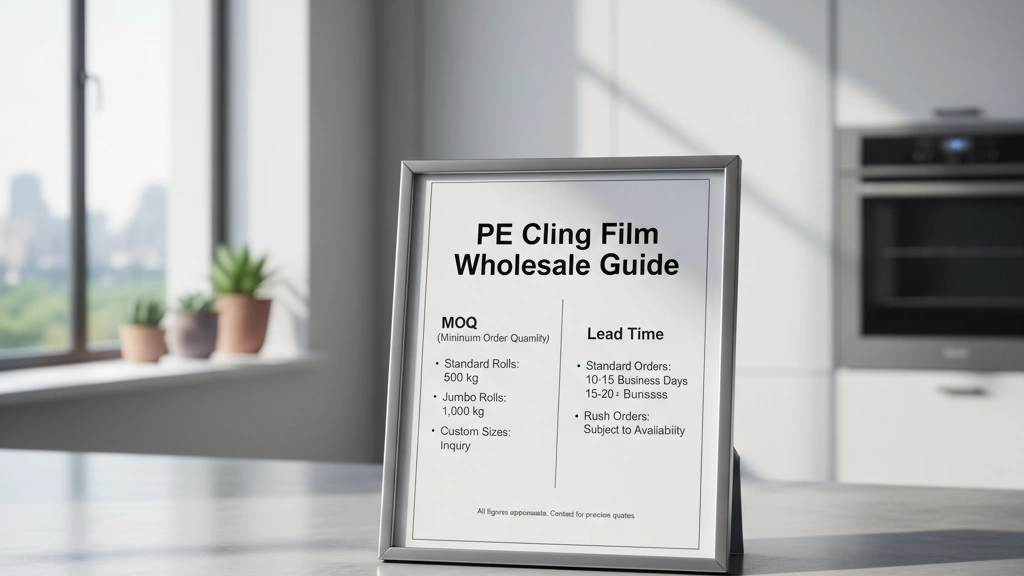
When you’re buying PE cling film wholesale in the U.S., your MOQ, lead time, and planning can make or break your margin. Here’s how I structure it with buyers so there are no surprises.
Typical MOQ Ranges (Factory vs Trading Company)
Most serious PE cling film manufacturers in China and Asia will set clear MOQ tiers:
- Standard, non-printed PE cling film
- Factory MOQ: 500–1,000 kg total (often mixed sizes allowed)
- By size/SKU: usually 200–300 rolls per spec
- Printed boxes / private label cutter box OEM
- Factory MOQ: 3,000–5,000 boxes per design
- Multiple languages or designs = higher combined MOQ
- Special thicknesses (like 9 micron, 12 micron, 15 micron)
- Often 1 ton+ per thickness to run efficiently
Trading companies sometimes accept lower MOQs (e.g., a few cartons mixed specs), but at higher price per roll and less control over production.
Standard Production Lead Times in 2025
For regular food grade PE cling film bulk orders, these are realistic timelines (after artwork approval and deposit):
- Repeat orders, standard specs, no printing
- 7–15 days production for <5 tons
- 15–20 days for 5–15 tons
- 20–25 days for full container (20–26 tons)
- Printed boxes / branding
- Plate-making & artwork: 5–7 days (one time)
- First order production: 20–30 days
- Peak seasons (Q2–Q4, pre-holiday shipping)
- Add 5–10 days buffer; resin and shipping can both slow you down
Transit to the U.S. (ocean) is separate:
- West Coast: about 2–3 weeks
- East Coast: about 4–5 weeks
How Customization and Printing Change MOQ and Timing
Custom specs are great for brand positioning, but they do lock in MOQs and longer lead times:
- Custom thickness / width / roll length
- Requires line changes and new packing setup
- Often 1–2 tons per spec as MOQ
- Custom printed cutter boxes and labels
- Higher MOQ per design because of printing cost
- Add 5–10 days vs plain boxes
- Special claims (microwave safe, freezer safe, high-clarity, “odor free”)
- Supplier must use specific resins/additives and often provide new test reports
- Expect longer sampling + approval time
If you’re pushing a private label cling film brand into supermarkets, build these steps into your timeline from day one.
Order Planning Around Sales Volume and Seasonality
For U.S. supermarket, restaurant, and foodservice distributors, I recommend a simple planning framework:
1. Know your real monthly run-rate
- Track rolls or kg sold per month by spec (e.g., “12 micron 30 cm supermarket roll,” “45 cm catering roll”).
- Base your orders on 3–4 months of average sales, not just last month’s spike.
2. Work backward from your required in-stock date
- Production: 15–25 days
- Sea freight: 20–40 days to the U.S.
- Customs + inland: 3–7 days
- Add a 7–10 day safety buffer
- In practice, place orders 60–90 days before you actually need stock in your warehouse.
3. Adjust for seasonality
- Pre-holiday (Thanksgiving, Christmas, New Year, July 4th, BBQ season):
- Expect higher usage from supermarket cling film roll wholesale and restaurant customers
- Place orders 1–2 months earlier than usual
- Off-season:
- You can stretch order cycles a bit, and sometimes negotiate better PE cling film wholesale price 2025 when resin is softer
4. Align order size with freight efficiency
- Full container loads (FCL) usually give you:
- Lower freight cost per kg
- Stronger price per roll from the factory
- If you’re still small:
- Combine multiple specs into one FCL
- Or build a PO plan to reach at least half-container so you don’t bleed on LCL freight
5. Keep safety stock, but don’t overstock
- PE cling film is stable, but:
- Ideal storage: cool, dry, away from direct sunlight
- For most SKUs, I suggest 2–3 months of safety stock in the U.S.
- Use FIFO so older film gets used first. Similar principles apply as with other food packaging like spoilage-preventing packaging strategies.
If you share your monthly volume, main specs, and target shelf coverage, I can help you map out a simple 12‑month order plan that balances MOQ, lead time, and cash flow.
Packaging, Cores, and Labeling Options for PE Cling Film Wholesale
When you buy PE cling film in bulk, the core, packaging, and labels matter almost as much as the film. They decide how easy it is for your team to use the rolls, how your shelves look, and how smoothly you move cartons through your warehouse.
Common Core Sizes and Materials
We supply PE cling film rolls on industry-standard cores that work with most supermarket dispensers and back-of-house holders.
Typical PE cling film roll core sizes
| Core Size | Common Use Case | Typical Width Range | Notes |
|---|---|---|---|
| 1.5″ (38 mm) | Household and light foodservice rolls | 11″–18″ (28–45 cm) | Lighter rolls, easy for hand use |
| 3″ (76 mm) | Supermarket dispenser & machine-grade rolls | 12″–24″ (30–60 cm) | Stronger core for heavy long rolls |
Core materials we use
- Paper core (most common) – cost-effective, strong enough for supermarket cling film roll wholesale.
- Water-resistant paper core – better for cold rooms, high humidity kitchens.
- Plastic core (on request) – for heavy-duty machine grade PE cling film roll and high-speed dispensers.
You can choose core color and printing (logo, length marks, production date) to help staff manage stock and trace batches, similar to how serious brands track quality issues in food storage bags.
Retail-Ready Packaging: Cutter Boxes, Sleeves, Shrink Wrap
For the U.S. market, retail packaging needs to be clean, strong, and easy to understand at a glance.
Main PE cling film packaging types
| Packaging Type | Ideal For | Key Advantages |
|---|---|---|
| Cutter box (OEM) | Supermarkets, club stores, online retail | Built-in blade, retail-ready, branding space |
| Sleeve + loose roll | Foodservice distributors | Lower packaging cost, fast repacking |
| Shrink-wrapped roll only | Back-of-house kitchen rolls | Minimal waste, simple, space-saving |
- Cutter box OEM – we offer custom printed cling film boxes with metal or plastic sliders; good for 12–18″ retail and restaurant cling film bulk buy.
- Plain or branded sleeves – best when you re-pack under your own supermarket food wrap distributor brand.
- Bulk shrink wrap – great for low-cost foodservice cling wrap wholesale where speed matters more than shelf impact.
Export Carton Standards and Palletizing
For PE cling film carton packaging, we design cartons to protect cores and blades during long transport and cross-docking.
Carton and pallet basics
- Carton strength: 5-layer export cartons for ocean freight; 3-layer for domestic-only shipments.
- Standard labeling: item name, thickness, width, length, roll count, net/gross weight, and lot/batch number.
- Palletizing:
- U.S. standard pallets (40″×48″) for FCL and LTL shipments.
- Stretch-wrapped and corner-protected to avoid box crush and deformation of rolls.
- Load plans: we optimize roll and carton count per pallet to cut freight cost per roll while keeping pallets forklift-safe.
Private Label, Barcode, and Branding Options
Most of our U.S. customers run private label cling film brands for supermarkets, restaurants, and distributors. We design packaging to plug directly into your system.
Private label options for PE cling film
- Brand design: you can supply print-ready artwork, or we create base layouts based on your brand guide.
- Barcode & identification:
- UPC/EAN barcodes on each cutter box.
- Master carton barcodes for warehouse scanning.
- Optional QR codes for recipes, safety info, or store apps.
- Regulatory text:
- “Microwave safe” / “freezer safe” statements (if the film spec supports it).
- Food-contact icons and disposal instructions.
- Clear material naming (e.g., “PE food wrap,” “LDPE cling film specifications”) to align with your compliance team.
- OEM supermarket cling film brand: we match your current box size, color tone, and claim language to keep shelves consistent with your existing food grade PE cling film bulk line.
If you also run private label bags or containers, we can align cling film branding and claims with your other food storage SKUs, similar to how we review safety claims for products like Ziploc-style food storage bags.
When you brief us, just tell us:
- Core size (38 mm or 76 mm)
- Roll width, length, and film thickness
- Packaging type (cutter box OEM, sleeve, shrink only)
- Branding level (full private label, co-brand, or neutral)
From there, we lock in a packaging spec that fits your shelf space, warehouse setup, and price point.
Top Buyer Questions Before Placing a Bulk PE Cling Film Order
When US distributors, supermarkets, and foodservice buyers talk to us about PE cling film wholesale, these are the questions that always come up before they place a bulk order.
Food‑grade proof and compliance
Before anything else, you should ask:
- Is the cling film FDA compliant for food contact (21 CFR)?
- Is it compliant with EU 10/2011 and local GB 4806.7 standards for PE film if you re-export?
- Can the supplier provide:
- Food-grade declaration / DoC
- Migration test reports
- Certificates (BRC, ISO 22000, ISO 9001 if available)
- Batch traceability for every production lot
I always recommend getting recent test reports (within 12–24 months) and checking that the tested thickness, resin type, and intended use (food wrap, microwave, freezer) actually match what you are buying. For more on what US and EU buyers should expect, our breakdown of food-contact certifications for plastic packaging is a good benchmark.
Custom thickness (including 9 micron) for cost control
US buyers are pushing hard on cost per roll without killing performance. Common questions:
- Can you make 9 micron, 10 micron, 11–12 micron PE cling film?
- What’s the minimum thickness that still works for:
- Supermarkets (produce, meat trays, deli)
- Restaurants and commercial kitchens
- Food processors and central kitchens
- How does thickness affect price per roll vs price per pound/kg?
- Can you run a few trial pallets of a thinner spec before we switch fully?
We usually lay out a simple comparison chart for 9–12 micron options so buyers can see how thickness affects roll yield, stretch, and breakage risk instead of just chasing the cheapest PE cling film wholesale price.
Real stretch rate and performance guarantees
You should get performance defined in numbers, not just “good stretch”:
- What is the stretch rate (%) under standard hand pull?
- How many wraps per roll can you expect vs your current brand?
- Is there a written spec sheet including:
- Thickness tolerance
- Width tolerance
- Roll length tolerance
- Cling level / self-adhesion description
- Will the supplier replace or credit rolls if:
- Stretch is far below spec
- Film keeps tearing or is off-gauge
- Cling is too weak or too aggressive
For serious supermarket and foodservice programs, I always recommend getting a performance guarantee in writing in the contract or PI, especially for machine-grade PE cling film where downtime is expensive.
Samples, lead time, and freight for samples
Before you commit to a container, clarify the sample terms:
- Are samples free? (Most of the time yes for standard specs, custom specs may charge film cost.)
- Who pays the freight?
- Small buyers often pay courier freight (UPS/FedEx).
- For ongoing partners, we usually ship free test rolls in the next shipment.
- Sample lead time:
- Standard spec: usually 3–7 days
- Custom thickness / width / core / cutter box: 7–15 days
- Mass production lead time after sample approval:
- Typically 15–30 days, depending on order size and season
If you’re buying for commercial kitchens or supermarkets, I suggest you test samples in real conditions (back-of-house, night shift, busy weekend) before locking in your long-term PE cling film bulk spec. Our article on commercial kitchen cling film rolls for wholesale walks through how operators usually test rolls on site.
Payment terms, deposits, and balance
US buyers want clear, low‑friction terms. The most common setups we see on PE cling film wholesale orders:
- For first orders / small buyers
- 30% deposit, 70% balance before shipment (T/T)
- Sometimes 100% T/T in advance for trial orders or small pallets
- For repeat / larger buyers
- 30% deposit, 70% against copy of B/L
- For big retail chains or long partnerships: L/C at sight or partial OA (open account) can be negotiated
- Make sure your PI clearly shows:
- Currency (usually USD)
- Trade term (FOB, CIF, or EXW)
- Bank details and who pays bank charges
My rule: never be shy about asking your PE food wrap manufacturer to spell out payment terms, late payment policies, and refund/credit rules before you sign. Clear terms up front save both sides from headaches once the container is on the water.
How to Choose a Reliable PE Cling Film Wholesale Supplier
Choosing the right PE cling film partner is where you protect your margin and your brand. Here’s exactly what I look for when I qualify a factory.
Key Green Flags: Signs of a Serious PE Cling Film Factory
Non‑negotiable good signals:
-
Own factory, not just a trader
- Clear factory address, photos, and video tours
- In‑house film blowing and rewinding lines
- Dedicated QA team and lab room
-
Solid certifications
- BRC / BRCGS for Packaging
- ISO 22000 / FSSC 22000 for food safety
- ISO 9001 for quality management
- SEDEX / SMETA for social compliance (nice plus for US retailers)
-
Professional documentation
- Up‑to‑date FDA, EU 10/2011, GB 4806.7 test reports
- COA (Certificate of Analysis) per batch on request
- Clear specs sheets for each cling film line
-
Export experience
- Can name current markets like US, Canada, EU, UK
- Knows FOB / CIF / DAP terms and US documentation needs
- Shares sample packing lists and previous shipment photos (with sensitive data hidden)
Red Flags: When to Walk Away Fast
Watch for these warning signs:
- Only offers very low prices and can’t explain how
- Can’t provide any valid food-contact reports
- Company name on website ≠ name on bank account
- Always avoids video calls or factory walk-through
- Sends blurry, outdated certificates or reports with:
- No lab name
- No test date
- No product name or model
- Won’t share basic details:
- Production capacity per month
- Lead time range
- MOQ structure
If 2–3 of these show up together, move on.
Why BRC, ISO 22000, SEDEX Audits Actually Matter
For food-grade PE cling film, third‑party audits are your safety net:
| Audit / Cert | What It Covers | Why It Matters for US Buyers |
|---|---|---|
| BRC / BRCGS Packaging | Hygiene, process control, traceability | Required or preferred by big grocery chains |
| ISO 22000 / FSSC 22000 | Food safety management | Reduces risk of contamination and recalls |
| ISO 9001 | Quality systems, documentation | More consistent roll-to-roll quality |
| SEDEX / SMETA | Social compliance | Helps with ESG, retailer onboarding |
If a supplier claims to serve major supermarkets or food brands, you should see at least BRC or ISO 22000 in place.
Why Factory Scale, Lab Gear, and Export History Matter
These three things tell you how stable the cling film supply will be.
Factory scale:
- Multiple extrusion lines (not just 1–2)
- Ability to run:
- Household rolls (e.g., 30 cm × 300–1000 ft)
- Foodservice/supermarket rolls
- Machine-grade rolls
- Enough capacity to handle promo spikes and seasonal demand
Lab equipment:
- Basic but important tools:
- Thickness gauge
- Tensile tester
- Haze / clarity meter
- Migration testing support via certified labs
- Can share real test data: stretch rate, tensile strength, haze %, etc.
Export history:
- 5+ years exporting food packaging (not just random plastics)
- Real references or case stories in retail, foodservice, or food processing
- Clear understanding of US import needs (labels, cartons, pallets, documentation)
For a broader look at how we manage food packaging projects end‑to‑end, you can see how we structure B2B food packaging solutions for international buyers on our site: B2B food packaging solutions for retailers and brands.
How to Vet a PE Cling Film Supplier Online (Before You Fly)
Do this homework before sending a big PO or booking a flight:
1. Website & company check
- Consistent company name, address, and contact across:
- Website
- Alibaba / industry platforms
- Product line focuses on PE cling film and food packaging, not “everything plastic”
2. Ask for proof up front
Request by email:
- Business license
- Recent BRC / ISO certificates (full PDF, not just a cropped logo)
- FDA / EU 10/2011 / GB 4806.7 test reports for PE cling film
- Standard spec sheets:
- Thickness / width / length
- Core size
- Roll weight
- Recommended use (household, catering, machine-wrap)
3. Run a video audit
- Live video call in the production area
- Ask to see:
- Extrusion lines
- Rewinding/packing area
- QC area and lab
- Raw material storage and finished goods warehouse
4. Start with a controlled trial order
- 2–3 SKUs that match your main demand
- Clear QC specs in writing:
- Thickness tolerance
- Core size tolerance
- Net length tolerance
- Stretch / clarity requirements
- Measure performance on your own lines and in real store/restaurant use
If a supplier is strong on certifications, lab data, stable pricing, and transparent communication, they’re usually worth building with long term—especially if you’re also buying related food packaging like wholesale plastic food storage bags from the same group to consolidate freight and supplier management.
Working with Established Manufacturers Like Artfullife
What long-term PE cling film specialists do differently
If you’re buying PE cling film wholesale, who you work with matters as much as the spec sheet. A long-term specialist like Artfullife is built around supermarket, restaurant, and food processor needs, not just “plastic film in general.”
Here’s what we do differently as a dedicated PE cling film manufacturer for the U.S. market:
- Focused material know‑how:
- We understand LDPE, LLDPE, and metallocene PE at a deep level and match blends to your exact use: supermarket trays, deli counters, commissary kitchens, or central processing.
- We design film for real-life tasks: high clarity for retail displays, stronger tear resistance for busy prep tables, and stable cling on cold or damp surfaces.
- Food-safety first:
- We prioritize food-grade resins, low-odor formulations, and migration-safe additives that meet FDA and EU 10/2011 requirements, as well as China GB standards.
- Our team is used to dealing with U.S. retailers’ documentation and audit expectations, so we build compliance into the product from the start.
- Consistency over “one-off deals”:
- We optimize for the same stretch, cling, and roll weight shipment after shipment, not just the lowest one-time quote.
- We run process controls so your “12 micron 30 cm supermarket roll” from this container behaves like the one you bought six months ago.
If you want more background on how we think about materials, our guide on the key materials used in commercial cling film explains how we choose and combine PE grades for food wrap performance: what are the key materials used in commercial cling film?
Advantages of in-house labs and multiple production lines
An established PE food wrap manufacturer with its own lab and several production lines can support you very differently than a small converter.
Key advantages you get with Artfullife:
- In-house quality lab:
- We run routine tests on:
- Thickness accuracy and uniformity
- Cling strength and stretch rate
- Transparency and haze
- Odor and basic migration checks
- This helps catch issues early, before they reach your warehouse or stores.
- We run routine tests on:
- Faster product development:
- Need a slightly thinner 9–10 micron film to reduce cost per roll?
- Need a tougher 13–14 micron film for heavy supermarket trays or bulk meat packing?
- With in-house R&D, we can trial, adjust, and lock in a new spec quickly instead of sending samples back and forth for months.
- Multiple production lines:
- Capacity buffer: If one line is down for maintenance, others can pick up the load to protect your lead times.
- Flexibility: We can run:
- Shorter, more customized private-label runs for regional chains.
- High-volume standard runs for national distributors and importers.
- Better slotting: We can schedule your peak-season orders (Thanksgiving, Christmas, summer BBQ season) across lines to avoid bottlenecks.
- Stable supply and backup options:
- We source resin from multiple qualified suppliers and adjust recipes without changing the performance spec you approved.
- That means less risk that a resin price spike or shortage suddenly impacts your supply.
How experienced suppliers support private label and OEM projects
For many U.S. retailers, club stores, and foodservice distributors, private label cling film is a key category. As a private label cling film factory, we handle OEM projects end to end, not just the film itself.
Here’s how we typically support OEM and store-brand projects:
- Product positioning and spec:
- Good-better-best structure:
- “Value” line: slightly thinner, cost-optimized PE cling film for price-sensitive shoppers.
- “Standard” line: balanced clarity, cling, and roll length for everyday use.
- “Premium/pro” line: stronger, smoother film with better stretch and clarity for heavy home users or professional kitchens.
- We advise on the right thickness, width, and roll length for your target retail price point and competition on U.S. shelves.
- Good-better-best structure:
- Packaging and branding:
- Custom cutter boxes with your branding, color scheme, and messaging.
- Core printing and stickers for quick SKU identification in back-of-house operations.
- Barcodes, nutrition-style info panels (where needed), recycling icons, and claims such as “microwave-safe” or “BPA-free” aligned with regulations.
- We understand OEM/ODM roles and can take the lead on design or work with your in-house team. For buyers comparing development models, our breakdown of OEM vs ODM for food packaging gives a clear view of how responsibilities are split: difference between OEM and ODM for food storage bag manufacturing.
- Compliance documentation under your brand:
- We provide FDA, EU 10/2011, GB 4806.7 test reports and declarations of compliance with your brand name and product code included where required.
- Batch tracking and traceability logs are set up so you can pass retailer or third-party audits.
- Market-fit and cost control:
- We help you adjust the spec over time as resin prices change or your sales data shows different store-level behavior (like high breakage in certain regions or higher usage in restaurant-heavy cities).
- We can offer more than one spec per brand: for example, a higher-grade “restaurant pack” and a lower-cost “home pack,” both under your private label.
What to ask on your first call or video audit with a factory
Your first call or video audit with a PE cling film manufacturer is your chance to filter real factories from middlemen and to see if they can match U.S. market expectations. Here are the questions I recommend you ask up front:
- Capacity and specialization:
- “What is your monthly capacity for PE cling film specifically (hand rolls and machine rolls)?”
- “What percentage of your production goes to supermarkets, restaurants, or food processors?”
- “Which main markets do you export to now? Do you already ship to the U.S. or North America?”
- Quality and certifications:
- “What food-contact standards do your PE cling films comply with (FDA, EU 10/2011, GB 4806.7)?”
- “Do you hold BRC, ISO 22000, or similar food packaging certifications?”
- “Can you show your in-house lab and testing equipment on video?”
- Product details:
- “What are your standard thickness and width ranges for:
- supermarket dispenser rolls,
- restaurant/catering rolls,
- machine-grade cling film?”
- “Can you produce custom specs such as 9 micron 30 cm x 300 m rolls or 12 micron 45 cm x 600 m rolls?”
- “What is your typical tolerance on thickness and roll length?”
- Private label and OEM capability:
- “Can you handle full private label projects: box design, barcode, and export carton layout?”
- “What is your MOQ for:
- standard spec with generic packaging?
- fully custom private-label packaging?”
- “Can you share examples of private-label brands you produce for (without breaking NDAs)?”
- Compliance and documentation:
- “Will you provide updated test reports (not older than 1–2 years) for food contact for each product family?”
- “How do you manage batch traceability and recall procedures?”
- “Can we get a signed declaration of compliance for our brand and SKU?”
- Pricing, terms, and logistics:
- “What are your 2025 PE cling film price levels for our target spec at 1×20’ FCL and 1×40’ FCL?”
- “What are your standard payment terms for new customers and for repeat customers?”
- “What are your normal lead times from deposit to shipment, and how does that change in Q4 or peak season?”
- Service and communication:
- “Who will be our day-to-day contact (export manager, key account manager)?”
- “How quickly do you typically respond to quality claims or urgent changes?”
- “Can we set up regular quarterly calls to review performance, costs, and upcoming orders?”
If a cling film supplier answers these questions clearly, shows you real production lines and QC processes on video, and can provide recent test reports, you’re dealing with a serious partner. That’s the baseline standard we operate at with Artfullife, and it’s what you should expect from any long-term PE cling film wholesale supplier serving the U.S. market.
Smart Ways to Save 15–30% on PE Cling Film Procurement
When I work with U.S. supermarket chains, food distributors, and restaurant groups on PE cling film, most savings don’t come from squeezing a few cents off the unit price. They come from smarter specs and smarter logistics. Here’s where you can realistically save 15–30%.
Use Full Container Loads Instead of LCL
Freight can easily add 5–15% to your PE cling film wholesale price if it’s not optimized.
If your volume allows it, always aim for FCL (full container load):
- Lower freight cost per roll/kg – The container cost is spread over more product.
- Less handling risk – Fewer touch points than LCL (less chance of crushed cartons or wet pallets).
- Faster and more predictable transit – LCL often sits longer at the consolidation warehouse.
When LCL still makes sense:
- First test order to check quality in your own stores.
- Highly customized SKUs where demand is uncertain.
- Regional distributors with limited warehouse space.
If you’re close to a full container but not quite there, I usually recommend slightly increasing roll length or adding a second core size (e.g., 38 mm and 76 mm) to top up to FCL and cut freight cost per unit.
Choose the Right Thickness, Not Just the Lowest Price
Many buyers default to “cheapest per roll,” but price per foot and performance per foot matter more.
Typical PE cling film thicknesses for the U.S. market:
- 8–9 micron – Light duty, low cost, good for light produce and short holding times.
- 10–12 micron – Standard supermarket and foodservice range.
- 13–15+ micron – Heavy duty, back-of-house use, meat trays, sharper edges.
How to save without hurting performance:
- For high-turnover items (fast moving deli, salad bars), you often can drop 1–2 microns and use a slightly narrower width to save 8–15% overall.
- For heavy or sharp products, going too thin increases breakage and re-wraps, which can quietly add 10–20% to your “real” cost per use.
I always suggest testing two thicknesses side by side in-store or in the kitchen for one week:
- Track wrap time, breakage, rewraps, and film used per tray or pan.
- Compare total usage cost, not just roll price.
Optimize Roll Length and Width to Cut Waste
The wrong roll size can silently drain your budget every single day.
Width optimization:
- Common U.S. widths: 11–12 in (28–30 cm), 15–18 in (38–45 cm).
- If staff always trim excess film, try:
- Dropping from 18″ to 15″ for many prep tables.
- Moving from 12″ to 11″ for smaller deli containers.
- Even a 0.5–1 inch reduction on big volume SKUs can save 3–7% on film usage.
Length optimization:
- Longer rolls (e.g., 1,000–2,000 ft vs 500 ft) reduce:
- Changeovers and downtime.
- Cardboard cores and box cost per foot.
- Freight and storage per foot of film.
For high-volume stores and commissaries, I recommend:
- Longer rolls on back-of-house dispensers.
- Standard or shorter rolls only for low-volume stations or small kitchens.
Use Seasonal Purchasing Strategies
PE resin and ocean shipping both move in cycles. You can use that to your advantage.
Resin price cycles (LDPE/LLDPE):
- Resin prices often rise before summer and around Q4 when demand spikes.
- If your cash flow and storage allow, pull forward 1–2 months of extra stock right before expected price hikes.
- Track basic LDPE/LLDPE resin trends to know when a quoted “increase” is real and when it’s just margin padding.
Shipping cycles:
- Freight rates usually jump ahead of major holidays (Chinese New Year, Golden Week) and U.S. peak seasons.
- Lock in bookings early for:
- Back-to-school.
- Thanksgiving/Christmas.
- Summer grilling season (big volume for meat and produce wrap).
By combining smart resin timing with smarter freight booking, my U.S. buyers often cut 10–20% off their annual cling film logistics cost.
For broader packaging cost strategy, some of our partners also look at aluminum foil and other food contact packaging; I’ve broken down how to think about long-term cost and sustainability in this aluminum foil packaging guide, which follows a similar logic.
Use Long-Term Contracts to Stabilize Price and Supply
If you’re a supermarket chain, distributor, or large foodservice group, ad-hoc orders almost always cost more.
What I recommend for serious buyers:
- 6–12 month supply contracts with:
- Monthly or quarterly release orders.
- Clear resin price adjustment formula (e.g., tied to ICIS/Platts LDPE index).
- Volume commitment in exchange for:
- Better film price per kg.
- Priority production slots in peak season.
- More flexible payment terms (e.g., 30–60 days after BL, once trust is built).
Benefits:
- You avoid sudden price spikes during tight resin or freight markets.
- We can plan raw material and production more efficiently, then pass some of that saving back to you.
- Your team spends less time re-negotiating small price changes and more time optimizing specs.
If you want to target a 15–30% saving on PE cling film, don’t just negotiate harder—adjust:
- Container load strategy
- Film thickness
- Roll dimensions
- Buy timing
- Contract structure
That’s where the real money is.
Inventory, Storage, and Handling Best Practices
Any serious PE Cling Film Wholesale Guide has to cover what happens after the rolls arrive. Even the best food grade PE cling film bulk order can lose performance if it’s stored or handled the wrong way.
If you’re focused on product freshness and display quality, I’d treat storage with the same importance as specs. We go deep on this in our own cling film preservation solutions for food businesses, but here are the practical basics for U.S. supermarkets, distributors, and foodservice buyers.
How To Store PE Cling Film Correctly
Keep PE cling film rolls in a clean, dry, temperature‑controlled area:
- Target temperature: 59–77°F (15–25°C), stable, away from ovens, HVAC outlets, and exterior doors.
- Keep humidity moderate; avoid damp corners that can damage cartons and cores.
- Store rolls off the floor on pallets or racking; never in direct contact with concrete.
- Protect from direct sunlight and strong UV to avoid aging, yellowing, and loss of stretch.
- Avoid stacking pallets too high; excessive weight can deform cores and cause telescoping.
Under good warehouse conditions, most PE cling film keeps best performance for 12–18 months from production. For long-term stock, ask your PE food wrap manufacturer in China or domestically for their recommended shelf life.
FIFO And Rotation For Supermarkets And Distributors
For supermarket cling film roll wholesale or distribution centers, FIFO (first in, first out) is non‑negotiable:
- Label every pallet and carton with production date, batch/lot, and thickness.
- Use simple color stickers or barcode labels so staff can spot oldest stock at a glance.
- Separate SKUs clearly (e.g., 12 micron 30 cm, 15 micron 45 cm) to avoid mix-ups.
- In stores, keep backup rolls behind the currently open carton so staff naturally rotate.
- Run a quick monthly check: flag any stock that’s close to its internal shelf life target.
Good rotation prevents “mystery cartons” sitting for years and keeps performance consistent across locations.
Temperature, Humidity, And Light Exposure
PE cling film is tough, but the wrong environment will slowly damage it:
- Heat: Storing rolls near steam tables, dishwashers, or walk‑in compressor vents can cause blocking (layers sticking together), loss of cling, and roll deformation.
- Cold: Very cold storage can make the film feel stiffer and less stretchable; let rolls warm up to room temp before use for best cling and clarity.
- Humidity: Wet or humid spots damage cartons and paper cores, causing rolls to jam in dispensers.
- Light: Strong sunlight or high UV can lead to discoloration and brittleness over time, especially on long‑stored stock.
Ideal zone: room temperature, low to moderate humidity, no direct sun, and away from strong heat sources.
Training Staff To Handle Rolls And Cutter Boxes
Even with perfect storage, poor handling can ruin good rolls. I train teams on a few simple rules:
- Carry, don’t drag: Never drag rolls or cartons; it crushes edges and causes uneven unwinding.
- Don’t drop rolls: Impact can crack cores, especially for PE cling film roll core size 76 mm used in machine or dispenser systems.
- Keep boxes clean and dry: Cutter boxes should stay off prep tables when spraying sanitizer or washing down. Moisture weakens the board and can rust metal cutters.
- Use cutters correctly: Show staff how to pull the film tight, then use the cutter in one smooth motion. This reduces film waste and keeps the blade from bending.
- Close the box after use: For retail and back‑of‑house, closing the lid protects the roll from dust, splashes, and accidental tearing.
- Designate storage spots: In kitchens and delis, assign a clear location for each carton so rolls don’t end up on hot equipment or window sills.
When you combine right storage conditions, strict FIFO, and basic handling training, your PE cling film performs closer to spec, waste drops, and you get more value out of every wholesale carton—whether you’re running a single restaurant or managing a multi‑state supermarket food wrap distributor network.
Order Checklist And Communication Tips For PE Cling Film Buyers
Getting PE cling film wholesale orders right comes down to clear, detailed communication. Here’s exactly what I recommend you send when you ask for a quote, plus a simple order template you can copy for your first bulk order.
Key Data To Include When You Request A Cling Film Quote
When you email or message suppliers, include these details up front. It saves days of back-and-forth and gives you a realistic PE cling film wholesale price for 2025.
- Basic product info
- Product: PE cling film / PE food wrap (not PVC, not stretch film for pallets)
- Application:
- Supermarket fresh food wrap (meat/produce trays)
- Restaurant / catering kitchen use
- Household retail (grocery store shelves)
- Machine-grade for automatic wrapping machines
- Food contact:
- Direct food contact, food-grade required
- Microwave safe? (yes/no)
- Freezer safe? (yes/no)
- Film specs (very important)
- Thickness:
- In micron (µm): e.g. 8 µm, 9 µm, 10 µm, 12 µm, 15 µm
- If you’re not sure, describe usage and ask for a suggestion (for US supermarkets, 10–12 µm is common; restaurants often use 10–15 µm)
- Width:
- Common: 11.8 in (30 cm), 15 in (38 cm), 17 in (43 cm), 18 in (45 cm)
- For US foodservice, 12″ and 18″ are typical
- Length per roll:
- Household: 30–100 ft (or meter equivalent)
- Foodservice: 500–3,000 ft (150–900 m)
- Material type:
- LLDPE, LDPE, or metallocene PE blend
- If you care about extra cling and clarity, mention “metallocene PE cling film preferred”
- Roll and core details
- Roll type:
- Hand roll (for manual use)
- Machine roll (for automatic wrapping machines)
- Core:
- Core diameter: 1.5″ (38 mm) or 3″ (76 mm)
- Core material: paper core / plastic core
- Core printing: plain, printed logo, or with usage arrows/text
- Packaging requirements
- For hand rolls / household:
- Cutter box or slide cutter box?
- Box material: white card / kraft / custom printed
- Retail barcode (UPC/EAN) needed? (yes/no)
- Languages on packaging (English only, English/Spanish, etc.)
- For foodservice:
- With cutter box, or core-only with separate cutters?
- Number of rolls per carton: e.g. 4 rolls, 6 rolls, 12 rolls
- Export packing:
- Palletized? (yes/no)
- Any special carton size limits for your warehouse racking?
- Compliance and safety
- Food contact standards you need:
- FDA compliant for food contact (US)
- EU 10/2011
- GB 4806.7 (China PE film standard)
- Certifications you want:
- BRC / BRCGS for packaging
- ISO 22000, HACCP, SEDEX, etc.
- Ask supplier to confirm:
- “Food-grade PE cling film, odor-free, suitable for direct food contact”
- Order quantity and pricing basis
- Quantity:
- Number of rolls (with exact specs)
- Or total weight (kg / lbs) if you buy by weight
- Target: sample order, trial pallet, LCL, or full container (20ft / 40ft)
- Shipping terms:
- FOB (which port, e.g. FOB Ningbo, FOB Shanghai)
- CIF (which seaport, e.g. CIF Los Angeles, CIF Houston)
- If you’re new to importing, ask for a CIF quote to your nearest port
- Target delivery:
- Required in-hand date at your warehouse
- Whether you can accept partial shipments
- Documentation and extras
- Documents needed:
- COA (Certificate of Analysis) per batch
- Food-contact test reports
- MSDS / SDS
- Branding:
- Private label cling film brand?
- Custom printed boxes and labels?
- Any color themes or design requirements?
- Payment:
- Your preferred terms (e.g. 30% deposit, 70% before shipment)
If you also care about broader cost trends and alternatives, you can review our insights on the cost-effectiveness of preservative film vs traditional packaging to help you benchmark your cling film pricing.
How To Brief Suppliers On Specs, Packaging, And Labeling
Keep your brief short but precise. Think like a purchase order, not a brochure.
- Be exact on specs
Instead of:
- “Need 12 micron cling film, quote please.”
Say:
- “PE cling film, 12 µm thickness, 30 cm width, 300 m length, hand roll, LLDPE+metallocene blend, food-grade for supermarket tray wrap, high clarity, strong cling.”
- Lock in packaging details
- “Each roll in printed cutter box with metal blade, 4 rolls per export carton, cartons palletized, stretch-wrapped, suitable for container shipping to the US.”
- “Retail boxes must include our logo, product name in English, usage icons, and a UPC barcode (we will provide the numbers).”
- Clarify labeling
- What must be on each:
- Roll core (if anything)
- Box (brand, size, thickness, usage, barcode, origin “Made in China”)
- Carton (item code, roll count, gross/net weight, batch/lot number)
- Mention regulatory needs:
- “Please ensure packaging claims line up with certifications (e.g. ‘Microwave safe’, ‘BPA free’, ‘Food contact safe’).”
- Confirm performance expectations
Write this in plain language:
- “Film must have strong self-cling, not too sticky for hands.”
- “Easy to cut on box blade, no excessive static.”
- “No strong plastic odor; suitable for US supermarket meat and produce.”
This helps the factory choose the right resin blend and processing settings.
Common Misunderstandings And How To Avoid Them
Here are the issues I see most often between US buyers and factories, and how to dodge them:
- Thickness confusion (micron vs gauge vs mil)
- Problem: You say “12 gauge” and factory thinks “12 µm” or vice versa.
- Fix:
- Always state thickness in microns (µm).
- If you know gauge or mil, write both: “12 µm (~0.47 mil).”
- Film type mix-up (PE vs PVC vs stretch film)
- Problem: Supplier quotes cheaper PVC or pallet stretch film.
- Fix:
- Write clearly: “PE cling film, not PVC, not pallet stretch film.”
- Mention “for food contact wrapping” to avoid pallet film confusion.
- Retail vs foodservice packing
- Problem: You want retail-ready cutter boxes; supplier sends bulk rolls in plain cartons.
- Fix:
- Clearly state: “Retail-ready cutter box with our branding” or “Plain carton, no box, for back-of-house kitchen use.”
- Hand roll vs machine roll
- Problem: You receive big heavy rolls that don’t fit your manual dispensers.
- Fix:
- Include: “Hand roll, max roll OD (outer diameter) ____ mm, core 3”.”
- “Microwave safe” assumption
- Problem: You assume all PE cling film is microwave-safe. Some blends may deform or not be tested.
- Fix:
- Ask for written confirmation: “Microwave-safe PE cling film, tested for food contact at microwave temperatures; provide related test report.”
- Price based on different specs
- Problem: Supplier offers a great price but quietly reduces thickness or length per roll.
- Fix:
- In your RFQ, lock specs and ask them to confirm:
- Thickness
- Width
- Length per roll
- Net weight per roll
- Ask for a datasheet and detailed quotation sheet specifying all of the above.
- In your RFQ, lock specs and ask them to confirm:
- Artwork and language mistakes
- Problem: Wrong spelling, wrong barcode, or claims that don’t meet US rules.
- Fix:
- Always require:
- Digital artwork proof (PDF/AI) before mass production
- Photo of first printed box off the line
- Approve in writing before they continue.
- Always require:
If you want a deeper view on cost and packaging strategy, our article on cost-effective alternatives to single-use plastics for B2B clients shows how different wrap formats affect your overall cost structure, which ties directly into how you brief your cling film specs.
Sample Order Structure For First-Time Wholesale Buyers
Use this as a template when you place your first bulk order or request a detailed quote. Just swap in your own numbers.
- Product details
- Product: PE cling film (food grade, odor-free)
- Application: US supermarket fresh meat and produce wrapping
- Thickness: 12 µm
- Width: 30 cm (11.8″)
- Length: 600 m per roll
- Material: LLDPE + metallocene PE blend
- Type: Hand roll for manual wrapping dispensers
- Performance: High clarity, strong cling, good tear resistance, microwave-safe and freezer-safe
- Core and roll
- Core ID: 3″ (76 mm) paper core
- Core: Plain brown, no printing
- Max roll OD: 140 mm (to fit existing dispensers)
- Packaging
- Inner:
- No retail box (for back-of-house use)
- Each roll wrapped in PE sleeve with simple product label (size, thickness, lot no., “Food Grade”)
- Outer:
- 6 rolls per export carton
- Printed carton with product info, brand, and barcode on outer carton (if needed)
- Cartons on pallets, stretch-wrapped, suitable for container loading
- Compliance and documentation
- Food-contact compliance:
- FDA (US) food contact for PE
- EU 10/2011 and GB 4806.7 (if available, for extra assurance)
- Documents required:
- COA per batch
- Food-contact test reports (migration test)
- MSDS/SDS
- Certifications:
- BRC / ISO 22000 / HACCP (please specify which you hold)
- Quantity and delivery
- Trial order:
- 1 x 20ft container equivalent (or specify number of cartons/rolls)
- Please advise max load for this spec in one 20ft container
- Shipping terms:
- CIF Los Angeles, USA (or your port)
- Lead time:
- Confirm production time after deposit
- Confirm estimated transit time to port
- Pricing request
- Please quote:
- Price per roll (USD)
- Price per kg (USD)
- Include all packaging costs
- Confirm:
- Validity of quote (e.g. 15–30 days)
- Payment terms: 30% TT deposit, 70% before shipment (or your standard)
- Sample confirmation
- Request:
- “Please send 3–5 sample rolls of this spec (or closest available spec) to our US address for testing before we confirm the full order.”
- Clarify who covers freight for samples, and whether sample cost can be deducted from bulk order.
If you use a structure like this, you’ll cut out 80% of misunderstandings, get cleaner quotes for PE cling film wholesale price 2025, and move from first conversation to confirmed order much faster.