
















Are you unsure whether to choose FOB vs CIF terms for ziplock bag orders?
Making the wrong choice on your shipping Incoterms can quietly eat away at your profit margins before the goods even arrive.
As a direct factory supplier with over 18 years of experience exporting to 140+ countries, Artfullife® knows that for bulk packaging orders, the devil is in the details.
In this guide, you’re going to learn the critical differences between these terms, uncover hidden destination fees, and determine which option secures the best landed cost for your business.
Let’s get your logistics sorted.
Understanding FOB (Free On Board) for Ziplock Bag Orders
When sourcing custom ziplock bags or bulk food storage solutions from overseas, understanding the shipping terms is just as critical as selecting the right material thickness. Under Incoterms 2020, FOB (Free On Board) is the standard term we use for most of our B2B and wholesale clients. Simply put, it draws a clear line in the sand regarding where our responsibility ends and yours begins.
Definition: Seller Loads, You Take Over
In an FOB agreement, the “Free On Board” designation means the risk transfers from us (the manufacturer) to you (the buyer) the moment the goods are loaded onto the shipping vessel at the named port of shipment, such as Shenzhen or Shanghai. This term is ideal for buyer control over shipping FOB, allowing you to leverage your own freight relationships.
Our Responsibilities as the Seller
As your manufacturing partner with over 18 years of experience, our role under FOB terms is comprehensive up until the cargo leaves the dock. We handle:
- Production & Quality Control: Manufacturing your order to spec (e.g., FDA-compliant PE, biodegradable resins) within our 20,000 sqm facility.
- Export Packaging: Ensuring cartons are palletized and secured for ocean transit.
- Export Clearance: Managing all documentation and customs procedures required to legally export the goods from China.
Your Responsibilities as the Buyer
Once the container is on the ship, the logistics baton passes to you. You are responsible for:
- Ocean Freight: Booking the vessel and paying the shipping line.
- Cargo Insurance: Protecting your investment against transit damage or loss.
- Destination Charges: Handling import duties, taxes, and drayage upon arrival in the US.
Real Talk: Why FOB Pricing Reflects Pure Product Cost
We often recommend FOB quotes from China suppliers because they offer the most transparency. When we provide an FOB price, you are paying strictly for the product cost—materials, labor, and packaging—without any hidden logistics margins. This model allows you to see exactly what you are paying for the bags themselves, ensuring you get the best value from our factory-direct pricing structure.
Understanding CIF (Cost, Insurance, and Freight)
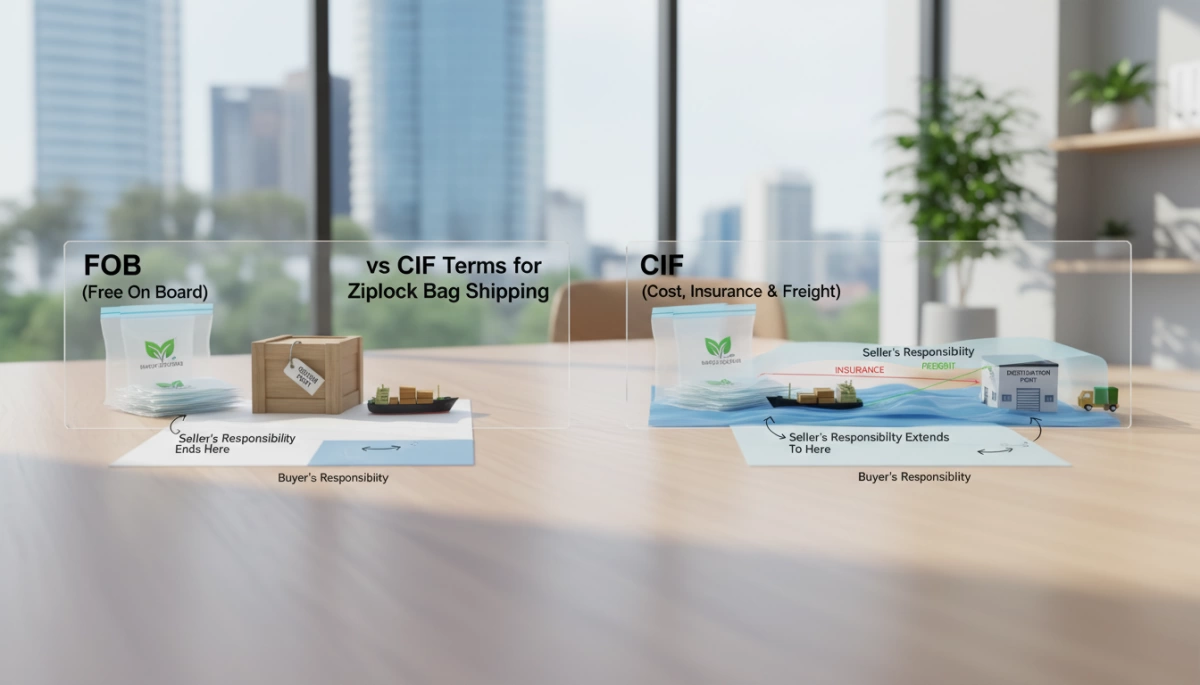
When you choose CIF terms for your packaging orders, you are essentially asking us to manage the logistics legwork until the cargo reaches your chosen US port. Under this Incoterm, the “Cost, Insurance, and Freight” price means we handle the export process from our facility, pay the ocean freight, and secure minimum insurance coverage. For new importers sourcing bulk eco-friendly food storage bags, this often feels like the path of least resistance because you do not need to hunt for a freight forwarder immediately.
Seller Responsibilities Under CIF
We take on the primary logistics burden to get the goods across the ocean. Our role includes:
- Production & Export: We manufacture your custom ziplock bags and handle Chinese export clearance.
- Freight Management: We book the vessel and pay shipping costs to the destination port (e.g., Long Beach or Newark).
- Insurance: We provide basic cargo insurance to cover risks during transit.
Buyer Responsibilities & The “Hidden” Costs
While CIF looks convenient on paper, the risk transfer changes the moment the ship docks. You are responsible for unloading, import customs clearance, and local delivery. A common pain point for US businesses is the arrival of CIF hidden fees destination charges. Local handling fees (THC) and documentation fees at US ports can sometimes be higher than expected because the seller’s freight forwarder often selects the destination agent, leaving you with little control over those specific costs.
The Reality Check: Freight Margins
Suppliers often prefer CIF because it gives them control over the shipping process and occasionally allows for a margin on freight rates. However, at Artfullife, transparency is key. Whether you choose FOB or CIF, we leverage our 18+ years of experience to ensure your retail packaging supplies arrive on schedule. We maintain a 99.97% on-time delivery rate, so if you prefer a hands-off approach, we can manage the shipping reliability while you focus on sales and distribution.
Head-to-Head Comparison: FOB vs CIF
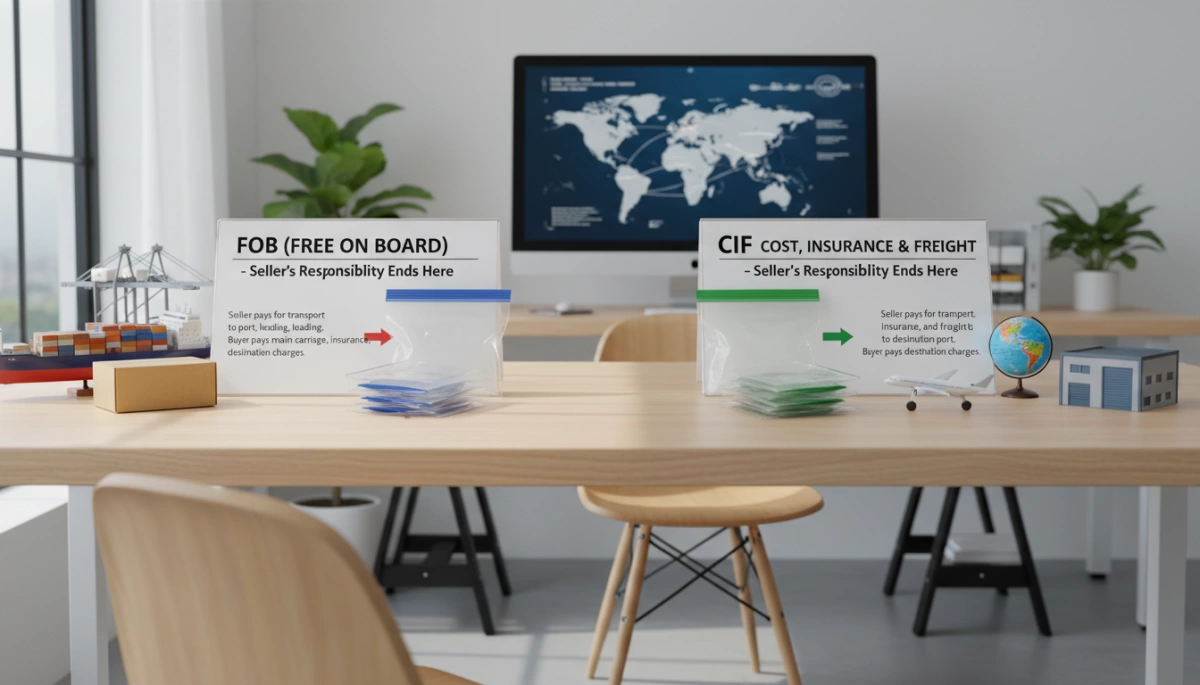
When sourcing bulk packaging, choosing between FOB vs CIF shipping costs impacts more than just the initial quote. It defines who controls the logistics and who bears the financial risk if something goes wrong on the water.
Side-by-Side Responsibility Table
Here is a breakdown of how we handle responsibilities under Incoterms 2020 for your ziplock bag orders:
| Responsibility | FOB (Free On Board) | CIF (Cost, Insurance, Freight) |
|---|---|---|
| Export Packaging | Seller (Us) | Seller (Us) |
| Loading at Origin Port | Seller (Us) | Seller (Us) |
| Ocean Freight Cost | Buyer (You) | Seller (Us) |
| Cargo Insurance | Buyer (You) | Seller (Us) |
| Risk Transfer Point | Once loaded on ship | Once loaded on ship |
| Unloading at Destination | Buyer (You) | Buyer (You) |
| Import Duties & Taxes | Buyer (You) | Buyer (You) |
Cost Breakdown: 20ft Container of Biodegradable Bags
Cost transparency is the main driver for large buyers. When you order a full container of our eco-friendly storage bags for supermarkets, the pricing structure changes significantly between terms.
- FOB Pricing: You pay us strictly for the manufacturing and transport to the Chinese port. You negotiate your own freight rates with a forwarder. This usually results in a lower total landed cost because you aren’t paying a supplier’s markup on shipping.
- CIF Pricing: We include the freight and insurance in the unit price. While this looks easier, it often hides a “convenience fee.” You lose visibility on exactly how much you are paying for the plastic versus the shipping.
Risk Transfer in Ocean Freight
Risk transfer in ocean freight is often misunderstood. Under both FOB and CIF, the risk of loss or damage technically transfers to you once the goods are loaded onto the vessel at the origin port.
- Moisture & Damage: Ziplock bags, especially biodegradable ones, are sensitive to humidity. Under FOB, you select the insurer and the coverage level, ensuring you are protected against moisture damage during transit.
- Claim Control: If goods arrive damaged under CIF, you have to rely on the insurance policy we purchased. Under FOB, you hold the policy, making the claims process faster and more direct.
Customs Duties: How CIF Inflates Your Tax Bill
Import duties are a percentage of the commercial invoice value. This is where Customs valuation on CIF value can get tricky.
- The CIF Trap: If the freight and insurance costs are bundled into the unit price of the bags without clear separation, customs authorities may assess duty on the entire CIF value. This artificially inflates your tax bill.
- The FOB Advantage: The commercial invoice clearly states the product value. You pay duties only on the actual cost of the goods, keeping your tax liability accurate and often lower.
- Hidden Fees: CIF shipments frequently arrive with surprise CIF hidden fees destination charges (like terminal handling charges) that the seller didn’t cover, causing delays at the port.
Which Term Is Better for Ziplock Bag Importers?

Deciding between FOB and CIF often comes down to your company’s infrastructure and how much control you want over the supply chain. As a manufacturer with over 18 years of experience exporting to the U.S. and Europe, we see distinct patterns in how our clients choose their terms.
Choose FOB for Cost Transparency and Volume Leverage
For established retailers and supermarkets, FOB (Free On Board) is generally the superior choice. This term gives you full buyer control over shipping FOB, allowing you to negotiate freight rates directly with your own forwarders rather than relying on our estimates. This transparency ensures you are paying the true market rate for shipping, not a marked-up price. When you are focused on finding OEM manufacturers for custom food storage bags, securing an FOB quote allows you to isolate the product cost from logistics expenses, making it easier to compare factory-direct pricing accurately.
Choose CIF for Minimal Coordination as a Beginner
If you are new to importing or running a smaller operation without a dedicated logistics team, CIF (Cost, Insurance, and Freight) removes significant friction. Under CIF, we handle the coordination of ocean freight and insurance until the goods reach your destination port. While this may result in a slightly higher total cost due to freight margins, it simplifies the process for best Incoterms for bulk packaging orders by reducing your administrative workload.
Why We Recommend FOB for Eco-Friendly and Reusable Bags
For high-value or specialized orders, such as those involving complex manufacturing processes for reusable silicone bags, we strongly lean toward FOB. Importing reusable ziplock bags from Asia often involves strict delivery windows and specific handling requirements. Managing your own freight ensures that you have direct oversight of the cargo’s movement, reducing the risk of delays that can occur when relying on a seller’s generic shipping line. Furthermore, consolidating FOB shipments allows for better eco-friendly bag procurement logistics, optimizing container space to lower the carbon footprint per unit.
| Buyer Profile | Recommended Term | Key Advantage |
|---|---|---|
| Large Retailers / Supermarkets | FOB | Maximum leverage on freight rates; total cost transparency. |
| Amazon FBA / Startups | CIF | “Hands-off” logistics; easier entry into importing. |
| Private Label Brands | FOB | Precise control over lead times and insurance coverage. |
Practical Tips for Bulk Orders
Requesting Both FOB and CIF Quotes
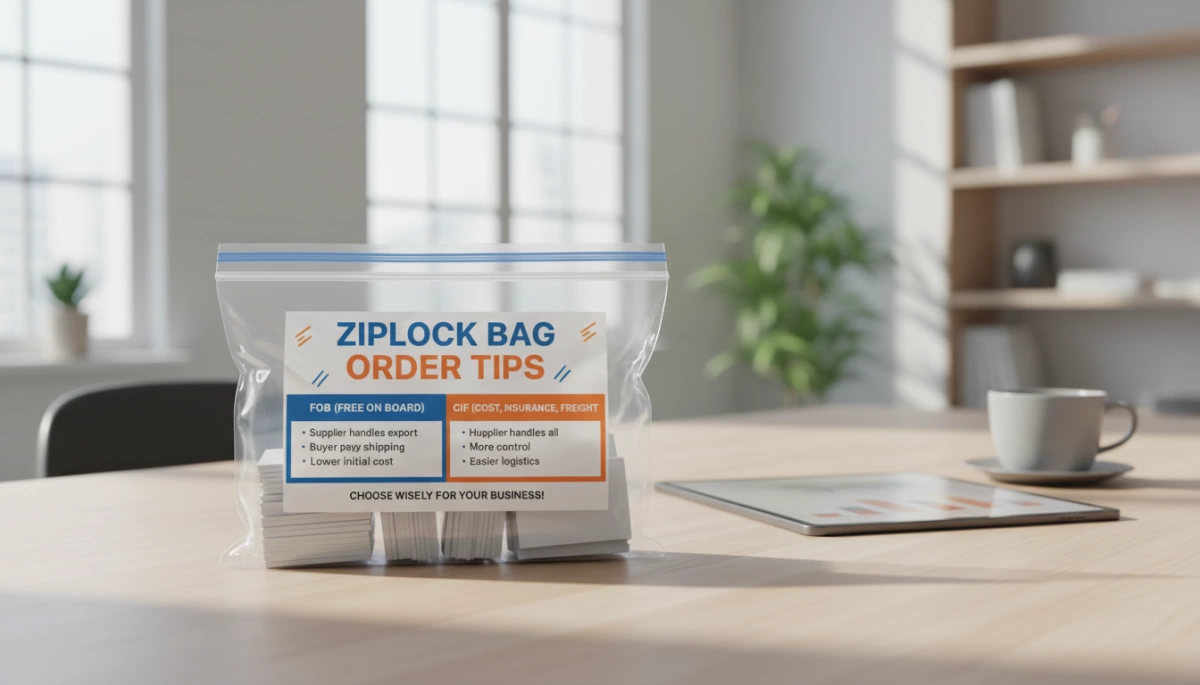
When sourcing from our factory, we always suggest B2B buyers request both quotes. Seeing the numbers side-by-side is the only way to audit the true cost of shipping. FOB vs CIF terms for ziplock bag orders often reveal that while a CIF price looks attractive initially, the freight margin added by suppliers can be higher than market rates. By comparing our factory-direct FOB pricing against a CIF offer, you can determine if you are paying a premium for the convenience of having us handle the shipping.
The Role of Freight Forwarders in FOB Terms
For established US importers, taking control via FOB is usually the smarter play. Using your own freight forwarder role in FOB terms gives you direct leverage over the shipping schedule and carrier choice. Since we maintain a 99.97% on-time delivery rate, handing the goods off to a forwarder you trust ensures that the efficiency we achieve on the production floor extends all the way to your warehouse dock. This is critical for coordinating seasonal inventory or urgent restocks.
Avoiding Pitfalls: Destination Charges and Insurance Gaps
Be wary of the “hidden” costs associated with CIF. A common issue for beginners is CIF hidden fees destination charges; once the cargo arrives at a US port, the local handling fees can be inflated if the shipper used a budget carrier to lower the CIF price. Additionally, ensure your insurance policy is explicit. Standard clauses might not cover specific damages, such as moisture affecting the integrity of biodegradable resins or packaging aesthetics.
Sustainability Angle: Efficient Logistics
Optimizing your logistics isn’t just about cost; it’s about carbon footprint. Consolidating orders—for example, combining standard PE sliders with eco-friendly silicone pouches—allows you to maximize container space. Eco-friendly bag procurement logistics rely on maximizing pallet density to reduce the energy used per unit shipped. We help clients plan these loads to ensure every cubic meter is utilized effectively.
Frequently Asked Questions
Is FOB always cheaper than CIF for ziplock bags?
Generally, FOB quotes from China suppliers offer a lower landed cost for experienced buyers. When we quote FOB, you get our transparent factory-direct price without any hidden logistics margins. Under CIF, suppliers often add a buffer to the freight cost to protect against fluctuating shipping rates. If you have a reliable logistics partner, managing the freight yourself (FOB) usually saves money on the final invoice.
What happens if damage occurs during transit?
This depends entirely on the risk transfer in ocean freight.
- CIF: We (the seller) hold the risk until the goods reach your destination port. We provide minimum insurance coverage, so if pallets arrive wet or crushed, you claim against our policy.
- FOB: The risk transfers to you once the bags are loaded on the vessel in Shenzhen or our local port. You must secure your own cargo insurance.
- Our Standard: Regardless of the term, we use heavy-duty export cartons to protect your custom-printed or vacuum seal bags, minimizing damage risks significantly.
Can I switch from CIF to FOB mid-negotiation?
Absolutely. We understand that logistics strategies change. If you initially requested a CIF price but found a better rate with your own forwarder, we can easily adjust the contract to FOB terms. It is common for buyers to compare the total landed cost of a dedicated bag order or a mixed container containing standard aluminum foil sizes before finalizing the Incoterm.
How do Incoterms affect lead times?
The Incoterm does not change our production speed; we maintain a 7–10 day turnaround for most custom orders. However, Incoterms for plastic bag imports do affect the shipping timeline:
- FOB: You control the schedule. You choose the fastest vessel or the most economical route.
- CIF: The seller chooses the freight line. While we aim for the most reliable carriers to maintain our 99.97% on-time delivery rate, we might prioritize cost over speed unless specified otherwise.