
















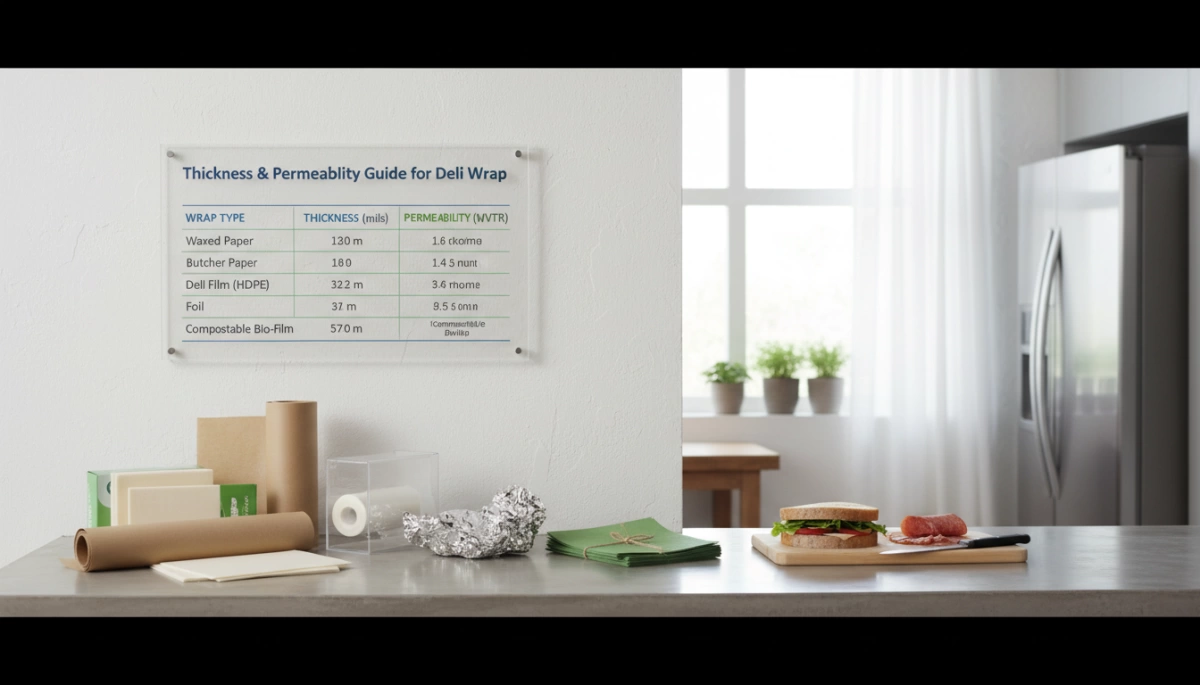
Understanding Deli Wrap Thickness & Permeability
If you run a deli, cafe, or food truck, your wrap isn’t “just plastic” or “just paper.” It quietly decides whether your sandwiches arrive fresh and appetizing or soggy and greasy. That’s why we take deli wrap thickness and permeability so seriously in our PE cling film factory.
What Deli Wrap Actually Does for Your Food
A good deli wrap should:
- Protect – stop dirt, handling, and cross-contamination
- Hold moisture where you want it – keep meats, cheeses, and bread from drying out
- Control grease – reduce visible grease bleed and mess
- Manage oxygen – slow down oxidation, browning, and off-flavors
- Handle temperature – from refrigerator and prep line to short reheating and delivery
Our PE cling film is designed to give you a tight seal, clear visibility, and reliable barrier without sticking to the food or tearing during busy service.
Why Thickness and Permeability Matter Together
Thickness and permeability work as a pair. You can’t really judge one without the other:
-
Thickness (how “heavy” or “thin” the film feels) affects:
- Strength and puncture resistance
- How easy it is to wrap and cling
- How much barrier you get against oxygen and moisture
-
Permeability (how easily oxygen and water vapor pass through) affects:
- Shelf life – slower oxygen transfer = better oxygen barrier food packaging
- Moisture control – prevents bread from drying out or getting soggy
- Steam management – crucial for hot foods and takeout
In our deli wrap thickness guide, we dial in micron thickness for deli film so you get enough barrier to protect food, but enough breathability to avoid trapped steam and condensation.
Key Specs You’ll See on Deli Wrap Packaging
When you look at a roll or box of deli wrap, watch for these core specs:
-
Thickness
- Listed in microns (µm) or gauge
- Thinner films: better cling, lower cost, ideal for quick-turn sandwiches
- Thicker films: more durable, better for stacked, heavy, or greasy items
-
Oxygen Permeability / OTR
- OTR (Oxygen Transmission Rate) = how much oxygen passes through a square meter of film in 24 hours
- Lower OTR = stronger oxygen barrier = better for deli meats, cheese, and cured meats
-
Moisture / WVTR
- WVTR (Water Vapor Transmission Rate) = how much water vapor moves through the wrap
- Lower WVTR = better moisture barrier, great for juicy, greasy, or high-moisture foods
-
Temperature Range
- Safe use in refrigerated, room temp, or brief heat exposure
- Important for takeout wrap for fried foods and hot sandwiches
When we design our PE cling film for deli needs, we balance thickness, OTR, WVTR, and handling so you get a practical, everyday wrap that’s strong, clear, and consistent across your entire operation.
Types of Deli Wraps and Materials
Paper-Based Deli Wraps (Dry-Waxed, Greaseproof, Parchment)
Paper deli wraps are popular for sandwiches, burgers, fries, and baked goods when you want a breathable food wrap with decent grease resistance.
-
Dry-waxed deli paper
- Thin paper coated with a light wax layer
- Great for burgers, fries, and hot sandwiches
- Handles grease well but still lets a bit of steam escape
- Common GSM range: 25–40 GSM for standard use, higher GSM for heavy duty deli paper for burgers
-
Greaseproof paper
- Special paper that resists oil without a heavy coating
- Good for pastries, cookies, and light fried foods
- Better greaseproof deli paper GSM usually means stronger, less bleed-through
-
Parchment paper
- Silicone-coated, smooth, and heat-resistant
- Used more for baking and reheating than basic wrapping
- Has higher moisture control for baked goods packaging and doesn’t stick
Paper wraps are usually more breathable than plastic, so oxygen permeability and water vapor transmission rate (WVTR) are higher. That can be a plus for foods that shouldn’t steam and go soggy.
Plastic Films (PE, PVC, PP) and When They Make Sense
As a PE cling film factory, this is our core: plastic deli films for when you need a tighter seal and stronger barrier.
-
PE (polyethylene) cling film
- Most common food wrap in U.S. delis and kitchens
- Flexible, strong, and safe across a wide temperature range
- Available in multiple micron thickness for deli film (typically 8–15 microns for standard cling, thicker for heavy-duty)
- Lower oxygen permeability than paper, so it works well for short-term freshness and display
-
PVC (polyvinyl chloride) film
- Very clear and clingy, good for meat and cheese display
- Strong stretch and tight seal
- Used when cling film oxygen permeability balance matters for shelf appeal and short-term storage
-
PP (polypropylene) film
- Stiffer and clearer, often used in bags or wraps for baked goods
- Lower water vapor transmission rate for wraps, so it’s great for keeping items from drying out
Plastic films make sense when you need:
- Better oxygen barrier food packaging
- Stronger puncture resistance
- Cleaner presentation on the counter or in the cooler
Eco-Friendly and Compostable Deli Wraps
Eco options are growing fast in the U.S. market, especially for brands that care about sustainable deli packaging solutions.
Common types:
- Compostable film wraps (PLA, other bioplastics)
- Look and feel similar to clear plastic
- Good for compostable deli wrap permeability where a moderate barrier is enough
- Biodegradable sandwich wrap options from coated paper
- Grease-resistant papers with plant-based coatings
- Often industrially compostable, sometimes recyclable depending on local rules
- Reusable food wrap alternatives
- For customers bringing their own containers or wraps, you can pair your service with portable stainless steel lunch boxes with thermal bags for repeat-use takeout systems: portable stainless steel lunch box with thermal bag guide
These eco wraps don’t always match plastic’s barrier, but they’re improving fast and usually work well for sandwich wrap thickness needs, baked goods, and light deli items.
How Material Choice Impacts Thickness & Permeability
Material choice is just as important as thickness. A thin plastic wrap can sometimes outperform a thicker paper on barrier.
-
Paper-based wraps
- Usually higher OTR (oxygen transmission rate) and WVTR, meaning more “breathable”
- Thickness is often measured in GSM, not microns
- Better for foods that need to vent steam or stay crisp
-
Plastic films (PE, PVC, PP)
- Measured in microns or gauge
- Lower OTR and WVTR at the same thickness vs paper, so better for short-term oxygen barrier food packaging
- Ideal for cold deli, cheese, meats, and display where your food wrap permeability ratings matter
-
Eco & compostable wraps
- Often kept thin to reduce material use
- Use smart coatings or multi-layer structures for barrier instead of just more thickness
- Good balance for operators who want recyclable food service wrap style performance without traditional plastics
In short: if you need stronger barrier and tighter temperature control, PE cling film or other plastic films are the most reliable. If you need breathability and presentation for hot or crisp foods, a waxed vs unwaxed deli paper choice often works better.
Thickness Guide for Deli Wrap
When we talk about deli wrap thickness, we’re really talking about how tough the wrap is, how it handles, and how it protects your food. For PE cling film and deli paper, here’s how I look at it.
How Thickness Is Measured (Microns, Gauge, GSM)
- Microns (μm) – Most common for PE cling film.
- 1 micron = 0.001 mm
- Gauge – Older term in plastics. Roughly:
- 100 gauge ≈ 1 micron (varies by region, but this is a simple rule of thumb)
- GSM (grams per square meter) – Used for deli paper (greaseproof, waxed, parchment).
- Higher GSM = thicker and stronger sheet.
If you’re buying cling film for export or large-volume use, you’ll see microns listed on the spec sheet, similar to how food wrap for export packaging is standardized.
Light, Medium, and Heavy-Duty Thickness Ranges
For PE deli cling film (typical US foodservice ranges):
- Light-duty:
- 8–10 microns
- For quick covers, light sandwiches, produce, bakery display.
- Medium-duty:
- 10–14 microns
- Everyday deli use, wrapped sandwiches, sliced meats for same-day service.
- Heavy-duty:
- 14–20 microns+
- Stacked burgers, loaded sandwiches, sharp bones, takeout and transport.
For deli paper, most shops use:
- Light: ~25–30 GSM (liners, bakery items)
- Medium: ~30–40 GSM (standard sandwich wrap)
- Heavy: 40+ GSM (greasy burgers, fried food, bone-in items)
How Thickness Affects Strength and Handling
As thickness goes up, you get:
- More strength and puncture resistance – Better for sharp crusts, bones, toothpicks, and overloaded sandwiches.
- Less tearing and stretching – Faster wrapping on a busy line; fewer wasted sheets.
- More structure – Heavy-duty film and paper hold shape better in baskets, clamshells, or paper boats.
But thicker film also means:
- Slightly less cling and flexibility compared to ultra-thin film.
- Slightly higher cost per use, so it needs to match your menu.
When Thinner Deli Wrap Is Actually Better
Thinner isn’t always cheap—it’s sometimes smarter:
- Fresh produce and herbs – A thinner, more breathable sandwich wrap thickness helps reduce sweating and mushy texture.
- Short-hold deli items – Same-day sandwiches and display items don’t need heavy-duty barrier.
- High-volume operations – Thin film rolls last longer per case; faster to handle for simple wraps and covers.
- Tight clinging – Ultra-thin micron cling film grabs containers and pans better, which is ideal for prep tables and line stations.
If you tell me your main menu items and whether they’re hot, greasy, or stored cold, I can suggest a specific micron thickness for deli film that balances cost, strength, and performance for your operation.
Permeability Guide for Deli Wrap
What oxygen, moisture, and grease permeability really mean
When we talk about deli wrap permeability, we’re really talking about how easily three things pass through the wrap:
- Oxygen permeability: How much air (oxygen) can move in and out.
- Low oxygen permeability = better oxygen barrier food packaging for meats, cheese, and anything that spoils or oxidizes.
- Moisture permeability: How much water vapor moves through the wrap.
- This controls sogginess vs dryness. Too tight and food sweats. Too open and it dries out.
- Grease permeability: How much fat and oil can soak through.
- For greasy sandwiches, burgers, and fried food, you want strong greaseproof deli paper so the bag or tray doesn’t turn into an oily mess.
For PE cling film, we usually target low oxygen and moisture permeability, while keeping the film thin enough to still handle steam and temperature shifts.
OTR and WVTR in simple terms
If you look at food wrap permeability ratings, you’ll see two specs a lot:
-
OTR (Oxygen Transmission Rate)
- Measures how much oxygen passes through a specific area of film in 24 hours.
- Lower OTR = stronger oxygen barrier.
- For deli meats, cheese, and cured products, a low OTR cling film keeps color, flavor, and shelf life stable.
-
WVTR (Water Vapor Transmission Rate)
- Measures how much water vapor passes through in 24 hours.
- Lower WVTR = better protection from drying out.
- Breads and baked goods sometimes need a balanced WVTR so they don’t sweat and get soggy.
For large buyers, we’ll usually match PE cling film micron thickness to target OTR and WVTR ranges that fit your menu and storage time.
How coatings change permeability (wax, silicone, plant-based)
With paper wraps, permeability is heavily affected by coatings:
- Waxed deli paper (dry-waxed or wet-waxed)
- Better grease resistance rating, moderate moisture barrier.
- Great for burgers, sandwiches, and fried foods that need heavy duty deli paper without sticking.
- Silicone-coated paper
- Nonstick, resistant to grease, handles higher heat.
- Good for hot-pressed sandwiches and reheats.
- Plant-based coated or compostable deli wrap
- Uses bio-based coatings for oil and moisture resistance.
- Permeability is tuned so food doesn’t suffocate, which is key for compostable deli wrap permeability.
Plastic films like PE don’t use surface coatings the same way. We design barrier by resin choice, film thickness, and multi-layer structure, similar to other multi-layer food wrap barrier solutions used in supermarkets, as you see in our cling film requirements for supermarket chains.
Permeability needs for short-term vs long-term holding
Permeability needs shift a lot depending on how you run your operation:
-
Short-term holding (minutes to a few hours)
- Food trucks, delis, quick-service:
- You want wraps that manage steam venting in hot food wraps and avoid sogginess more than you need ultra-low OTR.
- Slightly “breathable” wraps help hot sandwiches and fried foods stay crisp.
-
Long-term holding (hours to days)
- Prep lines, grab-and-go, chilled cases:
- You need lower OTR and WVTR to protect deli meats, cheese, and cut produce.
- Here, PE cling film with controlled oxygen permeability and proper micron thickness performs better than plain paper.
Our PE cling film factory can dial in thickness, OTR, and WVTR so your wrap matches real-world use: fast turnover service, overnight storage, or chilled display—without overpaying for barrier you don’t actually need.
How Thickness Affects Permeability in Deli Wraps
Why thicker wrap blocks more oxygen and moisture
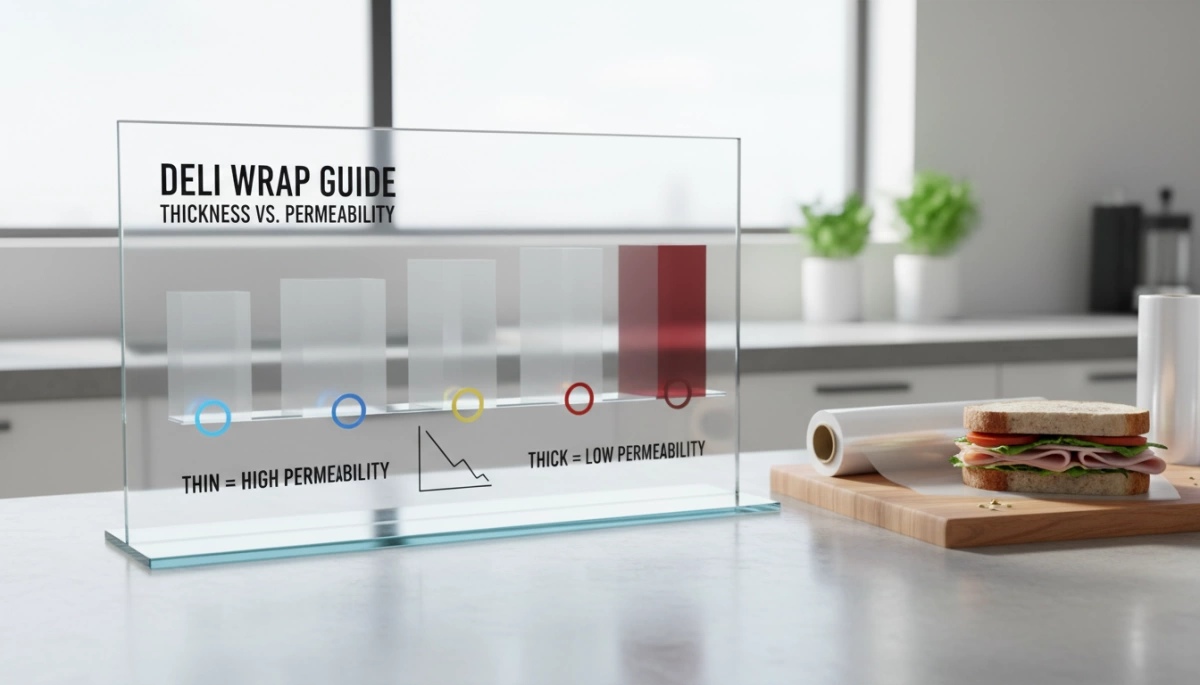
With deli wraps, thickness and permeability always move together. In general:
- Thicker PE cling film (micron thickness for deli film) = lower oxygen transfer and lower water vapor transmission (WVTR). That means:
- Better oxygen barrier food packaging
- Less moisture loss and less drying out
- Thicker film also gives better:
- Grease resistance
- Puncture resistance for stacked sandwiches, subs, and wrapped meats
That’s why for higher-value items or longer holding times, I usually recommend a medium to heavy-duty sandwich wrap thickness instead of the thinnest option.
When too much barrier becomes a problem
You can absolutely “over-wrap” food:
- Hot food in a very low OTR, low WVTR wrap traps steam
- Steam turns into condensation, leading to:
- Soggy bread and buns
- Sweating cheese and deli meats
- Texture loss on fried or crispy items
In those cases, a slightly thinner film or a more breathable structure works better so moisture can escape instead of flooding the food.
Real examples: cold sandwiches, hot burgers, chilled meats
Here’s how I look at thickness and permeability by use:
-
Cold sandwiches & wraps
- Medium thickness PE film for moderate oxygen barrier
- Keeps bread soft without trapping extra moisture
- Great for grab-and-go, same-day or next-day service
-
Hot burgers, greasy sandwiches, fried food
- Too-tight, thick film = fogging, sweating, soggy buns
- Better: combine greaseproof deli paper or heavy duty deli paper for burgers with a properly vented or slightly thinner film
- Allows steam venting in hot food wraps while still catching grease
-
Chilled meats & cheeses
- Need low OTR wrap for cured meats and sliced cheese
- Slightly thicker PE film or multilayer structure keeps oxygen out and slows drying
- Works well with secondary overwrap or bags from wholesale plastic food storage suppliers and global cling film export logistics support if you’re scaling nationally
How eco wraps balance thin material with barrier
Eco and compostable deli wrap permeability is a little different. Many eco-friendly deli packaging materials are:
- Thinner than traditional plastic film
- Engineered with coatings or blends (plant-based, waxed vs unwaxed deli paper) to boost barrier
- Designed to breathe slightly so hot items don’t turn soggy instantly
In practice, that means:
- You may use a thinner eco wrap but still get solid moisture and grease control
- For high-grease or long-hold items, I often pair eco paper wraps with a PE overwrap to balance:
- Barrier performance
- Presentation
- Sustainability goals for U.S. customers looking for sustainable deli packaging solutions
Best Thickness & Permeability by Food Type
As a PE cling film factory, I look at deli wrap thickness and permeability very differently depending on what you’re wrapping. Here’s how I’d match thickness, temperature, and oxygen permeability to the most common deli and foodservice uses in the U.S.
Deli meats and cheeses: ideal barrier levels
For sliced deli meats, cured meats, and cheeses, you want medium-thickness PE cling film with a low oxygen transmission rate (OTR) and solid moisture barrier.
- Recommended thickness: 12–18 microns (0.47–0.70 mil) PE cling film
- Permeability:
- Low OTR to slow oxidation and color change
- Low WVTR (water vapor transmission rate) to prevent drying out
- Use case: Short-term storage in the deli case, sandwich prep, and overnight holding
- Tip: For high-value cheeses or cured meats, pair cling film with paper or trays for extra protection and presentation.
For operators looking to reduce plastic, pairing cling film with durable, reusable food containers is a smart move for back-of-house storage and portioning.
Greasy sandwiches, burgers, and fried foods
Burgers, fried chicken sandwiches, and loaded subs need grease control plus enough breathability so they don’t steam into a soggy mess.
- Recommended wrap:
- Grease-resistant paper + PE cling film band, or
- Heavy-duty PE cling film with venting if packed hot
- Thickness:
- Paper: 30–45 GSM greaseproof
- Film: 15–20 microns for heavy-duty, tight wrap
- Permeability:
- Strong grease resistance rating
- Slight breathability or venting to let steam escape for hot fried items
- Use case: Takeout, food trucks, burger joints, late-night to-go orders
Baked goods and pastries that shouldn’t go soggy
Cookies, croissants, muffins, and pastries need moisture control more than a hard oxygen barrier. Too tight a wrap and they sweat; too loose and they stale fast.
- Recommended wrap: Light to medium PE cling film or paper + film combo
- Thickness: 10–14 microns PE for pastry wrap
- Permeability:
- Moderate WVTR so excess moisture can escape
- Not fully “airtight” to avoid condensation on delicate toppings
- Use case: Bakery cases, display racks, café grab-and-go
Pairing film with reusable or stainless steel containers in the back-of-house can keep bulk-baked goods fresher longer while cutting down on disposable packaging.
Fresh produce that needs to breathe
Cut produce, herbs, and fresh greens need breathable food wrap so they don’t suffocate or rot.
- Recommended wrap: Thinner PE film or perforated deli sheets
- Thickness: 8–12 microns for high-breathability use
- Permeability:
- Higher OTR so produce can “breathe”
- Controlled WVTR to prevent wilting but avoid trapped condensation
- Use case: Prep tables, salad stations, fresh-cut fruit cups, herb bundles
Hot foods and takeout wraps for heat and steam
For hot sandwiches, breakfast wraps, and takeout items coming off the line, you’re dealing with temperature + steam at the same time.
- Recommended wrap:
- Paper + PE combination, or
- Heavy-duty PE cling film with intentional venting
- Thickness:
- Film: 15–20 microns for heat resistance and strength
- Paper: 35–50 GSM for structure and hand feel
- Permeability:
- Enough barrier to keep heat and moisture in for short delivery times
- But with venting or partial wrap to avoid extreme condensation and soggy bread
- Use case: Takeout, delivery, busy lunch rush, food trucks
If you’re exploring sustainable deli packaging solutions, focus on wraps that balance thinner material with solid grease and moisture control, especially for hot and fried items, so you don’t sacrifice performance while cutting plastic.
Traditional vs Eco Deli Wraps: Thickness & Permeability Guide
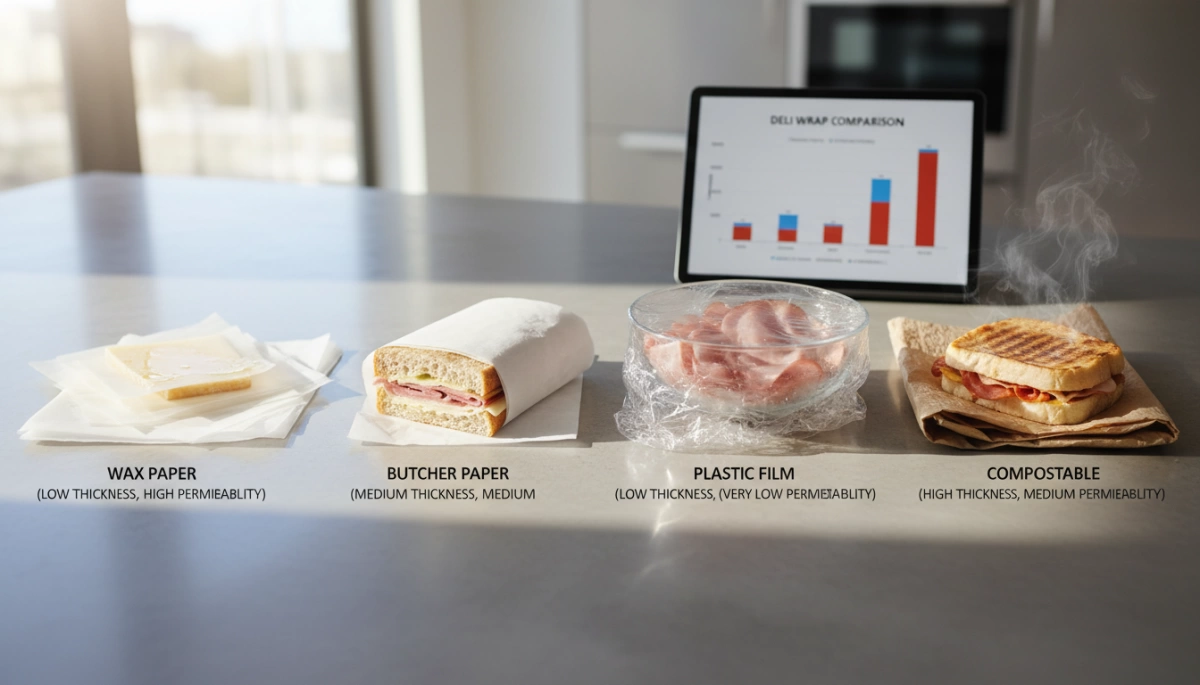
When you’re choosing deli wrap for a busy U.S. operation, it really comes down to plastic film vs paper, and how each one handles thickness and permeability (oxygen, moisture, and grease).
Plastic Film vs Paper Wraps (Barrier & Thickness)
As a PE cling film factory, I look at three things first: micron thickness, oxygen barrier, and grease resistance.
Plastic film (PE, PVC, PP)
- Typical thickness: 8–20 microns for deli and sandwich wraps
- High oxygen barrier (especially PVC/PP), great for cured meats and cheese
- Very low WVTR (water vapor transmission rate) – slows moisture loss and keeps food soft
- Naturally greaseproof, no coatings needed
- Cling-style PE wrap gives tight seal and strong puncture resistance
Paper-based deli wraps (waxed, greaseproof, parchment)
- Typical thickness: 25–45 GSM for standard deli sheets, higher for heavy-duty burger paper
- Oxygen barrier: low to medium, depends on wax/silicone coating
- Moisture barrier: good for grease, weaker for water vapor over long holds
- Better breathability, so less condensation on hot or toasted items
If you’re running delivery or longer holds (paired with insulated or leakproof lunch boxes for food delivery), plastic film’s stronger barrier often wins on shelf life, while paper wins on “fresh-made” feel and handling. For reference, see how barrier matters alongside containers in this guide to sustainable food delivery packaging.
How Eco-Friendly Deli Wrap Handles Grease, Oxygen & Moisture
Eco deli wraps (compostable or recyclable) are catching up fast, but they behave differently:
-
Grease:
- Coated paper (wax, silicone, plant-based) gives strong grease resistance for burgers and fried food.
- Compostable bioplastic films (PLA, bio-PE) handle grease very well and feel close to traditional PE.
-
Oxygen:
- Paper-based eco wraps have moderate oxygen barrier; good for same-day sandwiches and bakery.
- Bio-films can offer better oxygen barrier, but are more sensitive to heat and storage limits.
-
Moisture:
- Paper eco wraps are more breathable, so less soggy bread but faster drying.
- Bio-films have lower WVTR, similar to plastic, keeping moisture in but risking condensation on hot items.
For hot sandwiches, burgers, and fried takeout, I like a PE film inner wrap for barrier plus an outer paper or box for structure and branding. For kids’ lunches or reusable setups, stainless or reusable containers can pair well with thinner eco wraps, similar to how a stainless steel lunch box for kids works with minimal wrap.
Trade-Offs With Compostable & Recyclable Wraps
Here’s what I walk customers through before they switch:
Pros:
- Better for brand image and sustainability goals
- Often recyclable or commercially compostable
- Paper-based wraps feel “natural” and premium to U.S. customers
- Good breathability for baked goods and fresh sandwiches
Cons:
- Higher cost per unit vs standard PE cling film
- Usually lower oxygen barrier, not ideal for long storage of deli meats or cheese
- Some compostable films are heat-sensitive (not great for high-temperature holding or reheating)
- Grease performance can vary; you need to test grease bleed on your real menu
I always recommend testing eco wraps on your greasiest items and your longest-hold items first; those are where weaknesses show up fastest.
When to Switch From Plastic to Sustainable Deli Wrap
I don’t tell people to dump plastic overnight. Instead, I suggest a targeted switch based on menu and service style:
Stay mainly with plastic film (PE) when:
- You need strong oxygen barrier for deli meats, cheese, and prepped ingredients
- You hold items overnight or multiple days
- You use cold-hold grab-and-go where fogging and shelf life matter
- You need very thin, strong, high-clarity wrap (micron-level PE cling film)
Start switching to eco / paper wraps when:
- Most of your food is made-to-order or same-day
- You sell a lot of burgers, fried foods, or hot sandwiches where breathability helps
- Your customers ask for eco-friendly packaging or you market sustainability
- You can pair wraps with reusable or recyclable containers to share the workload on barrier
Hybrid approach (what I see working best in the U.S.):
- Plastic film (PE) for back-of-house prep, portioning, and proteins
- Eco paper deli wrap and compostable or recyclable wraps for front-of-house wrapping, eat-in, and quick-service takeout
- Thicker, heavy-duty deli paper for greasy burgers and fryer items; thinner eco sheets for bakery and sandwiches
Since we’re a PE cling film factory, my job is to help you decide where plastic film is critical (oxygen barrier, long storage, freezer use) and where you can confidently move to sustainable deli packaging without hurting food quality.
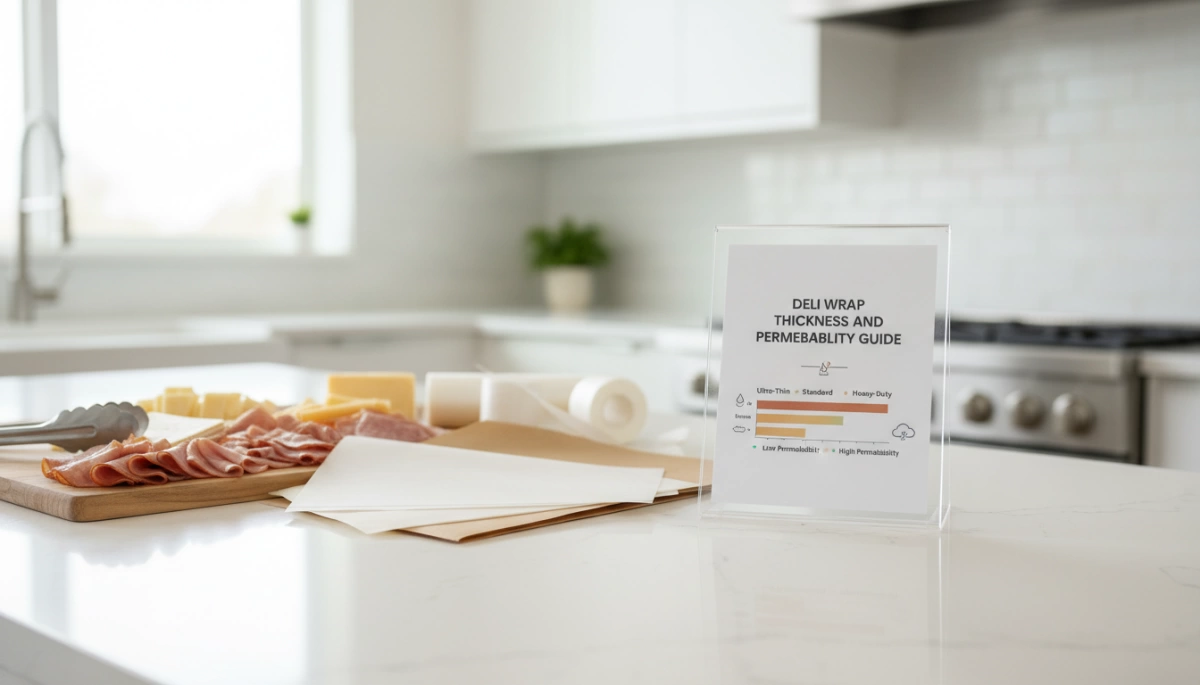
How to Choose the Right Thickness & Permeability for Your Operation
Key questions before you pick a deli wrap
Before you choose deli wrap thickness and permeability, I always start with these questions:
-
What are you wrapping?
- Cold deli meat, cheese, salads
- Greasy burgers, fried chicken, breakfast sandwiches
- Bread, pastries, or fresh produce
-
How long is the hold time?
- Under 30 minutes (fast-service, food trucks)
- 1–4 hours (lunch rush, catering)
- Overnight or longer (prep, storage, grab-and-go)
-
Where is it stored?
- Line, hot holding cabinet, cold table, walk-in, display case
- Dine-in basket vs takeout bag vs delivery
-
What matters most to you?
- Lowest cost per wrap
- Best barrier for freshness
- Eco-friendly or recyclable
- Strong enough not to tear in a rush
Match wrap specs to menu, service style, and time
Simple rule:
- Fast turnover + eat-now = thinner, more breathable wrap
- Longer storage + high grease or aroma loss risk = thicker, lower-permeability wrap
Quick guide:
| Operation Type | Typical Food | Suggested Wrap Type |
|---|---|---|
| Food trucks / QSR | Hot sandwiches, burgers | Medium PE cling film, 10–12 microns |
| Deli / sandwich shop | Meats, cheeses, stacked subs | Medium–heavy PE cling film, 12–15 μm |
| Bakery / café | Pastries, bread, cookies | Breathable paper + light film |
| Supermarket / meal prep | Chilled, pre-packed items | Low OTR PE film, 12–18 μm |
If you’re buying commercial kitchen cling film rolls, go for a thickness that matches your heaviest item first, then standardize across your line.
How to read thickness, OTR, WVTR, and grease resistance
When you look at spec sheets, here’s how I keep it simple:
-
Thickness
- Measured in microns (µm) or gauge
- For deli use, PE cling film usually runs 8–18 µm
- Thicker = stronger, better barrier, but less cling and flexibility
-
OTR (Oxygen Transmission Rate)
- How much oxygen passes through the wrap
- Lower OTR = better oxygen barrier food packaging
- For meats and cheese, look for low OTR PE cling film numbers
-
WVTR (Water Vapor Transmission Rate)
- How much moisture passes through
- Lower WVTR = better moisture barrier (good for keeping food from drying out)
- Higher WVTR = more “breathing” (good for fresh produce and some baked goods)
-
Grease resistance
- Often shown as “greaseproof,” “grease resistant,” or test level
- For greasy foods or hot sandwiches, pair heavy duty deli wrap or thicker PE film with high grease resistance
If you need deeper info on barrier performance and manufacturing, I share more details in our breakdown of the manufacturing process for preservative films and how that impacts OTR and WVTR in real use (manufacturing process for preservative films).
Balance cost, performance, and sustainability
For the U.S. market, I look at deli wrap choices like this:
-
Cost:
- Thinner film = more yield per roll = lower cost per wrap
- But go too thin and you’ll get tearing, double-wrapping, and waste
-
Performance:
- Match thickness to worst-case use (greasy, hot, heavy items)
- Standardize where possible so staff doesn’t have to think about it
-
Sustainability:
- If you’re shifting from plastic to eco-friendly deli packaging materials, make sure the compostable deli wrap permeability still fits your menu
- For operations using reusable options alongside film, silicone bags or pouches are a strong long-term add-on; we’ve compared their benefits in our guide to ecofriendly silicone pouches for food storage (benefits of using ecofriendly silicone pouches).
My rule:
- Start with performance (does it protect the food?),
- Then check cost per use,
- Then choose the most sustainable option that still hits those first two targets.
Real-World Tips for Testing Deli Wrap Thickness & Permeability

When you’re choosing deli wrap thickness and permeability, don’t just trust the spec sheet—run a few fast tests in your own kitchen. Here’s how I’d do it.
Simple In-House Tests for Grease Bleed & Strength
Use these quick checks to compare wraps side by side:
-
Grease bleed test (burgers, fries, bacon):
- Wrap a hot, greasy item.
- Set it on plain white paper or a tray for 15–30 minutes.
- Check the back side of the wrap and underneath for oil rings.
- A good greaseproof deli paper GSM or PE film should keep grease inside the wrap with minimal staining.
-
Strength and puncture test:
- Wrap a sandwich with sharp edges (baguette, toasted bread, hard crust).
- Squeeze like a customer would carry it in a bag.
- Look for tears, stretch marks, or film snap—this shows if your micron thickness for deli film or heavy duty deli paper for burgers is enough.
- For films, gently try to poke with a fingernail or the corner of a clamshell to check puncture resistance.
Quick Checks for Fogging, Sweating & Sogginess
Permeability shows up fast once food sits for a bit:
-
Fogging test (cold cuts, cheese, chilled sandwiches):
- Wrap and chill for 30–60 minutes.
- If your cling film turns milky with condensation, permeability is too low for that item.
- A good oxygen barrier food packaging will still manage moisture without turning the product “wet-looking.”
-
Sweating & sogginess test (fried foods, hot wraps, pastries):
- Wrap hot fries or a fried chicken sandwich.
- Let it sit 10–20 minutes like a delivery order.
- Open and check for:
- Soggy crust
- Pooling moisture
- Skin separation on fried foods
- If everything turns limp, you need either a more breathable food wrap or venting, not a higher barrier.
If you want more background on how film behavior affects moisture, this breakdown of film preservation vs. food preservation explains why the “strongest” film isn’t always the best for food quality.
Trialing New Eco
Thickness & Permeability FAQs for Deli Wrap
Best Thickness for Greasy Foods & Hot Sandwiches
For burgers, fried chicken, and loaded hot sandwiches, I recommend:
- Paper wraps: 30–40 gsm heavy-duty greaseproof or dry‑waxed deli paper
- PE cling film: 12–15 microns for tight, leak‑resistant wraps
- Combo: Wrap in greaseproof paper, then overwrap with PE film for delivery or longer holds
You want enough thickness to stop grease bleed and tearing, but not so thick that steam gets trapped and turns buns soggy—leave a small vent or wrap a bit looser for very hot items.
Permeability for Cheese Storage & Cured Meats
Cheese and cured meats need controlled breathability, not a total seal.
- Soft and fresh cheeses: Use breathable cheese paper or perforated PE film so moisture can escape slowly and mold risk drops.
- Hard cheeses & cured meats: Aim for low to medium oxygen permeability (lower OTR) to slow oxidation, with moderate moisture control so they don’t dry out too fast.
- For longer storage, pair PE cling film with low oxygen permeability plus a paper layer to help manage surface moisture.
Are Eco Deli Wraps as Good a Barrier as Plastic?
Eco-friendly deli wraps—like compostable papers and plant-based films—have gotten much better, but they’re not all the same:
- Grease & moisture: High‑quality compostable wraps now match or come close to PE film on grease resistance and WVTR for day‑of service and short‑term storage.
- Oxygen barrier: Most eco wraps still have higher oxygen permeability than standard PE, so pure barrier performance for long-term storage is usually better with plastic.
If you’re moving toward sustainable deli packaging, it’s smart to test barrier performance alongside options like biodegradable sandwich wraps or even newer edible preservative films.
Using Heavy-Duty Wraps for Hot & Reheated Items
Heavy-duty wrap makes sense when:
- You’re wrapping very hot, greasy food (fresh off the grill or fryer)
- Items will be stacked, transported, or reheated
- There’s a risk of tearing, puncture, or sauce leakage
For hot and reheated items:
- Use 35–40 gsm heavy-duty deli paper or 15–18 micron PE film
- Avoid fully airtight wrapping for steaming-hot foods—venting reduces condensation so fries, buns, and crusts stay crisp
Temperature & Storage Limits for Common Deli Wraps
Here’s a tight guide I follow in our own packaging line:
-
PE Cling Film (our main deli film)
- Typical safe range: -40°F to about 175°F (check your supplier spec)
- Great for cold storage, fridge, and short-term freezer use
- Not for direct oven, broiler, or grill contact
-
Waxed / Greaseproof Deli Paper
- Handles hot foods up to 400°F+ indirect heat
- Perfect as a liner or primary wrap for hot sandwiches, burgers, and fried foods
-
Compostable & Biodegradable Wraps
- Usually fine for fridge temps and moderate heat, but many are not freezer-friendly and can soften with high steam
- Always double-check temperature and WVTR ratings in the spec sheet before using for hot or long-hold applications
If you’re unsure, start by matching wrap thickness and permeability to your hottest menu items and longest storage times, then scale from there.