















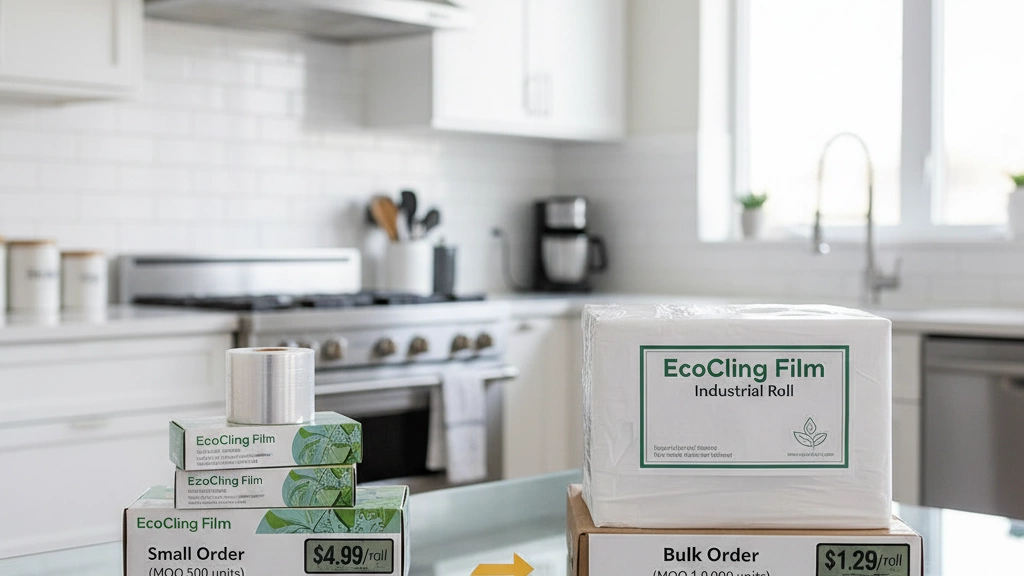
You’re ready to buy cling film in bulk… but every supplier keeps talking about MOQ, pricing “tiers,” and long lead times.
And you’re probably wondering:
- Do I really have to order a full container to get a good price per roll?
- What actually happens to my cost if I order 500 cartons instead of 2,000?
- Why does a lower minimum order quantity (MOQ) usually mean slower production and longer delivery times?
If you run a supermarket, catering business, or you’re building a private label, these details directly hit your cash flow, warehouse space, and shelf price.
In this guide, we’ll break down in simple numbers how MOQ affects cling film price and lead time in 2025:
- how factories really calculate minimum order quantity
- how different MOQs change your final landed cost per roll
- how MOQ shapes production scheduling and ETDs/ETAs
- practical ways to reduce MOQ without paying crazy premiums
By the end, you’ll be able to look at any quote, plug in the MOQ, and see instantly whether the price, lead time, and quantity actually work for your business.
What Is MOQ in Cling Film Sourcing?
When we talk about MOQ (Minimum Order Quantity) for cling film, we simply mean:
The smallest quantity of cling film a factory is willing to produce and sell at a given price and lead time.
It’s not just a random number. It’s the point where a production run becomes economical for the supplier and sustainable for you as a buyer.
How MOQ Works in a Real Cling Film Factory
Inside a cling film plant, MOQ is tied to how we actually run the lines, not just what we type on a quotation.
Every order triggers a chain of actions:
- We buy and prepare resin (PVC or PE)
- We run extrusion or casting to make jumbo rolls
- We slit jumbo rolls into finished widths and lengths
- We print and set up cartons, labels, cores, and packing
Each of these steps has fixed setup costs and time. Whether we produce 300 cartons or 3,000, we still:
- Clean and set up the machines
- Adjust thickness, width, and tension
- Run tests and discard off-spec material
- Change printing plates and packaging settings
That’s why MOQ exists: to spread those fixed costs over a reasonable number of rolls.
Key Cost Drivers Behind Cling Film MOQ
Here are the main cost drivers that push MOQ up or down:
| Cost Driver | What It Means in Practice | Impact on MOQ |
|---|---|---|
| Resin purchasing | Resin is bought in bulk lots (PVC/PE). Small runs still need full bag or pallet purchases. | Lower MOQ = higher cost per lb of resin used per order. |
| Masterbatch color runs | For tinted or colored cores/prints, masterbatch must run long enough to avoid waste. | Custom colors need higher MOQ to justify a full color run. |
| Jumbo roll extrusion/casting | Starting a new thickness or width means a fresh setup and initial scrap. | Small runs waste more film per roll, so MOQ goes up. |
| Jumbo roll slitting setup | Setting slit widths and lengths requires time and test cuts. | More custom sizes = more setup = higher MOQ. |
| Carton printing plates | Custom artwork means printing plates and print job setup. | Private label cartons need a higher MOQ per design. |
| Inner cores & labels | Private label cores or labels have minimum print runs. | Branded programs raise MOQ per SKU. |
The bottom line: the more customized your film or packaging, the higher the MOQ the factory needs to stay profitable.
Why Machine Setup and Waste Force a Minimum
Every cling film production run has startup waste:
- Off-thickness film at the beginning
- Trim waste when dialing in width
- Test rolls for QC checks
- Cartons and cores used during setup
That waste cost is the same whether you order 200 cartons or 2,000. On a small order, that waste becomes a big percentage of the total volume, so:
- Cost per roll jumps
- Operator time per roll jumps
- Machine time per roll jumps
So suppliers set MOQ to:
- Keep the cost per roll acceptable for you
- Make sure the run is worth the machine time for them
Without MOQ, the factory would either lose money or quote very high prices for tiny runs.
Typical Cling Film MOQ Ranges in 2025 (Export Buyers)
For export buyers in 2025, most serious cling film factories work within these ballparks:
| Buyer Type | Product Type | Typical MOQ (Export) |
|---|---|---|
| General export buyer | Standard PVC/PE cling film, plain carton | 300–500 cartons per SKU |
| Price-focused importer | Standard, repeat spec | 1,000–2,000 cartons per SKU |
| Supermarket chain | Private label, printed carton | 800–1,500 cartons per SKU |
| Catering wholesaler | Catering-size rolls (12″–18″, 2,000–3,000 ft) | 500–1,000 cartons per SKU |
| Small importer / start-up | Semi-standard spec, maybe shared plate | 200–300 cartons per SKU (usually at a higher unit price) |
These numbers vary by:
- Film type (PVC vs PE)
- Roll length and width
- Packaging style (cutter box vs refill, printed vs plain)
But this is a realistic starting point for 2025 export cling film sourcing.
Different MOQ Expectations by Buyer Type
In practice, we don’t treat all buyers the same. Typical MOQ thinking looks like this:
Supermarkets (especially with private label)
- Usually accept higher MOQ per SKU
- Expect sharp pricing and stable supply
- Often run full-container loads mixed across a few high-volume SKUs
Wholesalers and distributors
- Need some flexibility to cover multiple customer types
- Often accept medium MOQ (500–1,000 cartons per item)
- Prefer mixed-SKU pallets or containers to balance stock
Small importers and start-up brands
- Care more about cash flow and storage space than absolute lowest price
- Look for lower MOQ (150–300 cartons per SKU) even if the unit price is higher
- Often trade some customization for more flexible MOQ (e.g., plain cartons, standard sizes)
Why MOQ Protects Factories (And Actually Helps Serious Buyers)
MOQ isn’t just about protecting the supplier’s margin. It also protects product stability and your long-term pricing.
MOQ helps factories:
- Avoid tiny, unprofitable runs that eat capacity
- Keep machines focused on stable, repeat SKUs
- Buy resin in larger, more predictable lots, which means:
- Better pricing from resin producers
- Better control over price volatility
- Maintain consistent quality instead of constantly changing setups
For you as a buyer, respecting a realistic MOQ:
- Keeps your unit price stable over time
- Reduces the risk of sudden price hikes after a few small orders
- Encourages the factory to treat your order as a priority line, not a filler job
When we quote a MOQ, it’s not to make your life harder. It’s to make sure both sides can work with sustainable pricing, consistent quality, and predictable lead times.
How MOQ Affects Cling Film Unit Price
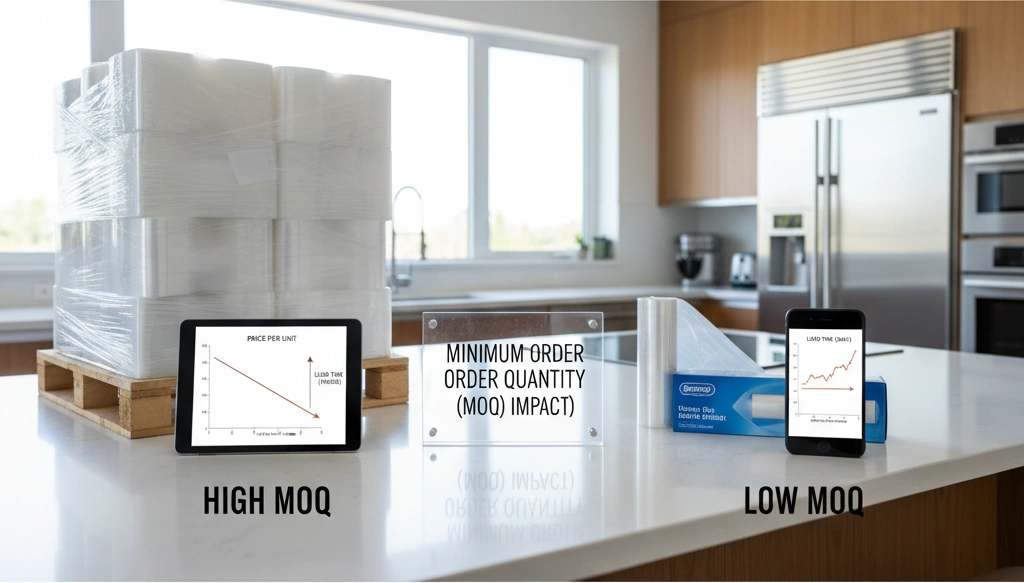
When you buy wholesale food wrap film, the basic rule is simple: the higher the minimum order quantity (MOQ), the lower your cling film unit price. That’s because we spread the same setup and overhead costs over more rolls instead of just a few.
Why Higher MOQ Lowers Price Per Roll
For every PVC or PE cling film run, we pay fixed costs whether you order 300 cartons or a full container:
- Machine setup and cleaning
- Masterbatch color and jumbo roll changeovers
- Carton plate setup (for custom printed boxes)
- Quality checks and film tests
When your MOQ is higher, those fixed costs per roll drop, so your cling film cost per roll comes down. That’s why cling wrap wholesale minimum order levels matter so much for your final price.
Typical Cling Film Price Tiers (Example Only)
For a common supermarket private label cling wrap (12 in x 3,000 ft, PVC, cutter box), a realistic price curve might look like this:
- 500 cartons (below ideal MOQ): highest price per roll, plus possible setup surcharge
- 1,000 cartons (near standard MOQ): noticeable price drop, fair for smaller importers
- 2,000 cartons: better PVC cling film pricing tiers, usually “sweet spot” for many retailers
- Full container (2,200–2,600+ cartons depending on spec): best price per roll, best freight efficiency
These are sample numbers, but the pattern is the same: bigger MOQ = better price tier. Many US supermarket buyers see this when they move from part-container orders to more optimized, container-level shipments similar to what we show in our cling film requirements for supermarket chains case study.
Fixed Costs vs. Variable Costs
Your minimum order quantity for cling film impacts how fixed and variable costs show up in the price:
- Fixed costs: machine setup, printing plates, artwork, pre-production samples
- Variable costs: resin, masterbatch, cartons, cores, labor, power
At low MOQ, fixed costs per roll are high, so your price per roll jumps. As MOQ increases, fixed costs per roll shrink, and you’re mostly paying for resin and packaging. That’s why MOQ vs cost is the key lever when you compare offers from a cling film manufacturer.
How Thickness, Width, and Length Affect MOQ and Price
Your specs play a direct role in MOQ and unit price:
- Film thickness: thicker (e.g., 12–15 micron PVC) uses more resin, so the base unit price is higher, but MOQ is often easier to hit because these are mainstream specs.
- Width: 11–18 inch food-grade cling film is standard; odd widths (like 13.5 in) often push MOQ up and limit price breaks.
- Roll length: longer rolls (2,000–3,000 ft) cost more per roll but often less per foot, and MOQ is usually set by total film volume, not just carton count.
If you choose standard supermarket and catering sizes that factories already run in volume, it’s easier to get a reasonable MOQ and a sharper price.
Packaging Choices and MOQ (Cutter Box vs. Refill)
Packaging can change both the MOQ and your cling film unit price:
- Cutter box vs. refill rolls: cutter boxes cost more (blade, board, printing), and often have higher MOQ for carton production; refills are simpler and can carry slightly lower MOQ with lower unit cost.
- Printed vs. plain cartons:
- Plain brown or white cartons = lower or more flexible MOQ, no plate cost.
- Custom printed cartons = higher MOQ to justify plates and print setup, but better for private label cling film minimum runs.
If you’re a smaller retailer or catering wholesaler, going with plain or 1–2 color cartons can help you keep MOQ under control without paying a big premium on each roll.
Realistic Cling Film Cost Per Roll Calculation
When you compare offers from a wholesale food wrap film supplier, look at cost per roll at different MOQs, not just carton price. A simple way to view it:
- Total order cost ÷ total rolls = real price per roll
- Then factor in:
- Landed freight cost
- Any setup or small-batch charges
- Duty and local inland freight
Example (for illustration):
- 500 cartons x 6 rolls = 3,000 rolls
- Total landed cost = $10,200
- $10,200 ÷ 3,000 = $3.40 per roll
At 2,000 cartons, your price per roll could easily drop into the $2.70–$2.90 range for the same spec once MOQ and freight efficiency improve.
Hidden Costs Below MOQ
When you push a cling film factory for very low MOQ, watch for these extra charges:
- Setup surcharges for running a short batch on the line
- Small-batch fees to cover wasted film at startup and changeovers
- Idle time charges if they have to stop a big standard run to fit your small order
On paper, the quote might look “cheap,” but once you add these up, the cling film unit price often ends up higher than if you had accepted a more realistic MOQ.
Freight and Shipping Cost Per Roll
MOQ doesn’t just change ex-factory price — it also changes shipping cost per roll:
- Higher MOQ means better pallet and container utilization
- Less “air” in the container, more actual rolls shipped
- Lower freight cost allocated to each roll
For US buyers importing from Asia, MOQ impact on shipping cost per roll can easily move your landed roll cost by 5–15% depending on whether you’re shipping a light load or a tightly packed container.
When a Higher MOQ Actually Saves You Money
Sometimes, ordering more than your ideal quantity is the right move. A slightly higher MOQ can make sense when:
- You have stable demand (supermarkets, catering businesses, distributors)
- Expiry and storage are not a big risk for your cling film spec
- The lower unit price and cheaper freight per roll offset the extra inventory
Many retailers find that moving from 700–800 cartons up to 1,200–1,500 cartons per shipment cuts their annual cling film spend and smooths availability, especially on high-runner SKUs. The key is to look at total yearly cost, not just “how many cartons can I squeeze into my next PO.”
How MOQ Controls Cling Film Production Lead Time
Step-by-step cling film production timeline
Here’s what your cling film lead time actually looks like from factory side:
- Resin & masterbatch prep
- Purchase or release PVC/PE resin and additives
- Drying, mixing, and color/masterbatch setup
- Film extrusion or casting
- Machine setup and warm-up
- Trial runs, thickness checks, cling and clarity tests
- Production of jumbo rolls
- Slitting & rewinding into finished rolls
- Set width, length, and core size
- Adjust tension and speed for your exact spec
- Cut and rewind to finished rolls for supermarket, catering, or household sizes
- Carton and packaging
- Carton or cutter box printing (or use stock cartons)
- Packing rolls into boxes, labeling, palletizing
- Final QC, booking, and loading
- Sampling and test reports
- Export packing, booking vessel, container loading
Every step has a setup cost and setup time. That’s where MOQ (minimum order quantity) starts to control lead time.
Where MOQ hits planning: batching, scheduling, changeovers
MOQ shows up in three key planning decisions:
- Batching:
Higher MOQ means we can run one film spec longer without stopping. Less cleaning, less waste, faster throughput. - Scheduling:
Bigger runs are easier to slot into production blocks. We group similar widths, thicknesses, and cores to keep lines running smoothly. - Line changeovers:
Every time we switch size, thickness, or packaging, we lose hours to setup and scrap film. Small MOQs create more switches, which pushes everyone’s lead time out.
When you understand this, it’s clear why MOQ isn’t just about price—it’s directly tied to how fast we can deliver.
Why small MOQ orders wait behind big repeat orders
In real life, factories (including ours) will prioritize:
- Full-container, repeat SKUs for big supermarkets and wholesalers
- Stable, standard specs that run efficiently on the line
- Annual or blanket orders with a clear forecast
Small MOQ one-off orders usually:
- Get scheduled after container loads
- Are grouped with other small specs to reduce waste
- Move slower when the factory is busy
It’s not favoritism—it’s survival. Large, repeat orders keep machines running and prices stable for everyone.
Container-level orders vs partial orders
Here’s how we naturally rank priority:
- Full container orders (FCL)
- Often booked on a fixed monthly schedule
- Locked-in production slots
- Usually get the most stable lead times and the best shipping cost per roll
- Partial containers / LCL or small pallets
- Filled around the FCL schedule
- More sensitive to line changes, shipping space, and port congestion
If you’re in the U.S. buying for retail or foodservice, even one container spread across multiple SKUs will usually get you faster, more predictable lead times than repeated tiny orders.
MOQ vs lead time: 300–500 vs 800–1,000 vs full container
Typical lead time patterns we see for export buyers:
- 300–500 cartons (low MOQ / trial orders)
- Often 25–35 days production, plus shipping
- May be pushed back if lines are full with bigger jobs
- More risk of schedule changes if another buyer confirms a full container
- 800–1,000 cartons (mid-range MOQ)
- Usually 20–28 days production
- Easier to batch and schedule as one solid run
- Good balance for regional wholesalers and catering suppliers
- Full container load (depending on roll size, often 2,000+ cartons)
- Often 18–25 days production in normal season
- Usually locked into a routine production and shipping cycle
- Best option for U.S. supermarket private label and big distributors
These are realistic ranges, not promises—final lead time depends on spec, season, and vessel space.
Custom specs and private label cling film lead time
Custom specs almost always stretch lead time compared with standard SKUs:
- Special film specs (very thin, very wide, unusual roll lengths)
- Private label printed cartons or cutter boxes
- Need plate making and print proof approval
- Carton production can add 5–10 extra days
- Non-standard cores, perforation, or colors
If you want faster lead time:
- Use standard supermarket or catering sizes that we already run in volume
- Keep carton design changes minimal (e.g., adjust artwork, not structure)
- Align specs with what we already produce for other U.S. buyers
For buyers also looking at sustainable options, the logic is similar to how reusable silicone food storage products are planned—standard specs always move quicker than custom ones.
Peak season vs low season cling film lead times
Lead time is heavily seasonal:
- Peak season (typically before major holidays and year-end):
- More orders from supermarkets and food brands
- PVC and PE resin markets can be tight
- Production lead time can stretch by 7–15 days
- Vessel space to the U.S. can be tougher to secure
- Low season:
- Easier to book production slots
- Faster changeovers even for small MOQs
- Better chance to negotiate shorter lead time for trials
If your business is seasonal (BBQ season, Thanksgiving, Christmas, New Year), it’s smart to pull orders forward or use blanket orders to lock capacity early.
Urgent, low-MOQ orders: overtime, surcharges, and delays
When a buyer asks for:
- Very low MOQ
- Custom spec
- Urgent delivery
…something has to give. The factory may need:
- Overtime or night shifts
- Extra scrap and rush setups
- To push back another buyer’s order
That can lead to:
- Expedite or rush fees
- Higher unit price to cover inefficient production
- Still no guarantee that shipping lines will have space on your ideal vessel
If you need urgent low-MOQ cling film, we’ll be upfront about the true cost and realistic date so you’re not surprised later.
What to expect when you change your MOQ up or down
When you increase MOQ:
- Production lead time usually stabilizes or shortens slightly
- Easier to lock regular monthly or quarterly production
- Better negotiation room on both price per roll and delivery time
When you reduce MOQ:
- Lead time can become less predictable
- Orders are more likely to be shifted around bigger runs
- You may need to accept:
- Slightly longer lead times, or
- Higher unit cost to secure a firm slot
For U.S. supermarkets, caterers, and wholesalers, the sweet spot is usually:
- Commit to a bigger overall MOQ per year
- Ship in smaller, regular batches
- Lock in both cost and lead time with a clear schedule
That way, MOQ works for you instead of against you—your shelves stay stocked, your cash flow stays sane, and your cling film cost per roll stays competitive.
Industry MOQ Benchmarks for Cling Film in 2025
When you’re buying cling wrap wholesale, MOQ (minimum order quantity) is not random. There are clear patterns by material, spec, and packaging. Here’s what “normal” looks like in 2025 so you can quickly tell if a cling film MOQ offer is realistic or risky.
PVC vs PE Cling Film MOQ
PVC and PE run differently in production, so their MOQs are rarely the same. If you’re still deciding between them, it helps to first understand the key materials used in commercial cling film.
Typical export MOQ ranges (per SKU, for serious buyers):
- PVC cling film (food-grade, standard sizes):
- 400–600 cartons for trial or mixed-SKU orders
- 800–1,200 cartons as a normal MOQ for stable pricing
- PE cling film (household or catering):
- 300–500 cartons for common specs
- 700–1,000 cartons for thicker, wide, or longer rolls
What this means for you (US buyers):
- PVC usually has slightly higher MOQ but very competitive unit price at container level.
- PE often allows lower MOQ on basic sizes, but custom specs can jump up fast.
Food-Grade vs Industrial Wrap MOQ
Minimum order quantity for cling film jumps when you move from basic industrial wrap to strict food-grade specs.
- Food-grade PVC / PE cling film:
- Often 600–1,200 cartons per SKU to support resin choice, certifications, and tighter QC.
- Non-food / industrial wrap (for bundling, non-contact use):
- Can start around 300–500 cartons per SKU for common, clear film.
For US supermarkets, caterers, and meal-prep brands, food-contact compliance is non-negotiable, so plan around higher MOQs for food-grade cling wrap wholesale.
Supermarket & Catering Sizes vs Custom Specs
Standard sizes are the easiest for any cling film factory to run and stock. Custom sizes cost more and push MOQ up.
Standard, high-runner specs (lower MOQ, better pricing):
- Supermarket rolls: 11–12 in width, 200–3,000 ft length
- Catering / foodservice rolls: 12″, 18″, 24″ widths, 2,000–3,000 ft
- Common thickness: 8–12 micron for household, 12–15 micron for catering
Custom specs (higher MOQ, more risk if they don’t sell fast):
- Very narrow or very wide rolls
- Unusual lengths (for specific dispensers)
- Special colors, tints, or high-clarity “premium” film
For US retail and foodservice, “standard supermarket and catering sizes” usually keep MOQ in the 400–800 carton range per SKU, while special requests can double that.
How Core Size, Roll Length, and Thickness Change MOQ
Factories try to keep core size, roll length, and thickness as standard as possible. Every change interrupts cling film production scheduling.
- Core size:
- 1″ and 3″ cores are typical. Anything else can add 200–400 cartons to the MOQ.
- Roll length:
- Very short rolls = more cutting, more packaging time → higher unit cost at same MOQ.
- Very long rolls = heavier, slower line speed → higher MOQ to cover setup.
- Thickness:
- Very thin film (<8 micron) or very thick film (>15–18 micron) often requires longer runs, so MOQ climbs.
In real life, “we just want a slightly different spec” can easily move MOQ from 600 cartons to 1,200+ if the spec is far from the factory’s normal window.
MOQ for Plain Cartons vs Printed Cartons
Carton printing is one of the biggest drivers of MOQ for supermarket private label cling wrap.
- Plain brown or white cartons (with sticker/label):
- MOQ can stay around 300–600 cartons per SKU because there’s no printing plate cost.
- 1–2 color logo on carton:
- Typical MOQ: 800–1,200 cartons per SKU for cost-effective printing.
- Full-color private label printed cartons:
- MOQ often starts at 1,500–3,000 cartons per design to spread plate and setup costs.
If you’re launching a new US store brand, it’s often smarter to start with plain cartons + label at lower MOQ, then move to full-color printed cartons once volume is proven.
Export Pallets vs Mixed Loose Cartons
For export to the US, how you load affects MOQ and cling film cost per roll.
- Full pallets, single SKU:
- Lowest handling cost, most efficient load → lower MOQ per SKU (for example, 400–800 cartons).
- Mixed loose cartons, many SKUs on one pallet or container:
- Higher labor and complexity → MOQ per SKU can drop to 200–300 cartons,
but the overall container MOQ (total cartons) usually stays similar.
- Higher labor and complexity → MOQ per SKU can drop to 200–300 cartons,
“Mixed SKU cling film container” offers are great for variety, but you should expect slightly higher unit prices or modest mixed-loading fees.
Big Factories vs Mid-Size Flexible Suppliers
You’ll see clear MOQ behavior differences by supplier type when sourcing cling film from Asia or China.
- Big factories:
- Prefer higher MOQ per SKU (often 1,000+ cartons).
- Offer strong price tiers at full-container loads.
- Best if you’re a large US supermarket chain, national wholesaler, or major foodservice distributor.
- Mid-size, flexible MOQ stretch wrap suppliers:
- Comfortable at 400–800 cartons per SKU with reasonable pricing.
- More open to mixed pallets, mixed SKUs, and trial orders.
- A better fit for regional wholesalers, restaurant supply distributors, and fast-growing e-commerce brands.
As a low MOQ cling film manufacturer in China, we sit closer to this second group: we keep MOQ practical while still running efficiently.
What a “Good” MOQ Looks Like in 2025
For US buyers, here’s a simple benchmark for what’s normally “good enough” and sustainable for both sides:
- Supermarkets / grocery chains (private label cling film):
- 800–1,200 cartons per SKU with printed cartons
- Lower per-SKU MOQ if you commit to a forecast or blanket order
- Catering and foodservice wholesalers:
- 400–800 cartons per SKU for catering rolls on plain or simple printed cartons
- Ability to combine multiple widths in one shipment is a plus
- Start-up brands, meal kits, and smaller importers:
- 300–500 cartons per SKU using standard specs and plain cartons
- Slightly higher cling film price per roll is normal at this level
If an offer is far below these MOQ ranges and still promises “factory-direct, super low price,” treat it as a red flag. For most serious wholesale food wrap film suppliers, these ranges are what keep quality, price, and lead time in balance.
Strategies to Lower Your Effective MOQ Without Killing Margins
Managing minimum order quantity for cling film is really about balance: keeping your cost per roll sharp without drowning in inventory. Here’s how I look at lowering “effective” MOQ in a way that still protects your margin.
When It Makes Sense to Push MOQ Down (And When It Doesn’t)
Pushing MOQ down makes sense when:
- You’re testing a new size, thickness, or brand in the U.S. market
- Your cash flow is tight and you can’t hold 4–6 months of stock
- Your warehouse space is limited or expensive
- Demand is still unpredictable (new store, new channel, or seasonal trial)
You shouldn’t force MOQ too low when:
- It explodes your unit cost and kills margin
- You already have stable, repeat demand
- Freight and handling per carton jump because you’re shipping lots of small orders
- The factory has to run “special” settings just for you
The goal is not “lowest MOQ at any price.” The goal is best total cost per roll over the year.
Mixed-Item Containers: Combine SKUs, Keep MOQ Smart
For many U.S. supermarkets, club stores, and foodservice distributors, mixed-item containers are the easiest way to reduce effective MOQ without paying “small order” pricing.
You can:
- Combine several cling film SKUs in one 20’ or 40’ container
- Example: 12″ x 2000’ catering rolls + 18″ x 2000’ + 24″ x 2000’
- Mix PVC cling film and PE cling film if they share similar carton sizes and pallet patterns
- Add a couple of test SKUs on top of your core high-volume SKUs
Benefits:
- You still hit the factory’s total MOQ on film tonnage and packaging
- You spread your risk across more sizes without separate small runs
- Your freight cost per roll stays low because the container sails full
We build mixed-SKU containers all the time for wholesale food wrap film buyers who want variety without overstock.
Stock-and-Sell / Blanket Orders: Big MOQ, Small Shipments
If your volumes are good over the year but you don’t want everything in your warehouse at once, blanket orders are a strong play.
How it works:
- You commit to a larger MOQ upfront (for example, 2–3 containers over 6–12 months)
- We plan production in one or two efficient runs at the lower “big order” unit price
- We store or stage part of the stock and ship to you in smaller batches
Why U.S. buyers like this:
- Better unit price because production is optimized
- Shorter lead time on replenishment — the film is already produced
- Smoother cash flow: you pay as you draw down, instead of all at once
If your annual usage is clear, blanket orders are often the best way to reduce your effective MOQ and your lead time.
Pay a Fair Setup Fee Instead of Overpaying on Unit Price
Sometimes you need a lower MOQ: maybe a niche private label cling wrap or a special width for a regional chain.
In that case, it’s usually smarter to:
- Pay a clear, one-time setup fee
- For printing plates
- For small-batch slitting
- For color masterbatch changes
- Keep the unit price closer to standard levels
This is typically cheaper long term than:
- Forcing the supplier to hide setup costs in a very high per-roll price
- Accepting a “no setup fee” quote that quietly bakes in a massive margin
Ask your cling film supplier to show:
- Standard unit price at normal MOQ
- Additional setup or small-run fee if you go below MOQ
Transparent breakdowns make it easy to compare and protect your profit.
Choose High-Runner Cling Film Specs Factories Love
If you want flexible MOQ and better pricing, choose specs that run constantly on production lines:
High-runner examples in the U.S.:
- 11–12″ x 2000’ and 18″ x 2000’ catering cling film
- Standard foodservice thicknesses around 11–13 mic (PVC) or popular PE food wrap gauges
- Common core sizes (1” or 3”) and standard box dimensions used by many buyers
Why this helps:
- We can fit your order into existing runs instead of doing a slow, one-off setup
- Lower waste and faster changeovers = better price and a more flexible MOQ
- Less risk for us means more room to negotiate for you
If you can match our standard cling film specs (or get close), you’ll feel it in both MOQ and cost per roll.
Standardize Sizes to Hit MOQ Faster
For retailers and restaurant groups across multiple states, the fastest way to lower effective MOQ is standardization.
Instead of:
- 3–4 carton designs per store
- Different widths and lengths by region
Try:
- One or two standard widths (11–12″ for home / 18″ for catering)
- One or two standard roll lengths that work nationwide
- Shared private label design with minor changes (UPC or small language tweaks if needed)
Benefits:
- Each SKU hits MOQ faster because volume is pooled
- Less leftover slow-moving sizes in your DC
- Stronger leverage to negotiate better pricing and payment terms
Standardizing around factory-friendly specs also fits well with what we explain about cling film manufacturing in our guide to being a cling film manufacturer for food storage.
Balance Private Label Customization With Realistic MOQ
Custom private label cling wrap looks great on shelf — but every change can push MOQ up:
MOQ drivers:
- Custom-printed cartons
- Unique box cutters or slide cutters
- Special film colors or tinted masterbatch
- Non-standard core, width, or roll length
To keep MOQ under control:
- Limit the number of designs (one master design, small regional tweaks)
- Share the same film spec (thickness, width) across brands or channels when possible
- Start with plain or 1–2 color boxes before going full high-color print on a new launch
You’ll get:
- Lower setup and plate costs per design
- More flexible MOQ from the factory
- Easier replenishment because we can repeat the same setup faster
How to Talk to Your Supplier About Flexible MOQ and Shared Risk
Don’t just ask, “What’s your lowest MOQ?” Instead, have a direct, numbers-based conversation around:
Share with your supplier:
- Your expected annual volume by SKU
- Your target price per roll and margin needs
- Your warehouse limits and cash flow reality
- Your service level goals (how many days of stock you want to hold)
Ask your cling film factory:
- What MOQ do you need to run this spec efficiently?
- What happens to unit price at different breakpoints (e.g., 400 / 800 / 1,600 cartons)?
- Can we mix SKUs in one container? What rules apply?
- Is there a one-time or per-order setup fee if I go under MOQ?
- Can we use a blanket order to get the “big order” price with smaller releases?
This kind of honest, data-based conversation usually leads to a shared-risk plan: you commit to realistic volume, we commit to better pricing and more flexible MOQ.
Real-Life MOQ Compromises That Worked
Here are a few types of deals that have worked well for both sides:
- Regional U.S. supermarket chain
- Needed three private label sizes but didn’t want massive stock
- We agreed on:
- One big production run to hit our ideal MOQ
- Mixed SKUs in one container
- A small setup fee for custom cartons
- Result: They got lower total cost per roll than three separate small runs.
- Mid-size catering wholesaler
- Annual volume was strong but very seasonal
- We set a 12-month blanket order with staged shipments
- Their price matched a “full container MOQ” rate, but they only received what they needed each quarter
- They cut both stockouts and storage headaches.
If you want more detail on how MOQ is usually set for food packaging products, I also break it down in our guide to the typical MOQ for ODM food storage bags, and the same thinking applies to cling film.
Bottom line: lower effective MOQ doesn’t have to destroy your margins. Mix SKUs, use blanket orders, standardize specs, and be open to clear setup fees. When you share your real volume and constraints, a good cling film supplier can usually build an MOQ plan that works for both your P&L and your warehouse.
Real Cling Film MOQ Case Studies From 2024–2025
Case Study 1 – European Supermarket Chain Cutting MOQ And Total Cost
One of our 2024 projects was with a European supermarket group that felt “locked” into a high minimum order quantity cling film program:
- Old model: 1 SKU, 2,200 cartons per order (about one full container, 30 cm x 300 m PVC food-grade cling wrap)
- New model: 3 SKUs, 900 cartons total per order (300 cartons per SKU), mixed in one container
They were worried that dropping their cling film MOQ per SKU would push the unit price up too much. Here’s what actually happened.
Before (high MOQ, single SKU):
- MOQ: 2,200 cartons / order
- SKUs: 1 supermarket private label cling wrap
- Factory pricing: about $0.89 per roll
- Average landed cost (including freight): about $0.97 per roll
- Stock coverage: 6.5–7 months in their regional DC
- Issues: overstock, write-offs when packaging designs changed, slow reactions to promo demand
After (lower effective MOQ, mixed SKUs):
- MOQ: 900 cartons total / order, 3 SKUs mixed in one container
- Factory pricing: about $0.93 per roll
- Average landed cost: about $0.99 per roll
- Stock coverage: about 3.5 months per SKU
- Benefit: better shelf fit (standard, jumbo, and catering size rolls) without overbuying
So yes, the cling film price per roll went up by about $0.02. But over the first 12 months:
- Overall yearly cling film spend dropped by ~11%
- Obsolete stock on old designs and lengths fell by ~60%
- DC space used for cling wrap shrank by roughly 30%
- Fill rate on core SKUs improved because they always had “the right” size in stock
The main win wasn’t just unit price; it was smarter MOQ vs cost. By letting us mix SKUs in one container and aligning with realistic supermarket cling film MOQ for each size, they:
- Reduced warehouse congestion and handling
- Improved promotion planning (faster reorders on bestsellers)
- Kept packaging updates moving without throwing away old cartons
This is the same logic we apply when we plan other food packaging materials like cling film or how aluminum foil is manufactured from raw materials to final product: higher volumes are cheaper per unit, but not if the extra stock just sits in your warehouse for months.
Case Study 2 – UK Catering Wholesaler Using Blanket Orders
A UK catering wholesaler selling to restaurants and food-service chains came to us with a different problem:
- They needed reliable bulk cling film for catering businesses, but
- Cash flow was tight, and
- Their lead time from Asia was drifting up to 60–72 days door-to-door
They were ordering below our ideal MOQ per shipment, which meant:
- Long gaps between runs
- Their orders always sat behind larger supermarket and export buyers
- Cling film factory lead time stretched whenever the schedule was tight
We restructured their program around a blanket order cling film model.
Old ordering pattern:
- Order size: 400–500 cartons, mixed PVC cling film SKUs
- “On demand” PO every time their stock got low
- Factory lead time: 35–40 days + 30+ days sea shipping
- Total lead time: often 65–72 days
- Result: safety stock had to be huge just to avoid stockouts
New blanket order model:
- Annual commitment: equivalent of 3 full containers of food-grade cling film
- Release plan: monthly or 6-week partial shipments from that blanket
- Effective MOQ per production batch stays high (good for pricing)
- MOQ per release shipment stays practical for their warehouse
Lead time results:
- Factory lead time dropped to about 18–21 days because we block line time for them
- Total lead time stabilized around 28–35 days
- Unit price stayed close to “full-container” PVC cling film pricing tiers
- Cash flow improved because they only paid per release, not for the whole year upfront
Because the factory could plan production in bigger, repeatable batches, we cut changeovers and idle time. That kept the minimum order quantity cling film requirement healthy on our side, while the wholesaler enjoyed:
- More predictable inbound deliveries
- Less money frozen in slow-moving stock
- Better availability during peak catering season
Lessons Retail Buyers Can Copy
Whether you’re a US supermarket, wholesaler, or a growing brand, a few patterns show up again and again in these MOQ case studies:
- Mixed SKU containers usually beat super-high MOQ on one SKU. You pay slightly more per roll, but you lower your total yearly cost because you buy what you actually sell.
- Blanket orders are powerful. They let the cling film factory treat your volume like a large, stable account while you ship in smaller, cash-friendly lots.
- MOQ vs cost is a system, not a single number. Look at cling film order quantity vs price, freight cost per roll, warehouse space, and write-off risk together.
- Realistic MOQ gets you priority. When your MOQ lines up with normal production batch sizes, you’re more likely to get faster, more stable lead times.
What Actually Moves The Needle On Cling Film Price And Lead Time
From what we’ve seen in 2024–2025, these are the levers that really matter for cling wrap wholesale minimum order and lead time:
- Commit to a realistic annual volume, even if each shipment is smaller
- Use mixed SKU cling film containers instead of very low MOQ per SKU
- Consider blanket orders so the factory can schedule you as a “core” customer
- Be flexible on specs where you can (high-runner widths and lengths)
- Track your cling film cost per roll with freight, warehousing, and write-offs included—not just the factory quote
If you’re not sure where your MOQ should sit, share your current order pattern, stock issues, and target price per roll. We can usually model a couple of MOQ scenarios that show, in plain numbers, where you save the most over a full year.
Red Flags With “Low MOQ” Cling Film Offers
When ultra-low MOQ kills your margin
A super low minimum order quantity for cling film sounds perfect when you’re tight on cash or testing a new SKU. But if the MOQ is way below normal, the supplier has to recover their setup and production cost somehow. Usually that means:
- High unit price that wipes out your margin
- Hidden add-on fees (packing, setup, “handling”)
- Weak quality that leads to product returns and wasted rolls
If the cling wrap wholesale minimum order looks “too friendly,” but the math doesn’t work when you calculate real cling film cost per roll, walk away.
Trading company or real cling film manufacturer?
Low MOQ offers often come from trading companies, not factories. That’s not always bad, but it usually means:
- They buy small from multiple factories and add a big markup
- You have less control on quality, lead time, and film spec
- Prices jump quickly when resin cost or freight moves
Common signs you’re dealing with a middleman:
- No factory address, only a city and WhatsApp
- Can’t answer basic questions about cling film production scheduling
- They offer every product under the sun, not just food wrap film
Quality risks with very low MOQ
Real cling film production needs stable runs. When a supplier accepts tiny orders at “factory price,” they may cut corners:
- Cheaper resin or mixed scrap material
- Inconsistent film thickness (e.g., “12 micron” that swings from 10–14)
- Poor cling strength – film slips off pans and containers
- Cartons that crush on pallets or in Amazon FBA handling
For U.S. supermarkets, caterers, and food brands, these issues turn into customer complaints and damaged reputation fast. If you care about freshness and hygiene, you also want to look at broader food packaging practices like sustainable packaging solutions for the food industry.
Old, yellowing, or overstock film risk
When MOQ is unrealistically low, some suppliers are just trying to clear old stock:
- PVC cling film can yellow and lose stretch over time
- Cartons may have old branding or incorrect barcodes
- Film may have been stored hot, affecting clarity and performance
If they push “ready stock” but can’t show recent production records or test dates, assume it’s overstock.
Warning signs in specs and documents
Watch for these red flags before you place a low MOQ cling film order:
- Specs are vague: “high quality,” but no clear width, thickness, or length
- No test reports (FDA / EU food contact, migration tests, etc.)
- No COA (Certificate of Analysis) with basic properties
- They avoid sharing factory name or visit details
For food-contact products like cling film, you should at least see some documentation similar in seriousness to what you’d expect for any food preservation film.
How to check if the MOQ offer is real or a trap
Before you say yes to ultra-low MOQ cling wrap:
- Benchmark their MOQ and pricing against 2–3 other suppliers
- Ask if they can explain their MOQ logic: resin batch size, printing runs, carton MOQ
- Request photos or video of the factory, production line, and packing area
- Ask for recent test reports and at least one regular export customer reference
If they get defensive or dodge simple questions, don’t send a deposit.
Key questions to ask about very low MOQ cling film
Use these questions to protect your margin and reputation:
- What’s your standard MOQ for this PVC or PE cling film spec? Why?
- Are you a manufacturer or trading company? Can I know the factory name and location?
- What’s the exact spec: width, length, thickness, core size, carton type?
- Do you have test reports for food-grade cling film for the U.S. market?
- Is this fresh production or overstock? When was it produced?
- How does unit price change if I move from your low MOQ to a higher MOQ?
- What extra fees apply at this low MOQ (setup, small-batch, packing)?
If the answers are clear, consistent, and numbers make sense when you run a cling film price-per-roll calculation, then the MOQ is probably realistic. If not, low MOQ is just bait—and it will cost you more in the long run.
How Artfullife Balances MOQ, Cling Film Price, and Lead Time
At Artfullife, we sell cling film every day to supermarkets, wholesalers, and growing brands in the U.S. and worldwide. So we design our MOQ, pricing, and lead time policies to be practical, not painful.
Here’s exactly how we handle MOQ, price per roll, and delivery time so you can plan with real numbers, not guesswork.
Typical MOQ Ranges for Our Main Cling Film SKUs
We keep MOQ realistic so you can test products, manage cash flow, and still get a competitive unit price.
Typical starting MOQs (for export and large domestic wholesale):
- Standard PVC/PE food-grade cling film:
- Around 300–500 cartons for common sizes (e.g., 12″, 18″, 24″ rolls for supermarket and catering use)
- Supermarket and retail cutter box film:
- Around 500–800 cartons for standard specs
- Private label / custom specs (logo, artwork, special length or thickness):
- Usually 800–1,200 cartons total across a few SKUs, depending on printing and packaging
These are reference ranges. If you’re just starting or testing the U.S. market, we’ll look at your full plan and see where we can bend.
Lower MOQ Options for Supermarkets, Wholesalers, and Start-Up Brands
We know not everyone can jump straight into full-container orders. That’s why we offer flexible MOQ paths based on who you are:
- For supermarkets and grocery chains:
- Lower MOQ per SKU if you commit to multiple approved SKUs
- Shared MOQ across several store formats (supermarket + neighborhood store + discount formats)
- For foodservice and catering wholesalers:
- Reasonable MOQ on high-rotation catering sizes (18″, 24″, 3,000 ft, etc.)
- Extra flexibility if you take mixed loads of cling film plus other food-packaging items
- For start-up and emerging brands:
- Smaller first order to validate the market
- Gradual scale-up plan so your MOQ grows as your sell-through grows
Our goal is to help you get into the game without locking you into unrealistic minimum order quantity cling film commitments.
How Our Price Tiers Work So Higher MOQ = Clear Savings
We keep our pricing structure transparent so you can see exactly how order quantity changes your unit price:
- Tiered pricing by total cartons:
- Example (not exact numbers, just logic):
- 300 cartons: base price
- 600 cartons: lower price per roll
- 1,200+ cartons: best price per roll, usually container-level
- Example (not exact numbers, just logic):
- Additional savings when:
- You standardize thickness, width, or length across multiple SKUs
- You run repeat orders on the same specs (less setup and waste)
- You accept printing on standard carton sizes instead of fully custom structural designs
We walk you through how fixed costs (setup, plate charges, slitting, carton printing) spread out as your MOQ increases, so you can see where the “sweet spot” is between inventory risk and cling wrap wholesale minimum order savings.
Flexible Options: Mixed SKUs, Partial Shipments, and Blanket Orders
We design our supply model so you’re not stuck with one rigid MOQ option:
- Mixed-SKU containers:
- Combine several cling film SKUs (e.g., 12″, 18″, 24″, refill rolls, cutter boxes) to hit container volume
- Great for supermarkets and wholesalers that need a full range but don’t want a huge quantity of any one item
- Partial shipments:
- Produce a larger batch to unlock a better price
- Ship in 1–3 partial loads on an agreed schedule, depending on your warehouse capacity
- Blanket orders:
- You commit to a larger annual or half-year quantity
- We lock in pricing and production capacity, and release goods in smaller batches as you need them
This kind of flexible MOQ stretch wrap supplier model helps you reduce your effective MOQ without destroying your margins.
How Our Production Planning Keeps Lead Time Stable
We manage cling film production scheduling so lead times stay predictable even when MOQs change:
- We block regular capacity for repeat supermarket and wholesale customers
- We group similar specs (same film, thickness, and core size) to reduce line changeovers
- We plan printed cartons and private label runs in weekly or bi-weekly cycles
This means:
- Small to medium orders don’t get endlessly pushed back by big customers
- Big, container-level orders still get preferred scheduling and the best cost per roll
- Custom packaging runs are slotted into realistic windows so you know exactly what to expect
Our experience with other food-packaging categories, like our eco-friendly storage solutions described in our guide to reusable produce bags for retailers (http://65.21.89.238/wholesale-purchasing-tips/sustainable-freshness-reusable-produce-bags-for-extended-food-life-with-artfullife-wholesale-solutions-for-global-retailers/), helps us run a tight production and planning process.
Standard Lead Times for Small, Medium, and Big Orders
Typical lead time ranges (from order confirmation and artwork approval):
- Small orders (around 300–500 cartons, standard specs):
- About 20–30 days production time
- Medium orders (around 600–1,200 cartons, mix of standard and light customization):
- About 25–35 days
- Large or full-container orders, multi-SKU:
- About 30–40 days, depending on printing, season, and mix of specs
For urgent, time-sensitive orders, we’ll tell you upfront whether we can speed things up without compromising quality or creating extra cost you don’t actually need.
How We Help You Calculate Real Cost per Roll at Different MOQs
MOQ vs cost is not just about the roll price. We help you model the total cost so you can make a smart decision:
We break down:
- Ex-factory roll price at different MOQs
- Carton and pallet count per order
- Freight and logistics cost per roll (FCL vs LCL, domestic vs export)
- Expected sell-through time based on your channel (supermarket, dollar store, club store, catering, etc.)
- Impact of slightly thicker or thinner film on your margin and customer perception
You’ll see clearly:
- When it actually makes sense to order below MOQ and pay a setup fee
- When increasing your MOQ slightly cuts your annual cost and reduces out-of-stock risk
We use the same cost-and-safety-first mindset we apply across our food-packaging products, similar to how we approach health and safety with our foil and packaging ranges (http://65.21.89.238/news/achieving-health-safety-standards-with-aluminum-foil-products/).
Simple Next Step: Pricing & Lead Time Calculator or Custom MOQ Plan
If you already know your target roll sizes, thickness, and channels, we can:
- Run a quick MOQ vs price scenario for:
- Low MOQ test order
- Mid-range MOQ
- Full-container MOQ
- Show you:
- Estimated per-roll price at each level
- Estimated lead time
- Estimated freight cost per roll
You can send us:
- Your current specs or photos of your existing rolls/cartons
- Your typical monthly or quarterly usage
- Your main sales channels in the U.S. (grocery, club, dollar, e-commerce, foodservice, etc.)
We’ll reply with a clear, no-nonsense MOQ and pricing plan, so you can see exactly how order quantity will affect your cling film price and lead time—and where you can save without adding risk.
If you want to grow your cling film business with a low MOQ cling film manufacturer in China that actually understands U.S. retail and foodservice, reach out to our team and we’ll build the right MOQ plan around your reality, not ours.