
















If you work with PE cling film, you already know one thing: not all films stretch the same.
Some tear too early.
Some don’t cling under load.
Some look good on paper but fail on the line.
That’s where stretch test methods for PE cling film come in.
In this guide, you’ll see exactly how professionals test tensile strength, elongation at break, and peel cling using standards like ASTM D882 and ASTM D5458—the same methods labs and leading manufacturers rely on for cling film quality control.
You’ll learn which test equipment you really need, how to run reliable tensile and elongation tests, how to measure cling in stretched conditions, and what to watch for when you move to biodegradable and recyclable PE films like Artfullife® without sacrificing performance.
If you want your PE cling film to be strong, consistent, and sustainable—and backed by data, not guesswork—keep reading.
Key Properties in Stretch Testing PE Cling Film
When we evaluate stretch test methods for PE cling film, we focus on a few core properties that directly affect how the film runs on your line and performs in real use.
Tensile Strength and Load-Bearing Capacity
For PE cling film tensile tests (ASTM D882), we measure:
- Tensile strength – the maximum stress the film can handle before breaking
- Load-bearing capacity – how much force the film can support when wrapped around trays, food packs, or bundled items
In practice, higher tensile strength means:
- Less film breakage on high-speed lines
- Better containment for sharp or irregular products
- More confidence when you upgrade to thinner, more sustainable gauges
Elongation at Break and Usable Stretch Range
We also track elongation at break and the usable stretch range:
- Elongation at break – how much the film can stretch (in %) before it fails
- Usable stretch range – the safe working zone you can run on your wrapper without frequent breaks
For QA and packaging teams, this tells you:
- How far you can pre-stretch the film on automatic or semi-automatic machines
- Whether a specific batch will run smoothly on high-tension settings
- If downgauging will still maintain load stability and pack appearance
Peel Cling Performance (Stretched and Unstretched)
With peel cling test methods (ASTM D5458), we check how well the polyethylene stretch wrap sticks to itself:
- Unstretched cling – key for hand wrap, simple food wrap, and light bundling
- Stretched cling – critical for pre-stretch systems, tight wrapping, and long transport
Stable cling force measurement helps avoid:
- “Flagging” or film loosening on trays and pallets
- Over-sticky film that blocks, tears, or is hard to unwind
- Inconsistent performance between inner and outer layers in multi-layer films
Related Properties: Puncture, Tear, and Elastic Recovery
To complete the picture, we also review:
- Puncture resistance – how well the film survives contact with corners, bones, or rigid product edges
- Tear strength – resistance to small nicks spreading into full tears during wrapping
- Elastic recovery – how well the film snaps back after stretching, keeping tension on the load or food pack
These polyethylene film elongation testing results help us design cling films that:
- Run fast without constant roll changes or machine stops
- Hold tight during storage, shipment, and display
- Balance downgauging, sustainability, and real-world performance for the US market
Industry Standards for Stretch Testing PE Cling Film

As a PE cling film manufacturer, I stick closely to the main U.S. and international standards so our stretch results are trusted by food brands, distributors, and industrial users.
Key Stretch Test Standards for PE Cling Film
| Standard | What It Covers | How We Use It for PE Cling Film |
|---|---|---|
| ASTM D882 | Tensile strength & elongation of thin plastic film | Core method for PE cling film tensile tests and elongation at break |
| ASTM D5458 | Peel cling of stretch wrap films | Main peel cling test method for stretch wrap cling force |
| ISO 527-3 | Tensile properties of films and sheets | International reference for polyethylene film elongation testing |
| ASTM D1709 | Impact & puncture resistance | Used when customers need puncture resistance PE cling data |
| ASTM D5748 | High-speed puncture resistance | For high-demand pallet wrap and stretch wrap applications |
These test methods help us align film performance with what U.S. food packers and logistics companies actually need, especially when they’re choosing between different plastic wrap stretch properties or deciding how much load stability they can expect.
Food-Grade vs Industrial PE Stretch Film Requirements
Food wrap and pallet stretch wrap do not follow the same rules. I separate them clearly in our QC:
| Aspect | Food-Grade PE Cling Film | Industrial Stretch Wrap Film |
|---|---|---|
| Main focus | Safe food contact, clean peel, easy handling | Load stability, high stretch, tear resistance |
| Key tests | ASTM D882, ASTM D5458, migration & odor | ASTM D882, ASTM D5458, ASTM D1709, ASTM D5748 |
| Cling behavior | Controlled cling, no blocking, easy unroll | Strong cling for pallet stability and wrapping |
| Regulations | FDA / food-contact compliance | Performance and safety in storage & transport |
When we design food-contact cling film, we also look at how it performs in real kitchens and food service — the same way buyers compare options in guides like how to choose the best food wrap for bulk orders that focus on safety and handling, not just lab data.
Using these PE cling film standards, we can customize film for both supermarket food wrap and heavy-duty pallet wrap, while keeping tensile strength, elongation, cling force, and puncture resistance under tight control.
Required Equipment for Accurate Stretch Testing of PE Cling Film
To get reliable stretch data on PE cling film, I always start with the right lab setup. If the equipment isn’t matched to thin film, your numbers for tensile strength, elongation, and peel cling will be all over the place.
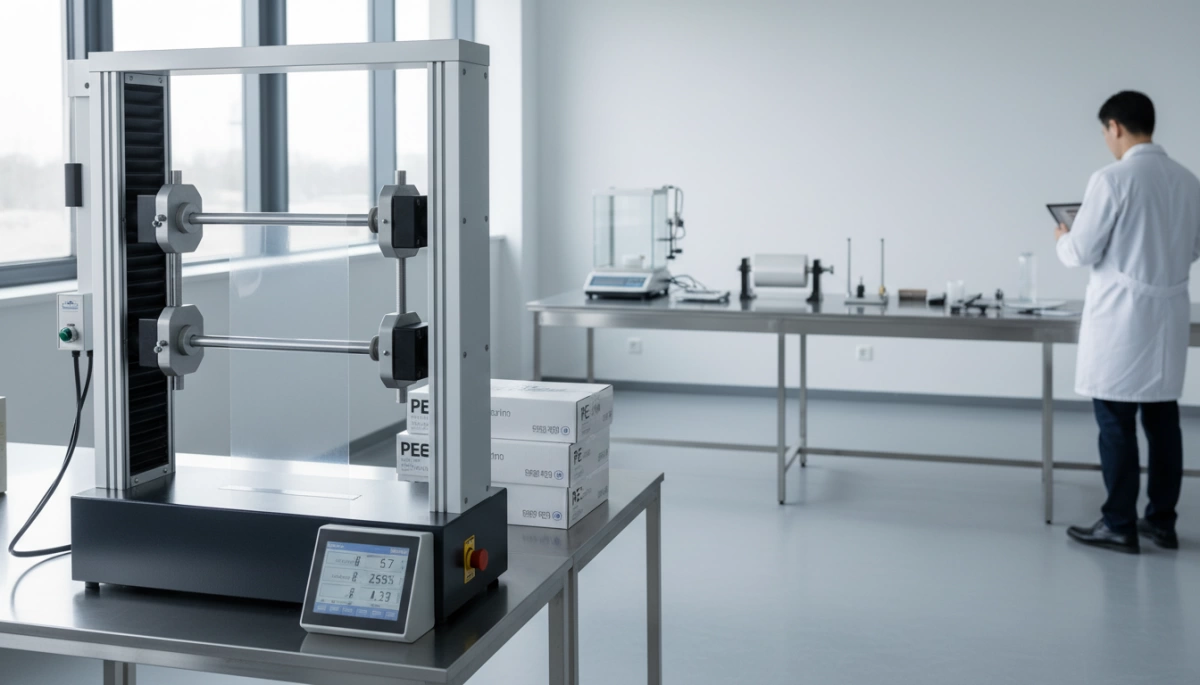
Universal Testing Machine (UTM) for Thin Plastic Films
For PE cling film tensile tests, a low‑capacity universal testing machine (UTM) is ideal. Key points:
- Capacity in the 1–5 kN range is usually enough for polyethylene cling film
- High crosshead speed control for polyethylene film elongation testing
- Software that outputs stress–strain curves, tensile strength, and elongation at break
Load Cells, Grips, and Film Fixtures
Use load cells sized close to your expected PE film tensile strength so you get accurate readings at low forces. For grips:
- Pneumatic or self‑tightening grips to prevent slip on thin plastic wrap
- Wide, rubber‑faced jaws to avoid cutting or damaging film edges
- Dedicated film clamps for consistent gauge width across tests
Inclined Plane and Peel Cling Fixtures
For stretch wrap cling measurement and peel cling test methods (like ASTM D5458):
- An inclined plane fixture to measure the sliding angle and cling behavior between film layers
- A 180° or 90° peel fixture to measure cling force at a set speed
- Adjustable angle and speed control to simulate real pallet wrap and food-wrap conditions
These same peel setups are critical when we design custom-branded cling film for private label clients; we rely on stable cling results to keep packaging performing well in retail and food-service channels. You can see how we approach that on our page about custom branded cling film OEM/ODM solutions.
Extensometers and Displacement Measurement
Accurate elongation at break cling film values depend on precise strain measurement:
- Non-contact extensometers (video or laser) work best on highly stretchable PE films
- Crosshead displacement is acceptable for basic in‑house plastic film stretch properties checks, if gauge length is short and grip slip is controlled
Environmental Chambers and Conditioning
Because temperature and humidity change how polyethylene behaves, I recommend:
- An environmental chamber or at least a controlled room for environmental conditioning for film tests
- Stable conditions (e.g., 23 °C, 50% RH) before and during testing to match common US lab practice
Calibration and Avoiding Slippage or Misalignment
To keep your polyethylene stretch wrap testing repeatable:
- Calibrate load cells, displacement, and speed on a regular schedule
- Check jaw alignment so the film pulls straight—no bending or twisting
- Use anti-slip jaw surfaces and consistent clamping pressure to stop grip slippage
- Run quick daily checks using a control roll of cling film as a benchmark
With this basic setup in place, a PE cling film factory can run reliable in‑house cling film quality control on tensile strength, elongation, and peel cling without over-investing in overly complex lab gear.
Tensile and Elongation Test Procedure (ASTM D882)

Sampling PE cling film across rolls and batches
For reliable PE cling film tensile tests, I always pull samples from:
- Start, middle, and end of each roll
- Multiple rolls per batch (at least 3–5)
Label each strip with roll, batch, and direction (machine direction / transverse direction). That’s the only way to catch real production variation and protect downstream customers like restaurants and food processors who buy bulk cling film for daily use.
Specimen cutting and edge quality
For ASTM D882 plastic film testing:
- Common strip width: 25 mm (1 in), length: 150–250 mm
- Use a cutting die or precision cutter, not scissors
- Keep edges smooth, straight, and free of nicks
- Avoid wrinkles and gauge bands when choosing locations
Bad edges will make tensile strength and elongation at break look worse than the film really is.
Conditioning time, temperature, and humidity
Before we test PE cling
Peel Cling Testing Under Stretch Conditions (ASTM D5458)

Why peel cling testing matters for PE cling film
For PE cling film and stretch wrap, peel cling testing tells us how well the film sticks to itself without adhesives. Under ASTM D5458, we measure cling force so we can:
- Control how tight the wrap holds trays, food containers, or pallets
- Avoid over-cling (films that block or are hard to unwind)
- Compare food-grade vs industrial stretch wrap performance in real use
For our U.S. customers, this is how we keep cling consistent from roll to roll so your wrapping lines stay stable and fast.
Preparing film layers and peel strips
To run a reliable peel cling test on PE cling film:
-
Cut base film:
- Use clean, straight strips (typical width: 50–100 mm / 2–4 in)
- Match the same thickness, lot, and orientation you use in production
-
Prepare peel strips:
- Same film or a defined “test” film as the peeling layer
- Make sure edges are smooth (no nicks or tears)
- Avoid fingerprints, dust, or oil on the test area
-
Contact area:
- Lay the peel strip on the base film under light, consistent pressure
- Define overlap length (per ASTM D5458) and keep it the same every time
Clean handling is key—any contamination changes cling results and hides the real behavior of your polyethylene cling film.
Setting pre-stretch conditions (optional)
In real life, PE stretch wrap is almost always used under tension. To match that:
- Set pre-stretch level (common ranges: 50–300%)
- Use a tensioning device or UTM to stretch the film to the target percentage
- Let the film relax for a short, consistent time (e.g., 30–60 seconds) before bonding layers
- Record:
- Pre-stretch percentage
- Direction of stretch
- Time between stretch and test
This tells you how cling changes when the film is actually used on pallet wrappers or manual dispensers in your warehouse.
Configuring inclined plane or peel test setup
ASTM D5458 allows different ways to measure stretch wrap cling:
-
Inclined plane setup:
- One film layer is fixed on the plane
- The second layer overlaps and clings
- Increase the angle or apply a known weight and measure the force to slide apart
-
Peel test on UTM:
- Clamp base layer in a fixed grip
- Clamp peel strip in the moving grip
- Peel at a fixed angle (usually 180° or 90°) and constant speed
- Record force vs. time
Key setup points:
- Correct angle (per method)
- Stable speed (no jerks)
- No wrinkles or trapped air between layers
Running the peel cling test and recording cling force
Once the setup is locked in:
-
Bond the layers
- Apply a consistent pressure across the overlap
- Keep the same dwell time before peeling
-
Start the test
- Run at the specified test speed (commonly 250–300 mm/min for films)
- Record the cling force continuously
-
Capture results
- Note average cling force (N/m or gf/in) over the steady region
- Ignore the initial spike caused by starting the peel
-
Repeat
- Test multiple specimens across the roll width and from different rolls/batches for QC
For customers comparing multiple food-packaging suppliers, this type of cling measurement is as critical as price and MOQ when evaluating B2B food packaging solutions such as different packaging materials and formats.
Comparing stretched vs unstretched cling
To understand how your PE stretch film cling behaves in the field:
- Test unstretched film (baseline cling)
- Test at different pre-stretch levels (e.g., 50%, 100%, 150%, 200%)
- Plot cling force vs. pre-stretch %
What you’re looking for:
- Does cling increase with stretch then plateau or drop?
- Does cling stay strong enough at your usual wrapping tension?
- Is there a risk of blocking when film is not stretched (storage, unwinding)?
This helps set the right pre-stretch on your pallet wrapping lines and on manual dispensers.
Checking multi-layer cling consistency and stability
For multi-layer PE films and co-extruded cling wraps:
- Test cling both sides if you have one-sided or two-sided cling
- Compare:
- Inside vs outside layer cling
- Across film width (edge vs center)
- Early-life vs aged samples (after storage at room and elevated temperature)
Watch for:
- Zones with weak cling (poor load stability)
- Zones with too strong cling (blocking, hard unwinding)
- Drift in cling as additives migrate or as the film ages
By locking in a tight peel cling test method with ASTM D5458, we keep our PE cling films predictable and easy to use in U.S. food-service kitchens, grocery backrooms, and warehouse operations.
Factors Influencing Stretch Test Results for PE Cling Film
Film Thickness and Gauge Variation
Film thickness is the first thing that will shift your stretch test results. Small gauge changes (±2–3 μm) can move tensile strength, elongation, and puncture resistance more than most people expect. For reliable PE cling film tensile tests:
- Keep gauge variation under tight control across and along the web.
- Always record thickness at the test location using a micrometer.
- Compare lots at the same nominal thickness to avoid false “quality” swings.
If you’re targeting downgauging for cost or sustainability, you’ll need even tighter thickness control to keep stretch performance and elastic recovery consistent.
Resin Type: LLDPE vs LDPE and Blend Ratios
Your resin recipe drives most of your polyethylene film elongation testing results:
- LLDPE (especially C6/C8) → higher tensile strength, better load-bearing, stronger puncture and tear resistance, usually higher usable stretch.
- LDPE → softer hand-feel, easier cling development, but lower tensile and lower puncture resistance.
- Blends → we tune LLDPE/LDPE/EVA to balance clarity, noise, stiffness, and cling.
Always log grade, MI, and density with your stretch data. If a roll fails spec, resin drift is often the first place we look.
Additives and Tackifiers
Cling performance and stretch behavior are very sensitive to additives:
- Tackifiers raise cling force but can lower modulus and affect unwind.
- Slip and antiblock can reduce cling and peel force if overdosed.
- Antioxidants and UV stabilizers help keep tensile and elongation stable over time.
When you change additive levels, re-run ASTM D882 tensile and ASTM D5458 peel cling tests side by side. That’s the only way to see the real tradeoff between stretch, cling, and handling.
Blown vs Cast Film and Orientation
Blown and cast PE stretch films don’t behave the same under test:
- Blown film → more balanced MD/TD properties, stronger puncture and better tear resistance, but more gauge variation.
- Cast film → tighter gauge control, better clarity and quieter unwind, but often more machine-direction orientation.
During PE cling film tensile tests, always note direction (MD/TD). Cast films usually show higher MD elongation and different necking behavior, which affects how far customers can safely pre-stretch on pallet wrappers or in kitchen applications.
If you’re supplying cling film to customers who also use reusable packaging solutions (for example, pairing film with stainless steel bento-style containers), this consistency in orientation and gauge really matters for sealing, cutting, and re-covering food.
Temperature, Humidity, and Aging
Polyethylene is sensitive to test conditions and shelf life:
- Low temperature → film feels stiffer, lower elongation, higher apparent modulus.
- High temperature → softer film, higher elongation, lower tensile at break.
- Humidity has less impact on PE itself, but can affect tackifier behavior and surface feel.
- Aging → oxidation and tackifier migration can change cling force and tear resistance over weeks or months.
For reliable data:
- Condition samples at standard lab conditions before testing.
- Run aging studies (e.g., 1, 3, 6 months) to see how cling and tensile strength drift under typical U.S. warehouse storage.
Handling, Storage, and Test Timing
How you handle film between production and testing can easily ruin stretch test results:
- Don’t test hot rolls straight off the line; let them cool and relax.
- Store test rolls away from direct heat, UV, and dust.
- Avoid edge damage, crushing, or deformation that can cause premature breaks.
- Keep test timing consistent (e.g., 24 hours after production) so lots are comparable.
If your PE cling film is going into U.S. distribution with long shipping times, simulate that in your timing: test right after production and again after realistic storage to make sure cling and stretch performance stay within spec.
Sustainable and Eco-Friendly PE Cling Film Testing

When we test sustainable and eco-friendly PE cling film, the stretch tests have to prove two things at the same time: good mechanical performance and real environmental value.
Stretch performance of biodegradable and recyclable PE films
For biodegradable PE films and recyclable PE cling film, we always compare:
- Tensile strength and elongation at break vs. our standard LLDPE cling film
- Elastic recovery and load-holding after stretch, to see if the film still grips tightly
- Puncture resistance and tear strength, especially for heavy or irregular food packaging
Most bio-based or modified PE films show:
- Slightly lower tensile strength
- Different elongation behavior (they may stretch less or neck sooner)
That’s why consistent stretch testing is critical before putting them into daily kitchen use or food-service environments where durability matters as much as sustainability.
Comparing with conventional PE cling film
In our lab, we benchmark every new eco film directly against our regular PE cling film tensile test data:
- Same thickness and width for fair comparison
- Same test speed, gauge length, and conditioning
- Overlayed stress–strain curves so we can see differences in stiffness, peak strength, and usable stretch range at a glance
If the eco film can hit 80–90% of the performance of our standard film at the same or slightly higher thickness, it’s usually a good candidate for U.S. homes, meal-prep users, and food-service customers who care about both quality and waste reduction.
Adjusting test parameters for bio-based or modified PE
Bio-based PE and modified formulations can be more sensitive to:
- Temperature – they may soften sooner, so we tighten environmental control
- Test speed – we sometimes run a slower crosshead speed to avoid shock failure
- Clamping pressure – softer films need careful grips to prevent cutting or slippage
We keep the core of ASTM D882 plastic film testing but may add:
- Extra intermediate stretch points (e.g., 50%, 100%, 150%)
- More frequent elastic recovery checks after loading/unloading
This helps us design films that feel “normal” in the hand, wrap tightly, and don’t tear too easily when pulled off the roll.
Compliance with environmental and food-contact regulations
For U.S. customers, eco cling film must be:
- Food-contact compliant (FDA 21 CFR for food-contact plastics)
- Free from harmful plasticizers, heavy metals, or unsafe additives
- Produced under good manufacturing practice for consistent quality
At the same time, we focus on:
- Recyclability within existing PE streams where possible
- Clear labeling to reduce contamination of recycling bins
- Alignment with global sustainability expectations that many American families already follow with reusable items like stainless steel lunch boxes, similar to those discussed in this stainless steel lunch box guide.
Long-term performance and stability in use
Eco PE films must not break down too soon during normal storage and use. We run:
- Aging tests at elevated temperature and humidity
- Shelf-life simulations – checking tensile strength and cling after weeks or months
- Repeat wrap/unwrap cycles to see if the cling, clarity, and stretch stay stable
Our goal is simple: eco-friendly polyethylene film elongation testing that proves you can have a greener cling film without giving up everyday usability, strong cling, and reliable stretch performance in American kitchens and food businesses.
Common Stretch Testing Issues and Troubleshooting for PE Cling Film
Premature Film Break & Low Elongation
If your PE cling film fails early in ASTM D882 tensile tests or shows low elongation at break:
- Check the film first
- Measure thickness and look for gauge bands, gels, or edge damage.
- Avoid wrinkles, creases, or nicks when you cut specimens.
- Check test conditions
- Confirm conditioning time, temperature, and humidity are per spec.
- Make sure test speed and gauge length match your standard method.
- Check material changes
- Review resin lot, LLDPE/LDPE blend ratios, and tackifier levels.
- Compare fresh rolls vs aged rolls to see if aging or storage is an issue.
Grip Slippage, Necking, and Wrong Failure Location
For thin polyethylene film elongation testing, grip setup is critical:
- Prevent grip slippage
- Use rubber-faced or pneumatic grips sized for thin films.
- Increase clamping pressure gradually; avoid crushing the film.
- Use anti-slip tabs (paper or plastic tabs) on very thin gauges.
- Control necking and failure
- Keep edges clean and parallel; no razor nicks.
- Ensure failure happens within the gauge length—if not, adjust grip type, grip pressure, or gauge length.
- Re-cut specimens if you see repeated edge tears or jaw breaks.
Inconsistent Cling Results Between Layers or Rolls
When peel cling test method results (ASTM D5458) are all over the place:
- Standardize how you prepare samples
- Always test from the same film side (inside vs outside).
- Use the same pre-stretch percentage and dwell time before testing.
- Avoid dusty, oily, or wet surfaces between layers.
- Control process variation
- Track roll position across the web—edge vs center.
- Monitor tackifier levels and chill roll temps on cast film lines.
- Check storage
- Keep rolls sealed and away from heat or UV.
- Test fresh rolls vs warehouse-aged rolls to spot cling decay.
Machine Setup Errors & Calibration Drift
Any PE film tensile strength or cling force measurement is only as good as your setup:
- Verify calibration regularly
- Calibrate load cells, displacement, and speed at defined intervals.
- Run a quick daily check with a known reference film or standard strip.
- Avoid alignment errors
- Center the specimen in both grips; no twist or skew.
- Match the test method’s gauge length and clamp separation exactly.
- Maintain your equipment
- Inspect grips and fixtures for wear or buildup.
- Log all parameter changes so you can trace odd results back to setup.
Best Practices for Repeatable, Reliable Lab and In‑Line Tests
To keep cling film quality control tight and consistent across batches:
- Lock in standard test methods
- Use written SOPs for PE cling film tensile tests and peel cling tests.
- Train operators to cut, handle, and mount specimens the same way.
- Run smart sampling
- Test across the roll width and at the start/middle/end of rolls.
- Track data by roll, line, resin lot, and production date.
- Use data, not guesswork
- Watch trends in tensile strength, elongation at break, and cling force.
- Set internal spec limits that match your customers’ real use cases, like food wrap, meal prep, or refrigerated storage alongside durable food containers.
A tight test setup and clear troubleshooting routine help keep your polyethylene stretch wrap testing fast, accurate, and aligned with what U.S. customers actually feel when they stretch and use your PE cling film.
Frequently Asked Questions on Stretch Testing PE Cling Film
1. What’s the difference between tensile strength and elongation in PE cling film?
- Tensile strength tells me how much load the PE cling film can carry before it breaks. For pallet wrap or industrial stretch wrap, this is key for load stability and damage prevention.
- Elongation at break shows how far the film can stretch (as a percentage of its original length) before it snaps. For food-grade PE cling film, good elongation means tight wrapping without tearing.
- In simple terms:
- High tensile strength = stronger film, better holding force
- High elongation = more stretch, better conformability
- When I review test data, I always look at both together to balance downgauging (thinner films) with real-world performance.
2. How does pre-stretch affect load stability and cling performance?
Pre-stretch is a big deal for both pallet wrap and heavy food-service rolls:
- Higher pre-stretch:
- Increases containment force and improves load stability
- Reduces film usage per pallet, cutting material cost
- Can reduce surface cling if the film is overstretched
- Too much pre-stretch:
- Can cause film neck-down, edge tears, or “roping”
- May reduce effective cling, especially in cold rooms
- For U.S. warehouses and distribution centers, I usually see optimal pre-stretch in the 200–300% range for industrial stretch film, adjusted based on resin, gauge, and tack level.
3. How does biodegradable PE stretch film behave vs standard PE cling film?
Biodegradable and recyclable PE cling films are getting more traction as brands move toward sustainable packaging in the U.S.:
- Biodegradable or bio-based PE films often have:
- Lower elongation at break
- Slightly lower tensile strength and puncture resistance
- More sensitivity to temperature and aging
- I typically tweak test parameters:
- Use careful conditioning before tensile and peel cling tests
- Track performance over time to monitor long-term stability
- The goal is to match standard PE cling performance as closely as possible while supporting corporate sustainability goals and aligning with trends in sustainable packaging demand.
4. What’s the minimum equipment for basic in-house PE cling film testing?
If you’re running a factory or converting plant and want practical QC without a full lab, I’d start with:
- A small tensile testing machine for films (even a compact bench-top unit) with:
- Low-capacity load cell (up to 500–1000 N)
- Film-friendly grips to avoid slippage and edge breaks
- A simple cling test setup:
- Inclined plane or basic peel fixture to compare cling force between batches
- A micrometer for thickness and a basic scale if you monitor yield and downgauging
- Controlled room conditions (or at least stable temperature) so your results aren’t all over the place
This setup is usually enough for day-to-day checks on PE cling film tensile strength, elongation at break, and basic cling film quality control.
5. Which standards matter most for food-contact PE cling film?
For U.S. food-service and retail wrap, I keep an eye on both mechanical standards and food-contact rules:
- Key mechanical test standards:
- ASTM D882 – tensile strength and elongation of thin plastic films
- ASTM D5458 – peel cling test method for stretch wrap films
- For food-contact compliance:
- FDA 21 CFR regulations for materials in contact with food
- Migration limits and additive controls (especially plasticizers, tackifiers, and slip agents)
- For food-grade PE cling film testing, I always confirm:
- The film passes tensile and elongation targets
- Cling is strong enough to seal but not so aggressive that it blocks or welds
- All resins, masterbatches, and additives are approved for direct food contact
By aligning our PE cling film testing with these standards, I can confidently supply films that perform well on the shelf, in the kitchen, and across U.S. distribution channels.