
















If you’re planning to source cling film (PE food wrap) and you’re not using a full factory audit checklist, you’re taking a bigger risk than you think.
A supplier can show you glossy samples and perfect prices… and still fail on food safety, regulatory compliance, or process control once real production starts. That’s where a Full Factory Audit Checklist for Cling Film becomes your best insurance policy.
In this guide, you’ll
Section 1 – Company Overview & Legal Compliance
When you audit a cling film factory, start by checking whether the manufacturer is even legally allowed to produce and export food contact PE cling film. Here’s the core of a full factory audit checklist for cling film at company level.
1.1 Business License, Export Status, Factory Registration
Verify the legal foundation of the supplier:
- Valid business license
- Company name, address, and business scope clearly cover plastic packaging / PE film production
- Registration is active; no abnormal or revoked status
- Export qualifications
- Import–export license where required
- US and target-market registration (if applicable, e.g., FDA device/food-contact facility registration)
- Factory registration
- Same legal entity on the license, invoices, COA, and contracts
- No hidden subcontracted site that’s not disclosed to you
Auditor tip: If the company on the test reports is different from the business license, push for an explanation and supporting contracts.
1.2 Food Contact Declarations and Certifications
For a food contact plastic audit, documentation is everything. Ask for:
- Food Contact Declaration of Compliance (DoC)
- For EU 10/2011 compliant food wrap: clear reference to EU 10/2011, EC 1935/2004, and relevant standards
- For FDA compliant cling film: specific CFR references (e.g., 21 CFR for LDPE/LLDPE)
- Migration testing for cling film
- Overall and specific migration test reports for simulants relevant to meat, vegetables, and fatty foods
- Test conditions reflecting real use (contact time, temperature, single vs repeated use)
- Third-party certifications
- BRCGS Packaging, ISO 22000, FSSC 22000, ISO 9001 (check scope includes PE food wrap / cling film)
- Current certificates, valid dates, and certification body accreditation
Auditor tip: Confirm test report authenticity by checking lab accreditation (ISO 17025), QR codes, and contacting the lab when in doubt.
1.3 Social Compliance and Ethical Sourcing
US buyers increasingly expect social compliance audit coverage for packaging suppliers:
- Programs and memberships
- BSCI, Sedex (SMETA), SA8000, or equivalent
- Scope of audit (whole site or partial)
- Latest audit status
- Date of last BSCI/Sedex audit and result (rating, critical findings, corrective actions)
- Evidence of closed CAPA for child labor, forced labor, excessive overtime, or unsafe conditions
- Policies
- Written code of conduct, anti-discrimination, anti-harassment, freedom of association
Auditor tip: Ask for the complete audit report, not just the or score.
1.4 Environmental Permits and Waste Management
For a cling film factory audit checklist, environmental control is both a compliance and brand-risk issue:
- Environmental permits
- Local government permits for air emissions, noise, and solid waste
- Validity dates and scope covering blown film extrusion and printing, if any
- Emissions and waste
- System for collecting and filtering fumes from extrusion
- Clear segregation of scrap, resin waste, and contaminated materials
- Evidence that waste is handled by licensed recyclers/disposal companies
- Waste management policy
- Written policy for plastic scrap reduction, recycling rate, and safe handling
- Records of hazardous chemical disposal (inks, solvents, cleaning agents)
Key takeaway: If a cling film supplier cannot show clear legal status, valid food-contact documentation, social compliance, and environmental control, they’re a high risk—no matter how attractive the price looks.
Section 2 – Raw Material Control for Cling Film

When we audit a PE cling film factory, raw material control is one of the first things we drill into. If the resin or additives are off, no amount of downstream QC will fix it.
Approved LDPE/LLDPE Supplier List
We only work with approved virgin LDPE/LLDPE suppliers that are qualified for food contact plastic:
- Documented approved supplier list with contact info, plant location, and scope (resin grades, additives).
- Qualification records: sample evaluation, food contact compliance review (FDA, EU 10/2011), and trial runs.
- Clear rule: no unapproved or recycled resin in food grade cling film unless explicitly specified and tested.
Supplier Audits, CoA, and Specs
A solid PE film supplier qualification program should include:
- Periodic supplier audits (on-site or remote) covering GMP, traceability, migration testing, and change control.
- Certificates of Analysis (CoA) for every batch: MFI, density, slip level, additives, and heavy metal status.
- Agreed material specifications for each resin and masterbatch, with tolerances and test methods listed.
Migration and Restricted Substance Testing
For food contact plastic audit work, we always verify:
- Valid migration test reports for cling film (overall and specific migration) for intended food types and conditions.
- Compliance against EU 10/2011, FDA, or other customer-required standards.
- Heavy metal, phthalate, and restricted substance test reports from ISO/IEC 17025-accredited labs.
- A clear process to re-test when:
- Resin supplier changes
- Additives/formulation change
- New markets or higher temperature applications are added
When brands also use other food packaging like poly bags for food packaging, we align the same migration and restricted substance expectations across all SKUs.
Incoming Raw Material Inspection and Rejection
A strong cling film quality control checklist always covers incoming material:
- Written incoming raw material inspection SOPs for resin, masterbatch, and additives.
- Checks for:
- Packaging integrity and labeling
- CoA vs spec review
- Visual inspection for contamination, lumps, moisture
- Basic quick tests (MFI, moisture, color tone) when required
- Clear reject criteria and documented disposition (return to supplier, scrap, or downgrade to non-food use).
Identification, Labeling, and Segregation
To protect food grade cling film compliance, the factory must:
- Label all raw materials with:
- Material name and grade
- Supplier and batch/lot number
- Arrival date and status (quarantine, released, rejected)
- Physically segregate:
- Food contact vs non-food grades
- Virgin resin vs regrind/recycled
- Approved vs quarantined materials
- Use barcode/ERP or at least manual logs to maintain traceability from resin to finished roll.
Storage Conditions and FIFO/FEFO
Poor storage kills performance, especially anti-fog and slip:
- Resin and additives stored:
- Off the floor and away from walls
- Protected from direct sunlight and moisture
- In controlled temperature/humidity where required
- Use FIFO or FEFO:
- Oldest batch used first
- Sensitive additives (anti-fog, slip) used before expiry
- Humidity and temperature logged in the warehouse, especially for hygroscopic additives.
Controls for Masterbatch and Additives
For cling film production process control and consistent roll performance, we look for:
- Approved color masterbatch, slip, anti-fog, and cling additives with:
- Food contact declarations
- Migration and restricted substance reports
- Defined additive dosing ranges by product spec (household vs catering cling film).
- Controlled storage and identification (additive name, usage level, expiry date).
- Periodic verification that dosing matches formulation and that film meets:
- Anti-fog performance tests
- Cling behavior checks
- Slip coefficient/“easy unroll” behavior
With this raw material control framework, you avoid most of the common audit failures seen in food contact packaging factory audits and set up a stable base for consistent, compliant cling film production.
Section 3 – Cling Film Production Process and Equipment
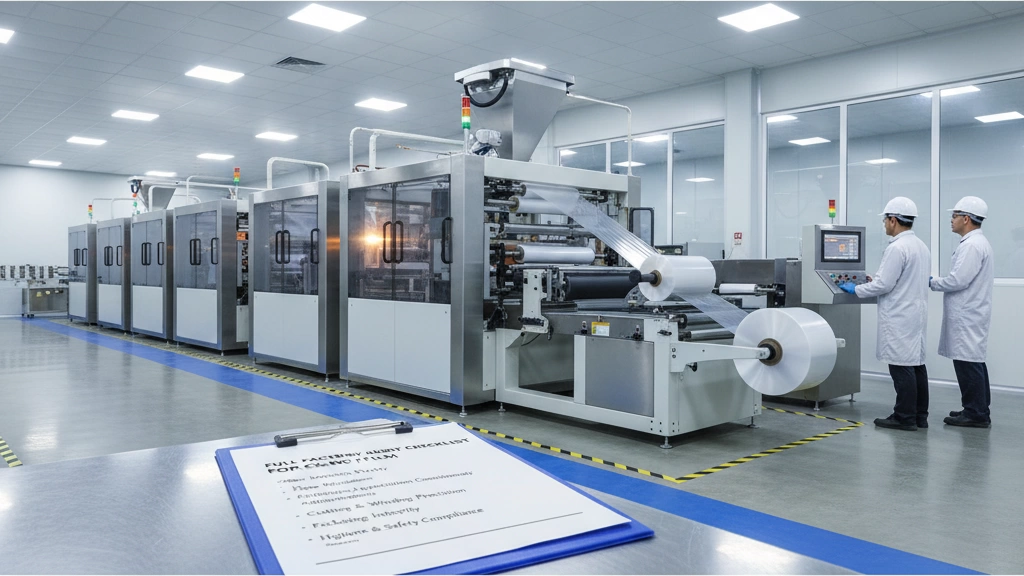
For a full factory audit checklist for cling film, the production line and equipment control are non‑negotiable. Here’s exactly what we focus on in our PE food wrap plants in the U.S. market.
Blown Film Extrusion Line Setup & Parameters
We run a documented setup for every blown film extrusion line, including:
- Standard process windows (temperatures, pressures, cooling air, line speed, blow-up ratio) per film spec
- Start-up and shutdown SOPs to avoid gels, black spots, and thickness waves
- Maintenance records for gearboxes, dies, and air rings, so film quality stays stable batch after batch
Auditors will ask to see that what’s written in the SOPs actually matches how operators are running the line on the floor.
Automatic Thickness Control & Calibration
Consistent gauge is critical for both household and catering cling film:
- Automatic thickness control systems or online measurement (cross-web and machine direction)
- Calibration history against certified gauges, usually at least once per year or per internal schedule
- Trend charts showing real data, not just “pass/fail”
If your film needs tight tolerances, thickness control is one of the first quality control points customers and third‑party auditors will dig into.
Metal Detection and X-Ray Inspection
For food contact plastic audits, foreign material control is huge:
- On-line metal detectors and/or X-ray systems after extrusion or before packing
- Verification logs (test pieces of Fe / non-Fe / stainless at defined intervals)
- Reject device checks to prove contaminated rolls cannot slip through
This is especially important for customers buying food wrap alongside other food contact items like bulk aluminum foil for food service.
Corona Treatment and Surface Energy
If the film requires printability or labeling, corona treatment has to be controlled:
- Corona treatment settings (power, line speed, electrode gap)
- Surface energy tests (dyne pens or test inks) with recorded dyne levels
- Identification of treated vs. untreated sides to avoid mix-ups
Auditors will want to see that treated film consistently meets specified dyne levels, not just “we corona everything.”
Additive Dosing Accuracy (Anti-Fog, Cling, Slip)
We keep tight control of performance additives so film behaves the same in every box:
- Gravimetric or volumetric feeders with set dosing ranges
- Verification checks (weighing masterbatch/feeders at intervals)
- Lot records tying additive batch numbers to each extrusion batch
This directly impacts anti‑fog performance, cling strength, slip, and unwinding behavior.
Cutting, Rewinding, and Core Insertion Accuracy
Downstream equipment is a major part of any cling film quality control checklist:
- Automatic length control for each roll (meter counter or encoder)
- Core insertion accuracy (no loose or off-center cores, controlled core weight)
- Rewinding tension control to prevent telescoping, wrinkles, or crushed cores
We run line checks to confirm roll width, length, and winding quality at defined intervals.
Roll Length, Width, and Core Weight Control
Customers in the U.S. want what’s printed on the box, no excuses:
- Width checks with calibrated rulers/frames
- Length checks by meter counter verification or full unwind checks per defined frequency
- Core weight and type standardized per SKU, with tolerances and inspection results
All this is tied back to batch records so we can prove compliance when needed.
Cleanroom or Controlled Environment Claims
If any “cleanroom” or “high hygiene” claim is made, the audit will verify it:
- Defined room classification or control standard (e.g., filtered air, overpressure, particle control)
- Environmental monitoring records (particulate, temperature, humidity if required)
- Controlled entry (gowning, restricted access, cleaning schedules)
Any claim has to be backed by validation and monitoring, not just marketing.
Equipment Cleaning, Lubrication, and Preventive Maintenance
To meet cling film GMP audit expectations, we maintain:
- Cleaning schedules for extruders, dies, nip rollers, and rewinding lines
- Food-grade lubricants where there is any risk of contact
- Preventive maintenance plans with dates, responsible person, and completed records
This helps reduce black spots, contamination, and unplanned downtime.
Backup Equipment and Downtime Contingency
Reliable supply is part of being a serious PE film supplier:
- Backup key equipment or alternative lines for critical products
- Spare parts inventory for high-wear items (heaters, sensors, drives, blades)
- Contingency plans for long downtime (outsourcing policy, priority scheduling, communication with customers)
For many U.S. buyers, this is the difference between a low-risk supplier and a one‑line operation that can’t guarantee delivery.
Section 4 – In-Process and Finished Product Quality Control
As a PE cling film supplier to the U.S. market, I treat in‑process and finished product quality control as non‑negotiable. This is where we lock in consistency, food safety, and performance for every roll that leaves our factory.
Documented QC Plan & Inspection Points
We run a documented QC plan that defines:
- Inspection points: resin feeding, extrusion bubble, film cooling, winding, rewinding, slitting, packing.
- Who does what: clear responsibilities for operators, in‑line inspectors, and lab technicians.
- What we check: dimensions, appearance, mechanical properties, cling performance, packaging, and labeling.
Every line has a visible QC checklist so operators and QC staff are aligned in real time.
Testing Frequency: Width, Thickness, Tensile, Elongation
For U.S. buyers, dimensional and mechanical stability are usually the first things they ask about. We test on a fixed schedule:
- Width: checked at start‑up, after any adjustment, and at set intervals (e.g., every 30–60 minutes).
- Thickness (gauge): monitored continuously with on‑line systems plus manual micrometer checks per roll or per set number of logs.
- Tensile strength & elongation: tested per batch or per defined number of jumbo rolls to ensure film won’t snap or deform too easily in household and catering use.
All test frequencies are written into SOPs so they’re executed the same way on every shift.
Cling Performance & Peel-Off Behavior
A cling film is only as good as its cling performance. We run:
- Cling/peel tests against standard plates or itself to confirm proper adhesion without over‑sticking.
- Peel‑off behavior checks to make sure the film:
- Separates cleanly from the roll.
- Doesn’t block (layers stuck together).
- Unwinds smoothly on manual and automatic dispensers.
For anti‑fog or high‑cling grades, we add functional checks that simulate real kitchen and foodservice conditions.
AQL Standards for Visual Defects
We work with clear AQL standards tailored to cling film, focusing on:
- Gels and black spots
- Wrinkles and creases
- Fish eyes, holes, streaks, and contamination
Typical practice:
- Define critical, major, minor defects.
- Use AQL sampling (e.g., based on ANSI/ASQ Z1.4) for each lot.
- Reject or rework lots that exceed the agreed defect limits.
Your AQL requirements can be built into our QC plan so what we release already matches your spec.
Sampling Size, Method & Acceptance Criteria
To avoid guesswork, we standardize:
- Sampling size: based on order quantity, number of rolls, or jumbo reels.
- Sampling method:
- Random selection across start, middle, and end of production.
- Coverage across different machines and shifts.
- Acceptance criteria: numeric limits for:
- Thickness tolerance.
- Tensile/elongation range.
- Cling test values.
- Maximum allowed defects per m² or per roll.
All of this is documented so you can audit and verify how decisions are made.
Nonconforming Product Control
Any roll that doesn’t meet spec is treated as nonconforming product and:
- Clearly labeled and moved to a quarantine area.
- Logged with defect type, root cause, and disposition (rework, downgrade, scrap).
- Reviewed by QA before any decision to re‑use or reprocess.
This keeps off‑spec film away from outbound shipments and prevents mix‑ups.
Retention Sample Policy
For traceability and claim support, we keep retention samples:
- Retain samples from each batch/lot of cling film.
- Store in a controlled warehouse or lab cabinet, protected from dust, heat, and sunlight.
- Keep them for a defined retention period (often tied to shelf life + extra buffer), so we can re‑test if there’s a complaint or regulatory question.
Retention samples are labeled with batch/lot number to match your shipments.
Laboratory Equipment & Calibration
Our lab equipment is matched to cling film performance needs, typically including:
- Micrometers and thickness gauges.
- Tensile testing machine.
- Cling and peel test setups.
- Scales, rulers, and other dimensional tools.
All instruments carry calibration certificates (internal or third‑party) with:
- Calibration dates and due dates.
- Traceability to national or international standards.
- Records of any adjustments or repairs.
We don’t release production based on equipment that’s out of calibration.
Internal vs Third-Party Testing
We balance internal testing and third‑party testing:
- Internal lab: daily routine checks for each production batch.
- Third‑party labs: periodic verification of key parameters and regulatory tests (e.g., migration, heavy metals, performance confirmation).
We compare and correlate data to catch any drift between our lab and external labs. If there’s a difference, we investigate and adjust our methods.
If you use a third‑party cling film inspection company, we can align our test methods with theirs to keep reports consistent.
COA Issuance & Batch Linkage
Every shipment can be supported with a Certificate of Analysis (COA) that includes:
- Batch/lot number and production date.
- Key test results: width, thickness, tensile, elongation, visual checks, and any special performance data you require.
- Reference to the relevant food contact compliance tests (e.g., EU 10/2011, FDA‑related testing) performed on the same or representative batches.
The COA is linked directly to the production batch and shipment, so if there’s ever a market issue or recall simulation, we can track back from your pallet to the exact production run and raw materials.
If you’re also sourcing related products like foil for oven and air fryer use, our approach to QC mirrors what we put into our food‑contact aluminum foil manufacturing: traceability, documented control points, and verifiable test data at every step.
Section 5 – Food Safety and Hygiene Management in Cling Film Plants
As a PE cling film supplier to the U.S. market, I treat food safety the same way restaurants treat their kitchen rules: zero shortcuts. This part of our full factory audit checklist for cling film is all about proving that our plant is clean, controlled, and ready for food contact packaging.
HACCP / ISO 22000 for Cling Film Production
I expect every cling film factory we work with to have:
- A documented HACCP plan or ISO 22000 system specific to PE food wrap.
- Clear hazard analysis for:
- Raw materials (resins, additives, inks, oils).
- Process steps (extrusion, slitting, rewinding, packing).
- Packaging materials (cores, cartons, film overwrap).
- Defined CCPs (Critical Control Points) like metal detection, contamination control, and label/batch verification.
We review the HACCP flow chart, hazard analysis, CCP limits, verification records, and annual review reports during every cling film HACCP audit.
Hazard Analysis for Raw Materials and Process Steps
For a food contact plastic audit, we look for:
- Risk
Section 6 – Full Factory Audit Checklist for Cling Film: Packaging, Warehousing & Traceability
As a PE cling film supplier to the U.S. market, I treat packaging, storage, and traceability as non‑negotiable. This is exactly what I check and maintain in our factories and what you should verify in any full factory audit checklist for cling film.
Packaging Specifications: Cartons, Labels, and Protection
For food-grade cling film, packaging has to protect the film and clearly identify it.
What I standardize and what you should audit:
- Inner cartons & master cartons
- Defined specs for board strength, dimensions, and loading weight limits
- Cartons must withstand normal U.S. distribution (truck + warehouse + last-mile)
- Food contact indication and clear “PE cling film” or “food wrap” labeling
- Labels
- Product name, film size (width, length, thickness), core type
- Batch/lot number, production date, factory code, and intended market (e.g., “US FDA”)
- Barcodes or QR codes where requested by retailers
- Palletization & stretch-wrap
- Stable stacking pattern (no overhang, controlled height)
- Corner protection where needed
- Stretch-wrap tight enough to prevent shifting, but not crushing cartons
This level of packaging control is the same standard I apply when we ship other food-contact products, like our large reusable food storage bags, to make sure they arrive clean and damage-free.
Protection From Dust, Moisture, and Damage
Cling film is thin and easily damaged. I require:
- Shrink or poly bag protection for individual rolls or small bundles
- Sealed cartons (no open tops in dusty areas)
- Pallets stored off the floor, away from walls, and protected from leaks, condensation, or direct sunlight
- No exposed film in warehousing or staging areas unless it’s in a controlled, clean area
Warehouse Zoning & Storage Practices
A proper cling film factory audit checklist must include how the warehouse is laid out and managed.
We strictly separate:
- Raw materials: resins, additives, cores
- WIP (work in process): semi-finished rolls, jumbo rolls
- Finished goods: packed, QC-released product only
- Quarantine area: on-hold, suspect, or rejected stock, clearly marked and blocked from use
I expect clear floor markings, signage, and a warehouse map. No mixing of food-contact and non-food-contact items that might risk contamination.
Temperature, Humidity & Stock Rotation (FIFO/FEFO)
Even PE film is sensitive to extremes. For U.S. customers, I maintain:
- Temperature & humidity monitoring
- Thermo-hygrometers in key areas
- Recorded readings (manual logs or digital system)
- Defined acceptable ranges and documented actions if limits are exceeded
- Stock rotation
- FIFO (First-In-First-Out) for standard cling film
- FEFO (First-Expiry-First-Out) if there’s a defined shelf-life or specific customer requirement
- Clear visual identification of receive dates or best-before dates
Batch Codes, Lot Numbers & Traceability
A strong food wrap traceability system is mandatory for a food contact plastic audit.
We design batch coding so you can:
- Read it easily on:
- Each roll (if requested)
- Each inner carton
- Each master carton and pallet label
- Decode:
- Production date and shift
- Line number
- Formula or resin grade
- Factory location (if multi-site)
Full traceability means:
- From resin and additives → extrusion line → roll → carton → pallet → shipment
- Audit trails that show:
- Raw material supplier batch numbers
- Internal process records (line, time, parameters)
- QC results linked to that exact batch
When we ship, every COA and packing list is tied back to these lot numbers to support FDA-compliant cling film and EU 10/2011 compliant food wrap requirements.
Recall Simulation & Traceability Tests
To pass a serious cling film factory audit checklist, you need proof, not just promises.
I run and document:
- Recall simulations
- Pick a finished batch and show how fast we can:
- Trace all customers and shipments that received it
- Identify all raw materials and suppliers used in it
- Target recall time: typically within hours, not days
- Pick a finished batch and show how fast we can:
- Traceability exercises
- “Forward” traceability: raw material → finished goods & customers
- “Backward” traceability: finished goods → all raw material batches
During audits, I open these records and let auditors follow real examples. This is one of the quickest ways to verify if a food contact packaging factory audit is more than just a paper system.
If you’re comparing PE food wrap suppliers, use this section as a strict, non-negotiable checklist. Any cling film factory that struggles with packaging specs, zoning, FIFO, or batch traceability will fail fast when there’s a complaint, a recall, or a regulatory check in the U.S.
Section 7 – Worker Training, Safety, and Competence (Full Factory Audit Checklist for Cling Film)

For a full factory audit checklist for cling film, auditors will dig into how we train, protect, and assess our people. In the U.S. market, buyers expect food-grade safety and strong OSHA-style safety controls, not just good product specs.
Food Safety & Hygiene Training Programs
We keep a documented training program that covers:
- Food safety basics (HACCP awareness, cross‑contamination, foreign material risks)
- Personal hygiene rules for cling film plants (gowning, handwashing, jewelry, eating/drinking restrictions)
- GMP requirements specifically for PE food wrap suppliers
Key audit points:
- Signed attendance records for all sessions
- Training for new hires before they enter production
- Annual refresher training or more often if procedures change
Machine Operation & Safety Training Matrix
Each job in cling film extrusion and packing has a defined skill set. We use a training matrix by position that shows:
- Who is authorized to operate extruders, rewinders, slitters, and packing lines
- Machine‑specific SOPs and work instructions trained and acknowledged
- Separate training for set‑up technicians, operators, helpers, and QC staff
Auditors will expect to see that no one runs a line without documented training and approval.
Lockout-Tagout (LOTO) & Emergency Shutdown
To pass a serious food contact plastic audit in the U.S., lockout‑tagout can’t be just a poster on the wall. We have:
- Written LOTO procedures for maintenance, cleaning, and troubleshooting
- Emergency stop and shutdown training for all machine operators
- Records showing who was trained, when, and on which line
Auditors will often test this by asking an operator:
“Show me how you lock out this extruder before maintenance.”
PPE Use and Condition
We define PPE requirements by area and task to protect both workers and product:
- Hairnets, beard covers, gloves, and gowns for production and QC
- Safety glasses, cut‑resistant gloves, hearing protection, and safety shoes where needed
- Regular checks that PPE is clean, intact, and properly used
During a cling film GMP audit, inspectors will walk the floor to confirm real PPE compliance, not just paperwork.
Accident, Near-Miss, and Incident Reporting
To prove continuous improvement, we maintain:
- A log of accidents, near‑misses, and unsafe conditions
- Root cause analysis and corrective actions for serious incidents
- Evidence that findings are used to update training and SOPs
This is critical for U.S. buyers who expect strong CAPA culture and transparent reporting from packaging factories.
Safety Signage, Emergency Exits, and First Aid
Our cling film factory layout is designed for safe, fast response:
- Clear safety signage at machines and hazard points
- Marked, unblocked emergency exits and evacuation routes
- First aid kits and trained first‑aid responders on each shift
Auditors often do a quick walk‑through to confirm that what’s on paper actually matches what’s on the floor.
Competency Assessments & Refresher Training
We don’t stop at one‑time training. For each critical role we have:
- Competency assessments (practical evaluations, written tests, or supervised runs)
- Defined refresher training frequency for food safety, machine operation, and safety rules
- A system to retrain immediately after procedural changes, incidents, or audit findings
For U.S. customers who care about consistent quality and food-safe film, this is what keeps our cling film quality control checklist and safety performance stable over time.
If you’re also buying other kitchen and food‑contact items, our approach to training and safety is aligned with the same standards we apply when supplying products like reusable storage bags for food that need strict hygiene and compliance controls: reusable storage bags for food.
Section 8 – Continuous Improvement & Documentation Control (Full Factory Audit Checklist for Cling Film)
For a serious cling film supplier in the U.S. market, this part of the full factory audit checklist for cling film is what separates “basic manufacturer” from “reliable long‑term partner.”
Internal Audit Program
We run a documented internal audit schedule that covers:
- Frequency: At least once per year for all key processes (raw material, extrusion, slitting, packing, warehouse, food safety, social compliance).
- Evidence: Written audit plans, detailed audit reports, photos where needed.
- Follow‑up: Clear deadlines, responsible owners, and closure status for every finding.
Auditors must be trained, independent from the area they audit, and their reports feed directly into our management review.
CAPA: Corrective & Preventive Actions
A cling film factory audit checklist will always dig into how we fix and prevent problems:
- CAPA workflow: Issue → containment → root cause → corrective action → preventive action → verification.
- Records: CAPA forms tied to specific batches, customers, or internal audits.
- Verification: We check effectiveness (defect rate trend, complaint rate, downtime data) before closing a CAPA.
No CAPA is closed without proof that the issue is actually under control.
Customer Complaints & 8D
For U.S. importers and retailers, complaint handling is critical:
- Complaint log: Date, customer, product, lot number, issue description, and impact.
- Root cause analysis: 5-Why / fishbone, plus 8D reports when the issue is serious (food safety risk, major quality issue, repeated claim).
- Feedback: Final report and corrective actions shared with the customer, with agreed timelines.
We keep complaint trends visible to management so recurring issues are not ignored.
Change Control (Resin, Formulation, Process)
Any serious PE food wrap supplier audit will check how we manage changes:
- Change scope: Resin grade, formulation (additives, slip, anti-fog, cling), thickness range, extrusion parameters, packaging specs.
- Approval: Documented review by QA, production, and sales before implementation.
- Customer notice: For critical changes (food contact, mechanical properties, migration behavior), we get written customer approval first.
- Validation: Trial runs, test reports (e.g., migration testing for cling film), and comparison against current product.
No “silent” changes that could impact food safety or performance.
Document Control (SOPs, Work Instructions, Records)
To pass any food contact plastic audit, document control must be tight:
- Controlled documents: SOPs, work instructions, HACCP plans, QC forms, specs, test methods.
- Version control: Unique ID, revision number, date, and approval signatures on each controlled document.
- Access: Only the latest version is available at the line; old versions are removed and archived.
- Record retention: Test reports, COAs, production logs, and traceability records stored for a defined period (aligned with U.S. customer and legal expectations).
KPIs for Quality, Food Safety, Delivery
We track clear KPIs that are standard in a cling film factory audit checklist:
- Quality: Defect rate per million meters, in‑process rejection, rework rate.
- Food safety: Number of food safety incidents, foreign body issues, pest findings, non‑conformances vs HACCP.
- On‑time delivery: OTIF (On Time In Full) by customer and by product.
- Customer view: Complaint rate per million rolls, average response and closure time.
These KPIs are reviewed monthly and linked to bonuses and improvement projects.
Management Review & Continuous Improvement
Top management is expected to be hands‑on:
- Management review meetings: At least annually, often quarterly, with formal minutes.
- Inputs: Internal audit results, CAPA status, customer complaints, KPI trends, regulatory changes (FDA, EU 10/2011), resource needs.
- Outputs: Clear improvement projects with timelines—e.g., investing in better thickness control, adding metal detection, or upgrading hygiene zones.
We treat audits and performance data as a roadmap, not a checkbox.
If you’re also buying other food packaging, our experience with custom heat seal bags and other food-contact formats helps us align documentation and audit expectations across different packaging types, similar to how custom heat seal bag manufacturers manage CAPA, change control, and KPIs for global food brands.
Frequently Asked Questions on Cling Film Factory Audits
1. How often should a cling film factory be audited?
For PE food wrap suppliers in the U.S. market, this is what I recommend:
| Type of Audit | Typical Frequency | Notes |
|————————————-|——————-|