















Buyer Summary
What Does EXW (Ex Works) Actually Mean in the Cling Film Industry? In the cling film business, EXW (Ex Works) means the price only covers the goods made available at our factory —nothing more.
What Does EXW (Ex Works) Actually Mean in the Cling Film Industry?
In the cling film business, EXW (Ex Works) means the price only covers the goods made available at our factory—nothing more. Under Incoterms® 2020, EXW is defined as:
The seller makes the goods available at their premises; the buyer takes on all costs and risks from that point onward.
EXW in Simple Cling Film Terms
When you see an EXW cling film factory price China (for example, “EXW $1.45/kg, PE food wrap”), it usually means:
- The goods are finished, packed, and ready for pickup at our plant.
- Risk transfers at the factory gate – once the goods are loaded onto your truck or your forwarder’s vehicle, you own the risk and the cost.
- You, as the buyer, are responsible for:
- Local trucking from the factory
- Export procedures and customs
- Sea freight or air freight
- Import duty, tax, and delivery to your warehouse
Think of EXW as: “You handle everything from our door to your door.”
Risk and Cost Transfer Point (Factory Gate)
You can visualize EXW like this:
-
Seller’s responsibility (us):
- Produce PE cling film according to your specs
- Pack and stage the goods at our warehouse
- Provide basic documents (invoice, packing list)
-
Buyer’s responsibility (you) from factory gate:
- Loading vehicle (depending on agreement)
- Inland transport to port
- Export clearance and terminal charges
- Ocean freight and surcharges
- Import customs, duties, VAT/GST
- Final delivery to your warehouse
All additional logistics and fees sit on your side under EXW.
Why Most Chinese PE Cling Film Factories Quote EXW
Around 90% of Chinese PE cling film suppliers prefer EXW for three main reasons:
- Simplicity: Factory focuses on manufacturing food-grade PE cling film, not managing complex international shipping.
- Flexibility for buyers: Many US and global buyers already work with their own freight forwarders and want full control over landed cost and routing.
- Price clarity: An EXW cling film price 2025 clearly shows the pure factory cost of the product without blended or hidden logistics margins.
For serious importers and supermarket buyers, understanding EXW vs FOB cling film is critical. EXW can be powerful if you control freight—but costly if you assume EXW is the same as “all-in” pricing.
Typical EXW Price Structure for PE Cling Film in 2025
When you see an EXW cling film price 2025 quote from a China factory, you’re usually only seeing the factory gate cost – not the real landed cost to your U.S. warehouse. Here’s how the numbers normally break down.
Current EXW Market Range (PE vs PVC, Jumbo vs Retail)
For food-grade PE cling film (8–12 micron) in 2025, typical EXW China ranges look like this:
-
PE jumbo rolls (industrial / rewinding use)
- 8–12 micron, food-grade
- Rough range: USD $1.40–$1.90/kg EXW (depending on width, length, carton quality, and order volume)
-
PE retail rolls (boxed for supermarket / grocery)
- 8–12 micron, with cutter box or slide cutter
- Rough range: USD $1.80–$2.50/kg EXW
-
PVC vs PE cling film pricing
- PVC cling film is usually cheaper per kg than PE (often $0.20–$0.40/kg lower)
- But many U.S. buyers prefer PE food wrap for safety regulations, freezer use, and cleaner marketing stories
These are EXW factory prices only. Once you add inland freight, ocean freight, duty, and delivery, your PE cling film landed cost in the U.S. will be much higher.
What’s Usually Included in an EXW Cling Film Quote
A serious cling film factory price China quote under EXW normally covers:
-
Raw materials
- PE resin (LLDPE/LDPE blend suitable for food contact)
- Additives for clarity, cling, and strength
-
Manufacturing costs
- Film extrusion and slitting
- Labor for production and basic QC
- Energy, machine depreciation, factory overhead
-
Basic packaging
- Paper cores or plastic cores
- Standard cartons suitable for export (but not palletized unless clearly stated)
- Basic product labels / outer carton printing
-
Factory margin
- A reasonable profit built into the EXW cling film price so the factory stays sustainable
When we quote EXW as Artfullife®, we spell this out in a clear breakdown sheet so you know exactly what you’re paying for.
What’s Never Included in EXW (With Real Examples)
Under Ex Works responsibilities buyer, everything beyond the factory door is on you. Your EXW quotation breakdown will not include:
-
Domestic trucking in China
- Example: Factory in Jiangsu to Shanghai/Ningbo port – often $150–$300 per 20FT and up
- Not included unless the quote clearly says “EXW + local delivery”
-
Port and export costs
- Export customs declaration
- Terminal handling charges (THC) and documentation fees
- Any inspection, fumigation, or CIQ fees if required
-
International freight
- Ocean freight, BAF/CAF, peak season surcharges
- Marine insurance (if you want coverage)
-
Destination country costs
- U.S. customs clearance, broker fees
- Cling film import duties, FDA-related costs if any
- Duty, VAT/GST (for non-U.S. buyers), and local handling fees
-
Final delivery to your warehouse
- Domestic trucking from U.S. port to your DC
- Unloading, pallet exchange, appointment fees with big-box retailers
Real example:
A buyer sees EXW $1.45/kg and thinks landed cost will be around $1.60–$1.70/kg. After all hidden costs, the real PE cling film landed cost can easily reach $2.80–$3.40/kg delivered to a U.S. distribution center.
If you’re also sourcing other packaging like PE bags for bulk food storage, you can often consolidate shipments to reduce per‑kg logistics costs. We walk through this strategy in our guide on wholesale PE bags for bulk food storage, and the same logic applies to cling film.
The key takeaway: EXW is just the starting number, not the full picture.
Hidden Costs Behind an EXW Cling Film Price (And What You Really Pay)
When you see an EXW cling film price like $1.45/kg, that’s only the factory gate price in China. For a U.S. buyer, your real landed cost is usually $2.80–$3.40/kg once everything is included.
Here’s where the extra money goes.
1. Inland Transportation in China (Factory → Port)
Under EXW (Ex Works), you arrange and pay for:
- Truck pickup from our plant
- Delivery to the export warehouse or port (Ningbo, Shanghai, Qingdao, etc.)
- Possible extra fees for waiting time, loading, or remote-area pickup
For a full 20’ or 40’ container, this can easily add $0.05–$0.12/kg depending on distance and current trucking rates in China.
2. Export Customs & Documentation in China
You (or your forwarder) are responsible for:
- Export customs declaration
- Export license use
- Commercial documents preparation (commercial invoice, packing list, HS code checking)
If you don’t have an export agent, you’ll pay a local forwarder. This is usually $80–$180 per shipment, which often works out to around $0.02–$0.05/kg on a full container.
3. Inspection, Fumigation & Compliance Fees
Not always required, but can include:
- CIQ inspection (for some destinations or random checks)
- Fumigation for wood pallets or certain packaging
- Extra testing for food-contact compliance if your market asks for certificates
These are typically charged as fixed fees per shipment, but allocated per kg they can add $0.01–$0.03/kg.
If you’re also buying other food packaging like PE food bags for chilled and frozen items, these checks are usually bundled together.
4. Port Handling & Terminal Charges in China
Before the container sails, there are:
- Terminal handling charges (THC)
- Warehouse handling and loading fees
- Documentation charges at the port
On a per-shipment basis, you’re often looking at $150–$350, or about $0.03–$0.07/kg.
5. Ocean Freight & Surcharges (China → USA)
This is the big one and moves a lot:
- Ocean freight
- BAF (Bunker Adjustment Factor) – fuel surcharge
- CAF (Currency Adjustment Factor) – currency risk
- Peak season or congestion surcharges
Depending on the route (e.g., Shanghai → Los Angeles / Long Beach / New York) and season, this can easily be $0.60–$1.20/kg on cling film, since it’s bulky and freight-sensitive.
6. Destination Customs, Duty, Taxes
Once your cling film lands in the U.S.:
- U.S. customs clearance fees
- Import duty based on HS code (e.g., PE food wrap tariff)
- Brokerage fees
- Any additional inspections or exams
This often adds another $0.10–$0.25/kg, depending on your duty rate and broker cost.
7. Final Delivery to Your Warehouse
Last mile to your DC or warehouse:
- Port → Inland warehouse trucking
- Possible drayage, chassis, demurrage, and detention if containers sit too long
For U.S. buyers, this can run $0.10–$0.30/kg, especially for inland locations away from the main ports.
EXW $1.45/kg → Real Landed Cost Example
Below is a simple, realistic example of how an EXW cling film price for PE food wrap can turn into your real landed cost in the U.S.:
| Cost Item | Approx. Cost per kg (USD) |
|---|---|
| EXW factory price (PE cling film) | $1.45 |
| China inland trucking | $0.08 |
| Export customs & documentation | $0.03 |
| Inspection/fumigation (if any) | $0.02 |
| Port handling & terminal charges (China) | $0.05 |
| Ocean freight + BAF/CAF | $0.80 |
| U.S. customs clearance, duty, brokerage | $0.18 |
| U.S. inland trucking to your warehouse | $0.19 |
| Estimated landed cost (USA warehouse) |
Buyer Responsibilities When Purchasing Cling Film EXW
When you buy PE cling film EXW from China, you (the buyer) carry almost all the responsibility and cost from the factory gate onward. Here’s exactly what that looks like in real life.
EXW Cling Film Checklist: From PI to Your Warehouse
Use this as a step-by-step checklist when you’re buying EXW cling film in 2025:
-
Confirm specs & PI
- Finalize thickness (8–12 micron), width, length, core size, packaging (jumbo rolls vs retail), and branding.
- Sign the Proforma Invoice (PI) with clear “EXW [city, China]” terms.
-
Arrange payment
- Pay deposit (commonly 30%) and balance terms (e.g., before pickup or before loading).
- Make sure bank fees on your side are accounted for.
-
Book your freight forwarder
- Choose a forwarder experienced with EXW cling film from China and your destination (e.g., U.S. West/East Coast).
- Share factory address, pickup date, and loading requirements.
-
Handle export documentation with your forwarder
- Coordinate commercial invoice, packing list, HS code, and export declaration details.
- Confirm who provides certificates (MSDS, food-contact compliance, etc.) if needed.
-
Arrange factory pickup
- Trucking from factory to your forwarder/warehouse or directly to port.
- Confirm loading terms: palletizing, forklift, container loading time, and any loading fee.
-
Insure the shipment (recommended)
- Cargo
EXW vs FOB vs CIF – Which Incoterm Is Best for Cling Film Imports?
When you’re importing PE cling film into the U.S., EXW, FOB, and CIF change who controls the shipment, who takes the risk, and who pays for what. Picking the right one can easily swing your final cling film landed cost by 10–20%.
Quick Comparison: EXW vs FOB vs CIF for Cling Film
| Point | EXW (Ex Works) | FOB (Free On Board) | CIF (Cost, Insurance & Freight) |
|---|---|---|---|
| Where risk transfers | At our factory gate | When goods are loaded on vessel in China | Also when loaded on vessel (same as FOB) |
| Who handles China side | Your side (buyer/forwarder) | We handle export, trucking to port, loading | We handle export + main freight + basic insurance |
| Who books ocean freight | Buyer | Buyer | Seller (we book freight) |
| Cost visibility | Very transparent factory price | Balanced – clear product + manageable logistics | Easy on paper, but freight can be “bundled” high |
| Best for | Big importers with strong logistics partners | Most U.S. importers, wholesalers, supermarket DCs | New buyers who want a simple quote (short term) |
| Common for cling film | Jumbo roll buyers, consolidations in China | Supermarket/private label brands, 40\’ FCL orders | Small/first orders, some distributors |
When EXW Cling Film Pricing Actually Makes Sense
EXW cling film price 2025 is great if you already run tight logistics:
- You have your own forwarder in China who negotiates good inland and ocean rates.
- You’re consolidating PE cling film with other SKUs (like food storage bags or nonstick aluminum foil for baking) from multiple factories.
- You regularly import full containers and understand all the hidden costs EXW doesn’t include.
In these cases, EXW can give you the cleanest factory price and more control over your full supply chain.
Why Most Supermarket Buyers Prefer FOB or DDP
For most U.S. supermarket chains, club stores, and larger distributors, FOB (or even DDP) usually works better long term:
-
FOB:
- We handle export paperwork, China domestic trucking, and loading.
- You or your forwarder just manage sea freight + U.S. import.
- Better control over routing and schedules to your U.S. port.
-
DDP (Delivered Duty Paid):
- Works for chains that want a “door price” to their DC, with duty and local delivery built in.
- Higher unit price, but zero operational hassle for your team.
Most big retail buyers start with CIF or FOB to keep things simple, then upgrade to FOB or DDP once they know their volumes, ports, and sales patterns. For cling film, that often means FOB for container imports and DDP for smaller trial programs or new store rollouts.
If you tell me your port, estimated annual volume, and whether you’re buying jumbo rolls or retail boxes, I can tell you in one line whether EXW, FOB, or CIF is the smarter play for your cling film program.
How Artfullife® Makes EXW Pricing Transparent and Hassle-Free
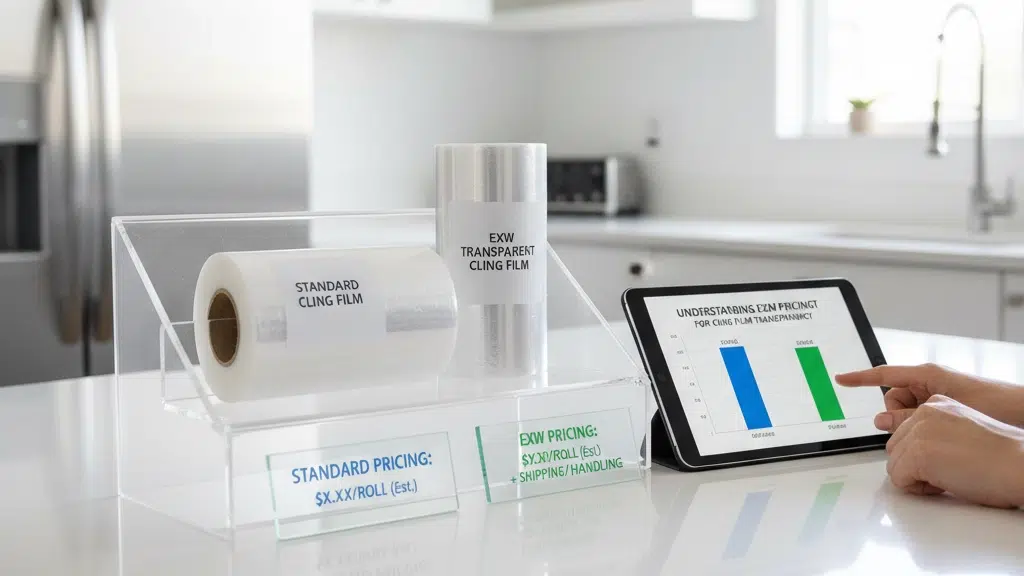
At Artfullife®, we believe in making EXW pricing as clear and simple as possible. To help our clients understand exactly what they’re paying for, we provide a detailed EXW breakdown sheet that outlines what’s included and what’s not. This sheet helps you identify the costs for raw materials, labor, basic packaging, and factory profit upfront—no hidden fees.
In addition to the standard breakdown, we offer a range of value-added services to make the process smoother. These include arranging factory pickups, offering consolidated documentation for easier customs processing, and recommending trusted forwarders to ensure seamless delivery.
One of our real customer success stories comes from a European supermarket chain that saved 12% on their total landed costs by understanding the true costs behind their EXW quotations. By getting a clear picture of all the necessary expenses, they were able to make informed decisions and avoid costly mistakes.
For more insights into our transparent pricing and how we can help streamline your supply chain, check out our wholesale purchasing tips.
Frequently Asked Questions About EXW Cling Film Pricing
Is EXW the cheapest way to buy cling film from China?
Not always.
EXW often looks cheapest because it only covers the factory price. Once you add:
- Inland trucking in China
- Export documents and port fees
- Ocean freight + surcharges
- Import duty, customs, and final delivery in the U.S.
…the landed cost per pound/kg can be higher than a well-negotiated FOB or CIF deal. EXW works best if you already have a strong freight forwarder and clear cost control.
Can the factory load the container for me under EXW?
Yes, we can load the container, but by Incoterms, EXW doesn’t require the seller to load. In real life:
- We usually help load pallets or loose cartons into the truck or container.
- If you want guaranteed loading service (including container sealing, loading reports, photos, etc.), we’ll confirm it in the PI and may add a small handling fee.
Always get “loading included” written into the purchase contract if it matters to you.
Who is responsible for the export license in China under EXW?
Under strict EXW rules, the buyer is responsible for export formalities and using a company with an export license.
In practice, most buyers ask us to use our export company or a partner forwarder to handle:
- Export customs declaration
- Export license usage (if needed for certain HS codes)
If you want us to handle export procedures while keeping EXW pricing, we’ll spell out those extra costs clearly.
Why do some suppliers quote extremely low EXW cling film prices?
Usually because of one or more of these:
- Thinner or lighter rolls than quoted (less film per roll)
- Lower-grade or mixed PE material
- Weak core/paper tube or minimal packaging
- Hidden extra charges later (carton fee, pallet fee, loading fee, document fee, etc.)
- Unrealistic “bait” price just to get your inquiry
When you see EXW cling film price 2025 offers that look too good to be true, double-check specs, roll length, carton weight, and what’s actually included.
How can I verify the real EXW price is fair?
Use a few quick checks:
- Ask for detailed specs (micron, width, length, net weight, gross weight per carton).
- Compare price per kg and price per usable foot with other suppliers.
- Request a packed carton weight and do the math on how much film you’re really getting.
- Check consistency with other PE packaging products like our safe food storage PE bags guide to see if material pricing aligns.
We’re happy to share a breakdown showing raw material, processing, and packaging so you can benchmark it.
Does Artfullife® offer FOB or CIF prices, or only EXW?
We offer:
- EXW – factory price
- FOB China main ports – including export handling
- CIF major U.S. ports – including ocean freight and insurance (on request)
If you’re new to importing cling film or supermarket private label packaging, FOB is usually the safest starting point.
What is the MOQ for EXW PE cling film orders?
For EXW PE food wrap:
- Standard MOQ is usually one full pallet per spec, or
- For custom supermarket/private label, MOQ is often tied to printing and packaging requirements (e.g., 5,000–10,000 rolls depending on size).
Tell us your target roll size and packaging style (jumbo rolls, bulk, or retail box for supermarket shelves), and we’ll give you a clear MOQ and price break.
How long is an EXW quotation valid?
Because PE resin prices move fast, our EXW cling film price 2025 quotes are usually:
- Valid for 7–15 days under normal market conditions
- Shorter validity if resin is highly volatile
Validity will be clearly shown on the PI. If it expires, just ask and we’ll update based on the latest resin and exchange rates.
B2B Buyer Review Notes
Under Incoterms® 2020 , EXW is defined as: The seller makes the goods available at their premises; the buyer takes on all costs and risks from that point onward.
| Buyer factor | What to verify |
|---|---|
| Material and specification | Confirm product fit, samples, and documented requirements. |
| MOQ and lead time | Check whether order quantity and delivery timing match the sales plan. |
| Compliance support | Request relevant certificates, test reports, or food-contact documentation when applicable. |
FAQ
What should B2B buyers check first?
Start with product specification, MOQ, lead time, packaging options, and compliance documents for understanding exw pricing for cling film.
Request Supplier Details
Contact the supplier with your target specification, order quantity, packaging requirements, and delivery timeline.
Key Takeaways
- In the cling film business, EXW (Ex Works) means the price only covers the goods made available at our factory —nothing more
- Under Incoterms® 2020 , EXW is defined as: The seller makes the goods available at their premises; the buyer takes on all costs and risks from that point onward
- EXW in Simple Cling Film Terms When you see an EXW cling film factory price China (for example, “EXW $1.45/kg, PE food wrap”), it usually means: The goods are finished, packed, and ready for pickup at our plant